
Germany's Turkey Patriot Move Makes NATO Burden Sharing Real
 Alexandra Reeves
Germany's Turkey Patriot Move Makes NATO Burden Sharing Real
Germany is sending one Patriot battery and roughly 150 troops to Turkey, and that sounds like a tidy NATO housekeeping story until you look at what it replaces. A German unit from Flugabwehrraketengeschwader 1 in Husum will deploy from late June through September 2026, according to the German Defense Ministry as reported by Defense News, taking over from a U.S. Patriot element on NATO's southeastern flank.
That is the part worth sitting with. Berlin is not adding a symbolic flag to an exercise. It is assuming a live air and missile defence mission after Iranian missile activity pushed NATO to reinforce Turkey earlier this year. For an alliance that spends so much time talking about European burden sharing, this is one of the cleaner tests: can a European ally take a high-demand U.S. mission without weakening the eastern flank or the Ukraine support pipeline?
The Southern Flank Is No Longer A Side Theatre
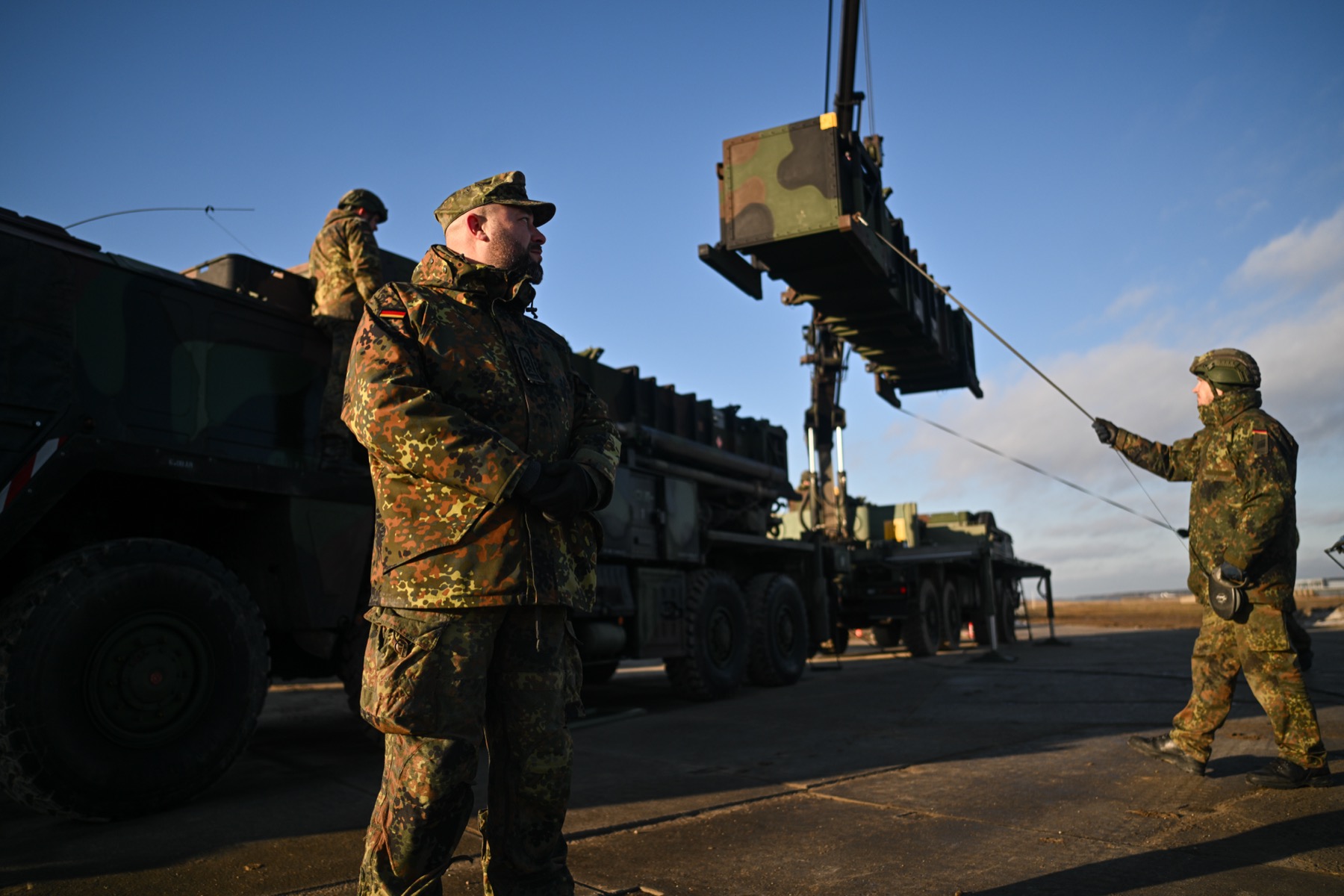
Defense News says the German Patriot Air and Missile Defence Task Force will operate under NATO's Integrated Air and Missile Defence framework, coordinating with Turkish and remaining U.S. forces. The deployment follows a period in which NATO air defences reportedly intercepted at least four Iranian ballistic missiles entering Turkish airspace in early March, including one apparently aimed at Incirlik Air Base in Adana province.
If that account is right, the southeastern flank has moved from contingency planning to active missile defence management. Incirlik is not just another Turkish base. It hosts U.S. forces and has long sat at the uncomfortable intersection of NATO strategy, Middle East escalation, and alliance politics. A missile flying toward that geography is not a regional nuisance. It is a NATO Article 5 headache waiting for a bad night.
NATO's own description of Integrated Air and Missile Defence makes the point in bureaucratic language: ballistic missile defence is a permanent mission to defend European populations, territory and forces, while rotational deployments of air and missile defence systems are meant to signal allied solidarity. That sounds dry. In practice it means moving scarce radars, launchers, trained crews and interceptors to whichever flank is suddenly least theoretical.
Patriot Is Powerful Because It Is Scarce
The MIM-104 Patriot remains one of the alliance's most valuable ground-based air and missile defence systems. CSIS Missile Threat describes a typical Patriot battery as including a radar set, engagement control station, power generation and support vehicles, and multiple launch stations. Modern Patriot variants can engage aircraft, ballistic missiles, cruise missiles and loitering munitions. That versatility is why everyone wants it.
It is also why this deployment matters. Germany has already sent Patriot capability to Ukraine and has faced repeated pressure to provide more. The same German air-defence community spent much of 2025 protecting the NATO logistics hub at Rzeszow in Poland, according to Defense News. Before that, Germany stationed Patriots in Turkey from 2013 to 2015 under NATO's Operation Active Fence, guarding against spillover from Syria.
So Berlin is not learning this mission from scratch. But experience does not solve the inventory problem. Patriot batteries cannot be in Ukraine, Poland, Lithuania, the High North and Turkey at the same time. Every deployment is a choice about which threat gets covered, which ally waits, and which political promise becomes operationally expensive.
That is the uncomfortable truth behind the phrase "burden sharing." It is not a spreadsheet about defence spending percentages. It is the moment a German commander has to send real crews and real launchers south because a U.S. unit needs relief and Iran has demonstrated reach into NATO airspace.
Berlin Gets Credit, But Not A Free Pass
German Defence Minister Boris Pistorius has framed the Turkey deployment as proof that Berlin is taking on more responsibility within NATO, while also pointing to Germany's eastern flank and High North commitments. He has a case. For years, Washington complained that European allies wanted American protection without accepting American operational strain. This Patriot move is exactly the kind of relief mission U.S. officials say they want.
But the short answer is no, this does not settle the argument. One battery for roughly three months is useful. It is not a European air-defence renaissance.
The harder question is whether Germany and its European partners can sustain a rotational model when the demand signal keeps widening. Russia's missile and drone campaign against Ukraine has made air defence the defining shortage of the war. Iran's missile activity has now reminded NATO that the southern flank can consume the same class of systems. The Red Sea and Gulf drone threat has already forced Western militaries to think about interceptor costs and stockpile depth. These are not separate stories. They are one inventory problem with different geography.
Europe has spent the past two years promising to buy more air defence, more missiles and more interceptors. The procurement logic is correct. The calendar is not kind. Patriot launchers, PAC-2 and PAC-3 interceptors, trained crews, sustainment contracts and integrated command-and-control links do not appear quickly just because ministers discover urgency.
The So What For NATO
This deployment should be read as a small success and a larger warning. The success is that Germany is relieving a U.S. unit in a real mission area, under NATO command arrangements, at a moment when the alliance needs to prove that European allies can carry more than talking points. That matters politically in Washington and militarily in Turkey.
The warning is that NATO's missile defence map is getting too busy for the number of high-end systems available. The alliance now has to think of Ukraine, Poland, the Baltic region, Turkey and the Middle East spillover zone as connected consumers of the same scarce assets. Moving a Patriot battery south may reassure Ankara and help Washington. It may also remind Kyiv that European air defence capacity is still a queue, not a warehouse.
For Alexandra's usual crowd in Brussels and Washington, the lesson is blunt: burden sharing becomes real only when it hurts. Germany's Patriot deployment to Turkey is real because it spends readiness, manpower and political capital. The next thing to watch is whether Europe treats this as a one-off favour to the Americans or as a warning that the alliance needs many more launchers before the next missile crosses the wrong border.
Germany is deploying a Patriot battery and 150 troops to Turkey from late June through September 2026, replacing a U.S. unit. This move is part of NATO's air and missile defense mission, responding to Iranian missile threats. The German unit will operate under NATO command, marking a significant shift in burden sharing within the alliance.
- Germany is sending one Patriot battery and approximately 150 troops to Turkey.
- The deployment will replace a U.S. Patriot unit and is part of NATO's air and missile defense mission.
- The German unit will operate under NATO's Integrated Air and Missile Defence framework.
- This deployment follows Iranian missile activity that prompted NATO to reinforce Turkey.
- Germany has previously deployed Patriot systems in Turkey from 2013 to 2015.