
Grassland Partners 2026: Machine Wolves Deployed, PLA Ground Combat Drones Begin to Enter Support Chain
 S.W
S.WPrairie Partner 2026 Machine Wolf Deployment: PLA Ground Unmanned Equipment Begins to Enter Support Chain
On the morning of June 1, a set of images from the China-Mongolia "Prairie Partner-2026" joint army training was more interesting than the usual formations and firepower displays. In the live report released by the Chinese military, after a mobile unit encountered a simulated disturbance, not only drones appeared, but also "Machine Wolves," unmanned transport vehicles, heavy-lift drones, and mechanical exoskeletons. Each piece of equipment is not new in itself; however, when viewed together in the same context, the signal changes.
Not a Show of Skills but Integrating Unmanned Equipment into Team Processes
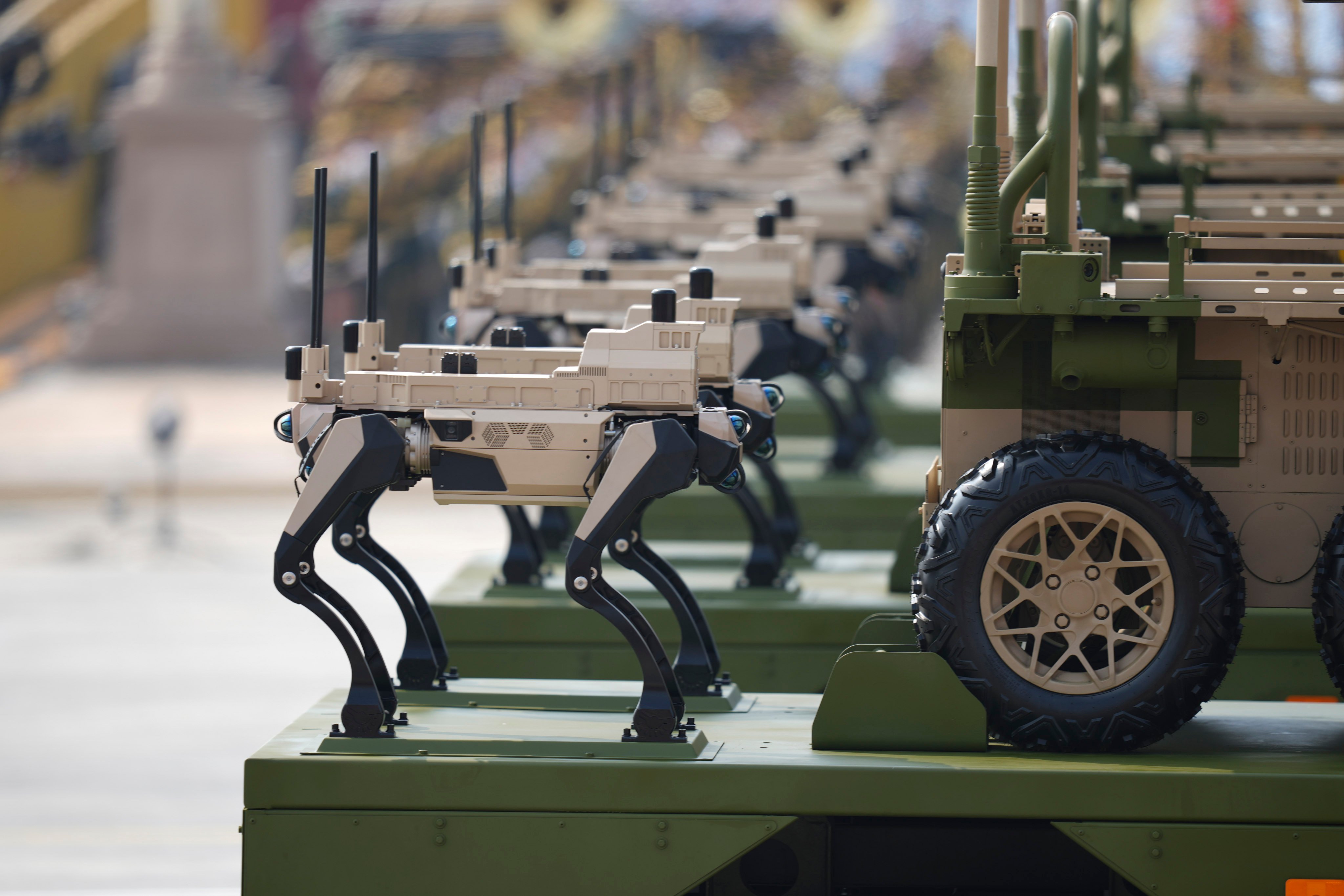
The Ministry of Defense confirmed on May 18 that "Prairie Partner-2026" was held in Inner Mongolia, China, from late May to early June. Details of the training subjects disclosed by the China Military Network on June 2 showed that the Chinese side integrated unmanned equipment into specific processes such as mobile disturbance, obstacle breaching, casualty transport, and vehicle repair. Two numbers from the report are worth noting: one is that the maximum load of the unmanned vehicle is 200 kilograms, and the other is that the maximum speed is 60 kilometers per hour; the exoskeleton can increase an individual soldier's load by 30 to 40 kilograms.
These numbers may not seem impressive, but they address the most realistic issues faced by grassroots army units. A load of 200 kilograms roughly covers the weight range of a casualty plus personal equipment, ammunition boxes, repair tools, or small generators; a speed of 60 kilometers per hour indicates that it is not just a robot that can only demonstrate slowly in the barracks; the exoskeleton's increase of 30 to 40 kilograms in load corresponds to physically demanding tasks such as emergency repairs, transport, and mountain resupply. In short, what the PLA is showcasing this time is not "walking machines," but rather "who will carry, scout, and take risks for the soldiers."
The Value of the Machine Wolf Lies in Coordination, Not Firepower
It is easy for outsiders to focus on whether the "Machine Wolf" can be armed. However, I believe the real key is whether it can work in the same command rhythm as the traversing machine, unmanned vehicles, and heavy-lift drones. A report from early May in the PLA Daily by a certain brigade of the 73rd Group Army has already revealed similar issues, where overlapping drone mission areas, intersecting unmanned boat routes, untimely synchronization of data from robotic dogs, and signal interference caused by multiple types of equipment being powered on simultaneously occurred when over ten unmanned systems were mixed in a group.
This public report is valuable because it acknowledges shortcomings. Automation does not automatically create combat effectiveness by simply purchasing a few robots. Link management, spectrum control, task allocation, data feedback, and human-machine interfaces—if any one of these is not done well, the more equipment there is, the more chaotic it becomes. The South China Morning Post on May 19 also cited the PLA Daily, pointing out that some units are still insufficient in integrating personnel and equipment and in training specialized personnel; new equipment, especially unmanned and intelligent systems, requires stronger technical literacy to support them.
Army Automation First Takes Root in Logistics and Engineering Tasks
Interestingly, this time "Prairie Partner-2026" did not package unmanned equipment as decisive weapons but integrated them into rescue, emergency repair, obstacle breaching, and accompanying mobility. This choice is more pragmatic. For the army, the scenarios where small unmanned platforms first mature are often not in frontal assaults but in high-risk, repetitive, and physically demanding tasks. For example, transporting casualties after encountering fire threats can easily expose manual stretcher teams; during vehicle repairs, if tools and spare parts cannot be delivered, the entire vehicle may get stuck on the road; when the front obstacles are unclear, having the traversing machine and quadruped platform scout ahead is more cost-effective than sending soldiers to feel their way through.
From a supply chain perspective, this type of equipment has another advantage. Unlike main battle tanks, long-range rocket launchers, or large drones, which are constrained by a few major assembly plants and complex engine systems, they rely more on motors, batteries, sensors, communication modules, and control algorithms. The scale of China's civilian robotics, low-altitude drones, and new energy industries can provide a broad industrial base for military small unmanned platforms. However, the challenge lies here: the most difficult aspect of converting civilian products to military use is not whether they can move, but their resistance to interference, reliability in extreme temperatures, battlefield maintenance, and secure communication.
The Real Focus Should Be on Training Standards
If we only look at a joint training exercise, we cannot conclude that "Machine Wolves have been widely deployed." Public videos usually select the smoothest segments, and the types of equipment, numbers, and communication systems have not been disclosed. I prefer to view it as a training signal, indicating that the PLA Army is pulling unmanned equipment from the display stage into the synthetic unit process, first addressing the questions of "how to use it, who will use it, and who will cooperate with whom."
The next step worth watching is not whether the Machine Wolf will be equipped with another gun, but whether the army will establish unified training standards for unmanned equipment operators, spectrum management, and battlefield maintenance. Without these standards, the Machine Wolf is just a new toy; with these standards, it could become a stable node in the operational chain at the squad and platoon levels. The real unanswered question is whether the grassroots units of the PLA can clarify personnel and processes before the speed of equipment diffusion catches up.
The People's Liberation Army (PLA) is integrating unmanned equipment into operational processes during the 'Prairie Partner-2026' joint training exercise in Inner Mongolia, which began on June 1, 2026. This includes the use of unmanned vehicles, drones, and exoskeletons to enhance logistics and support roles. The exercise emphasizes practical applications of these technologies in high-risk tasks such as casualty evacuation and vehicle repairs.
- The PLA is using unmanned equipment in logistics and support roles during the 'Prairie Partner-2026' exercise.
- The maximum load for unmanned vehicles is 200 kg, and they can reach speeds of 60 km/h.
- Exoskeletons can increase a soldier's load capacity by 30 to 40 kg.
- The exercise is taking place in Inner Mongolia from late May to early June 2026.
- The integration of unmanned systems aims to improve operational efficiency and reduce risks for personnel.