
HII's $56M AUKUS Contract Tests 2026 Submarine Promises
 Marcus Chen
HII's $56M AUKUS Contract Tests 2026 Submarine Promises
A $56.2 million U.S. Navy contract awarded to Huntington Ingalls Industries looks modest beside the price of a Virginia-class submarine. It is not modest in what it reveals. The award funds engineering, design-agent work and technology transfer for Australia and the United Kingdom under AUKUS. An option could raise the value to $91.1 million, with completion scheduled for September 2027 or September 2028 if exercised.
The money is foreign-funded. The bottleneck is American. AUKUS is discovering that transferring nuclear-submarine capability requires more than political agreement, and that every transfer consumes scarce shipyard expertise at the same time the U.S. Navy is trying to build its own fleet.
The Contract Is About Knowledge Before Steel
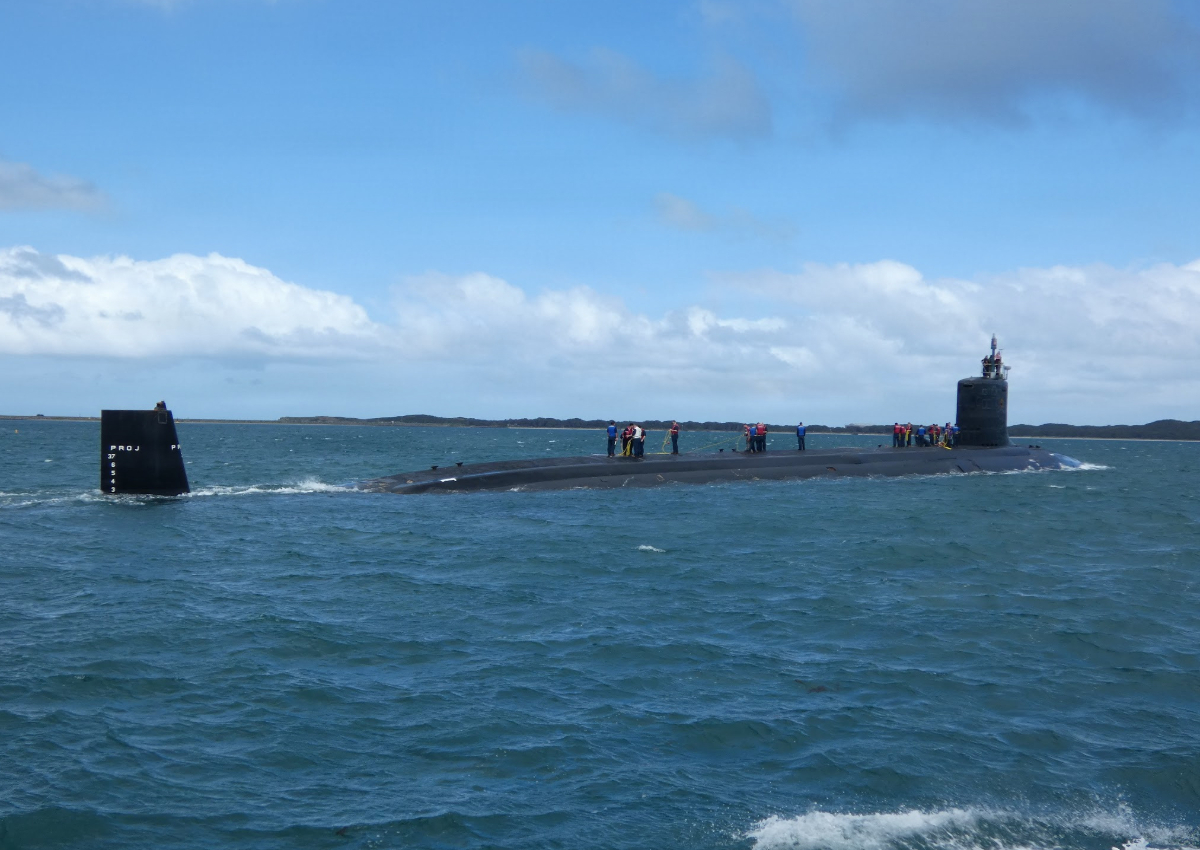
Newport News Shipbuilding will perform 88 percent of the work at its Virginia yard. The remaining 12 percent will occur at unspecified foreign locations. The scope includes engineering and technical support, design-agent responsibilities, and design transfer for nuclear-submarine capabilities and sustainment. HII said the work supports the trilateral Australia–United Kingdom–United States partnership and includes United States Industry Support for the SSN-AUKUS design.
That language matters. A design agent is not simply a consultant. It is the organization responsible for maintaining a submarine class’s technical baseline over decades, resolving design changes, and ensuring that the ship can be built, repaired and upgraded without losing configuration control. Design transfer is the handover of the technical knowledge that makes an industrial program reproducible.
Australia cannot become a nuclear-submarine builder by buying finished hulls. It needs engineers, welders, nuclear-qualified supervisors, supply-chain managers, safety systems and a documentation culture that can survive personnel turnover. This contract addresses the invisible infrastructure first.
AUKUS Has Eight Boats on Paper
Australia’s plan calls for at least eight conventionally armed, nuclear-powered attack submarines. The first phase is expected to include three to five Virginia-class boats purchased from the United States in the 2030s. The second phase is the SSN-AUKUS, a new class to be designed and built by Britain and Australia.
The arithmetic is politically attractive and industrially severe. Australia wants a sovereign nuclear-submarine capability, Britain must deliver a new class while sustaining its own attack-submarine fleet, and the United States must transfer knowledge without weakening the shipyards already behind schedule on Virginia and Columbia production. These are not separate schedules. They draw on the same limited pool of naval architects, nuclear engineers, qualified suppliers and senior production managers.
HII’s 88 percent share also exposes the geography of the problem. Most of the work remains in the American yard because that is where the mature design authority exists. That is sensible for quality control, but it means the near-term AUKUS industrial base is still overwhelmingly American. An Australian flag on a future submarine does not make its design ecosystem Australian.
The Virginia-Class Transfer Is Not a Shortcut
The Virginia-class submarine is roughly 7,800 tons submerged, carries a crew of about 130, and combines torpedoes, cruise missiles, advanced sensors and nuclear propulsion in a highly integrated platform. Its capability is the product of a design and sustainment system, not just the hull’s dimensions. Exporting selected boats to Australia therefore requires a long chain of approvals, training pipelines and maintenance arrangements.
HII’s contract should be read as preparation for that chain, not evidence that the chain is ready. The U.S. Navy’s Foreign Military Sales mechanism can pay for engineering support, but it cannot create a second nuclear-submarine workforce on demand. Nor can it remove the physical limits of dock space, reactor-component production or test capacity.
General Dynamics Electric Boat received a separate AUKUS engineering award in April, reportedly worth $196 million with options that could exceed $930 million through 2031. Together, the two awards show that Washington is building an AUKUS support architecture through incremental contracts. They also show how much design work precedes the first Australian-built boat.
Industrial Reality Will Set the Pace
Australia has committed billions of dollars to the U.S. submarine industrial base, including a planned $3 billion contribution. That money can expand facilities, qualify suppliers and fund workforce development. It cannot compress a ten-year nuclear certification process into two years.
The danger is schedule asymmetry. Political leaders can announce a fleet target in one year, while shipyards need a decade to qualify people and suppliers. If the American yards remain focused on their own Virginia and Columbia workloads, AUKUS support will compete with U.S. fleet readiness. If Washington protects its domestic schedule too aggressively, Australian confidence in the partnership will erode. Either choice has a cost.
There is also a strategic question. Australia needs submarines for a theater in which distance is the first enemy. A boat that arrives late is not merely an accounting problem; it leaves fewer hulls available for patrols from the Indian Ocean to the Philippine Sea. But rushing design transfer before Australia can safely absorb it would produce the appearance of sovereignty without the sustainment capacity that sovereignty requires.
The Contract Is Necessary but Not Sufficient
The $56.2 million award is a rational step. It places Newport News engineers inside the design-transfer process, gives Australia and Britain access to the people who maintain the technical baseline, and creates a measurable work program through 2027. The option to reach $91.1 million provides room to extend that effort.
It does not solve the central AUKUS problem: three governments are trying to synchronize a new submarine class with two existing fleets and a U.S. industrial base that is already under pressure. The next indicators are not press releases. They are the number of Australian suppliers that pass qualification, the growth of the nuclear-trained workforce, the stability of Virginia production, and whether design data arrives early enough to influence SSN-AUKUS construction rather than merely document it.
AUKUS is no longer waiting for a political decision. It is waiting for enough qualified people, certified suppliers and shipyard hours to make the decision real.
The contract proves that the machinery has started. It does not prove that the machinery can move eight submarines. Until the industrial base demonstrates repeatable output, AUKUS remains a transfer program with a fleet target attached.
Sources
- Defence Blog, October 2026, reporting the U.S. Navy–HII award and contract scope.
- HII release, October 13, 2026, on AUKUS engineering, design transfer and SSN-AUKUS support.
- U.S. Representative Joe Courtney, statement on the Electric Boat AUKUS contract.
- Virginia Business, reporting on HII’s Australian submarine supplier qualification program.
Huntington Ingalls Industries (HII) was awarded a $56.2 million contract by the U.S. Navy in October 2026 for engineering and design work related to nuclear submarine capabilities under the AUKUS partnership. The contract aims to support Australia and the UK in developing their submarine capabilities, with completion expected by September 2027 or 2028. Most of the work will be conducted in Virginia, highlighting the reliance on U.S. expertise for this initiative.
- HII received a $56.2 million contract from the U.S. Navy for AUKUS-related work.
- The contract includes engineering and design support for nuclear submarines.
- Completion of the contract is expected by September 2027 or 2028 if options are exercised.
- The majority of work (88%) will be performed at Newport News Shipbuilding in Virginia.
- Australia plans to acquire at least eight nuclear-powered submarines under AUKUS.