
HYDEF2 and IRIS-T SLM 2026 Show Europe's Air Defense Gap Against Mach 5
 Dr. Klaus Weber
HYDEF2 and IRIS-T SLM 2026 Highlight Europe's Air Defense Gap Against Mach 5
99,988,962.68 Euros EU contribution, twelve companies from five European countries, and three years of conceptual work: this is the institutional foundation on which Europe aims to establish its first own response to hypersonic threats. The figure sounds precise, almost reassuring. However, it is primarily a reminder of how small the European beginning still is when the threat is already being planned for Mach 5 and beyond.
The announcement on June 11, 2026, at ILA Berlin by Diehl Defence and Sistemas de Misiles de España to jointly prepare HYDEF2 is therefore more than just an industry news item. It shows that Europe's air defense policy is entering a new phase: moving away from individual effectors towards a connected system of early warning, command, sensors, and interceptors. It is at this point that it will be determined whether European defense policy finally generates capability or merely produces new acronyms.
From the EDF Project to a Pre-Industrial System
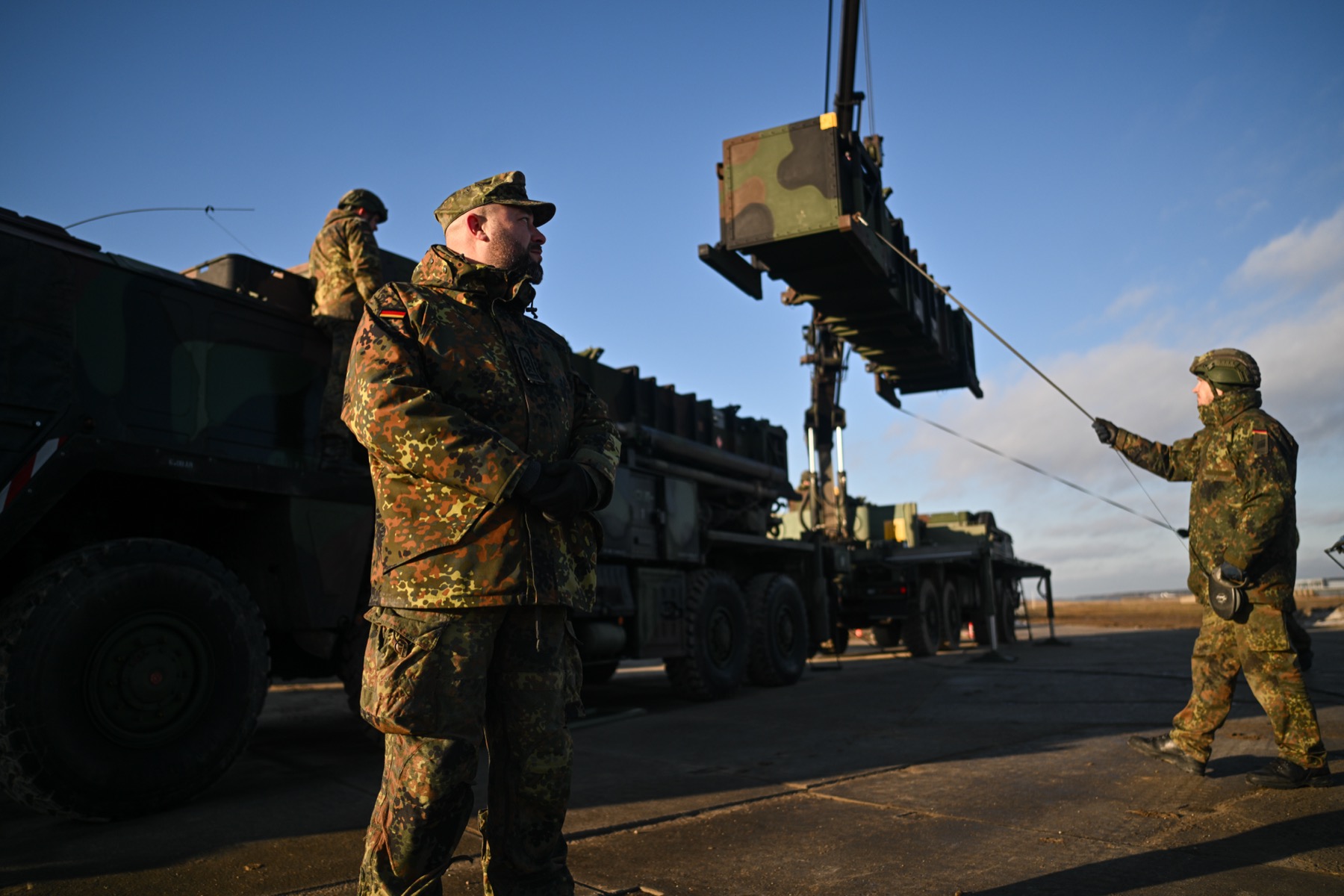
HYDEF began as the European Hypersonic Defence Interceptor under the European Defence Fund. OCCAR describes the program as research and concept definition for a European interceptor against highly maneuverable ballistic and hypersonic glide missiles. This sounds technical, but it is politically significant: Europe is not only trying to finance another missile project but is also attempting to regain a capability that has so far depended almost entirely on American architectures.
The division of roles in the first HYDEF phase is typically European and simultaneously instructive. SMS from Spain leads the program coordination, while Diehl Defence from Germany is responsible for the technical coordination of the overall system. Companies from Spain, Germany, Norway, Poland, and Belgium are also involved. On paper, this is European division of labor. In practice, it is a test of whether Europe has learned from the mistakes of FCAS, Eurodrone, and older defense cooperations: those who integrate do not only control work packages but also pace, interfaces, and technical sovereignty.
Diehl and SMS now want to form a new consortium for the upcoming EDF-2026 call for HYDEF2. According to Diehl, it will focus on a joint pre-development phase for the interceptor, aiming to achieve operational effectiveness against the most challenging endo-atmospheric threats as quickly as possible. The important addition is: HYDEF2 is to address the definition of the entire weapon system as part of an Integrated Air and Missile Defence. This is the crucial sentence of the announcement.
Why an Interceptor Alone is Not Enough
Hypersonic defense rarely fails solely due to the interceptor missile. It fails earlier: at detection, classification, handover of tracks, fire control decision, and the question of who in the alliance is allowed to shoot when. An interceptor against a maneuvering target is a costly object without politically usable effect without a reliable sensor and C2 chain.
This is precisely why the parallel Airbus-Diehl agreement on integrated air and missile defense is relevant. Airbus brings NATO-certified command-and-control experience and the IBMS environment; Diehl contributes with IRIS-T SLM and SLS, a proven effectors network in Ukraine. Eight European countries, including Germany, Denmark, Estonia, Latvia, Slovenia, Sweden, Bulgaria, and Switzerland, have since adopted or chosen corresponding GBAD solutions. This is not yet a European missile defense architecture, but it is a real user core.
For HYDEF2, this means: the European added value does not lie in developing yet another national missile with an EU label. It lies in embedding the interceptor into an open, multinational IAMD architecture. Europe needs less symbolic sovereignty and more technical interoperability. A German, Spanish, Polish, or Norwegian sensor must not have to go through political translation before it feeds a European effector.
The Four Gaps Behind the Berlin Announcement
The first gap is early warning. Diehl has also announced a cooperation with Spire Global at ILA for satellite-based reconnaissance and early warning against ballistic and hypersonic missiles. Spire refers to RF detection, geolocation, and a Munich manufacturing capacity of up to 100 satellites per year. This is interesting, but it does not yet replace a sovereign European early warning constellation. Rather, it shows that the industry has understood that the interceptor remains blind without space data.
The second gap is industrial scaling. The first HYDEF project costs around 110 million Euros, of which nearly 100 million comes from the EDF. For a concept and risk reduction phase, this is significant; for a capability against 2035-plus threats, it is small. Those who want to turn HYDEF2 into an operational architecture must talk about series production, test campaigns, engines, seekers, actuators, and ammunition stockpiling. Europe often discusses programs; Russia and China plan stockpiles.
The third gap is governance. HYDEF has previously competed politically with other European approaches to hypersonic defense, particularly French-led concepts around MBDA. Competition can generate innovation. However, in Europe, it often creates parallel structures because each government wants to secure industrial returns. If HYDEF2 becomes another compromise product where technical leadership disappears behind national balance, the FCAS problem will only repeat itself at a higher speed.
The fourth gap is NATO embedding. Diehl explicitly speaks of NATO and EU goals. This is correct but not trivial. The European Sky Shield Initiative currently relies heavily on available systems like IRIS-T, Patriot, and Arrow 3. HYDEF2 aims for a future layer that is supposed to counter maneuvering high-speed targets. This layer must fit into NATO Air Command, national rules of engagement, and EU-funded industrial policy. Three logics in one system: military effectiveness, alliance political interoperability, and industrial autonomy.
Germany Takes Responsibility, Not Just Work Packages
For Berlin, HYDEF2 is uncomfortable. Germany can no longer limit itself to the role of a buyer in air defense. The dependence on Patriot, the IRIS-T experiences in Ukraine, and the European Sky Shield Initiative have pushed Germany into a leadership position that it has long avoided institutionally. Diehl thus becomes a political bearer of German security responsibility, not just an industrial contractor.
This is a consequence of the turning point, which often appears smaller in procurement practice than in government statements. Those who shape a European IAMD architecture decide on interfaces, data formats, exportability, and future dependencies. Germany must find a balance: enough leadership to not dilute technical integration; enough European openness to not let HYDEF2 appear as a German industrial channel.
The Benchmark is 2035, Not the ILA Press Release
The real question is not whether the Berlin MoUs are convincingly formulated. It is whether Europe can build a coherent defense chain against fast, maneuvering threats by the mid-2030s. This includes space early warning, ground and sea sensors, C2, interceptors, tests, ammunition production, and political release procedures. Every missing part makes the rest less valuable.
HYDEF2 is therefore a good test case for European defense integration. Not because it provides immediate security. But because it removes the typical excuse that Europe only needs more money. The money is there, even if not yet in sufficient amounts. The industry is there. The threat is there. What is missing is the ability to turn programs into an architecture and from architecture into deployable military capability.
Europe cannot afford perfect autonomy in hypersonic defense. But it can afford even less to treat the next generation of capabilities again as a procurement problem. The contradiction remains stark: without American systems, Europe's sky remains open today; without its own system integration, it will remain politically dependent tomorrow.
Sources
Diehl Defence and Sistemas de Misiles de España announced the development of the HYDEF2 hypersonic defense interceptor system in Berlin on June 11, 2026. This initiative, supported by a 99,988,962.68 Euro contribution from the European Defense Fund, involves twelve companies from five European countries. The project aims to enhance Europe's air defense capabilities against hypersonic threats by creating a connected air and missile defense system.
- The European Defense Fund contributed 99,988,962.68 Euros to the HYDEF2 project.
- The project aims to develop a hypersonic defense interceptor system by 2026.
- Diehl Defence and Sistemas de Misiles de España are leading the initiative.
- The project involves collaboration among twelve companies from five European countries.
- The focus is on creating a connected air and missile defense system.