
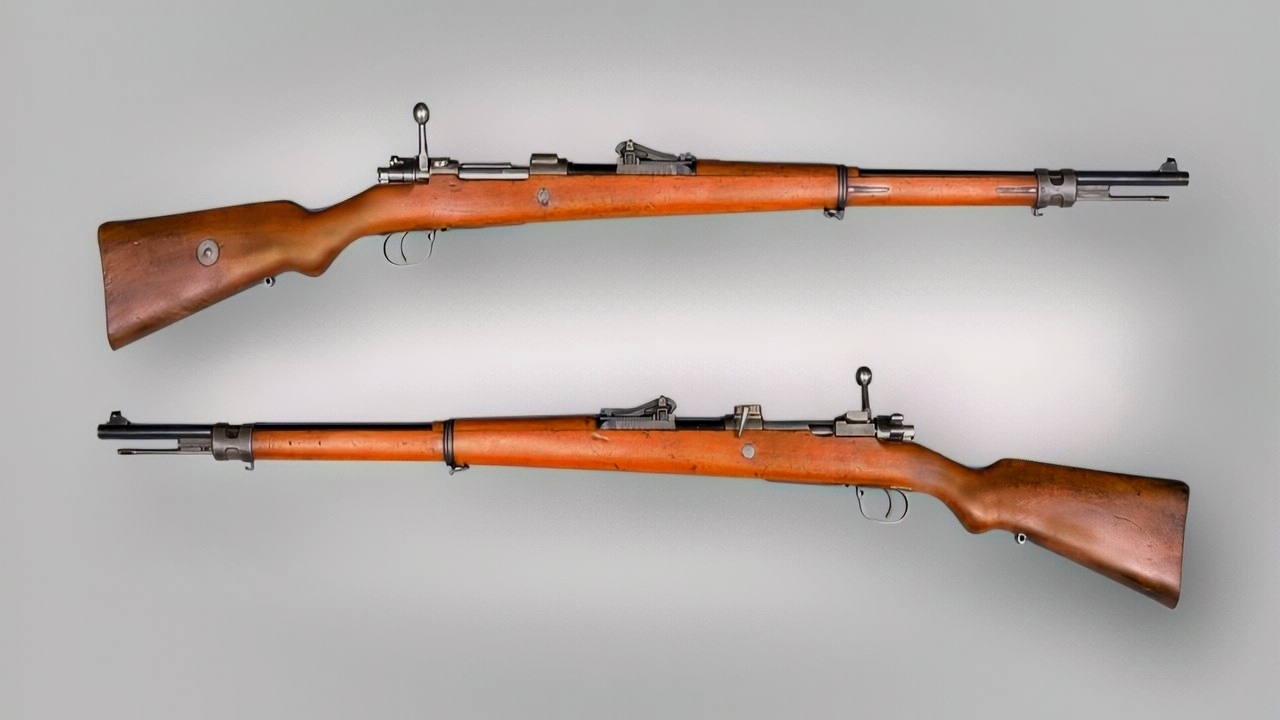
 Mauser 98 Rifle Creative Commons Photo
No rifle spent more time deciding what a bolt-action should be than the Mauser 98. Soldiers carried it through two world wars, hunters still cycle it today, and nearly every bolt gun built since has borrowed some piece of its guts. The Karabiner 98k just happened to be the version that did the most work.
The Mauser Kar98k was a very strong, accurate, and reliable bolt-action rifle, widely considered the peak of turn-bolt design.
The Mauser 98 bolt-action is smooth, very strong, and features controlled-round feeding, making it one of the most reliable and widely copied mechanical designs in history.
It was precise, capable of good long-range accuracy, and easily adapted into effective sniper variants with optics. Chambered in 7.92×57mm Mauser (8mm Mauser), it delivered heavy stopping power and great ballistic performance.
Early-war production models featured high-grade milled steel and meticulous craftsmanship. And, when it was all said and done, 100 million total Mauser 98 rifles were built.
Mauser 98 Rifle: Where It All Started
Paul Mauser filed the patent for what became the Gewehr 98 in September 1895, and the German military adopted it on April 5, 1898.
It wasn’t Mauser’s first bolt-action rifle.
He’d already sold export models like the 1893 and 1895 to Spain and Chile, and each one worked out a piece of the puzzle.
The Gewehr 98 was the version where all those pieces finally fit.
It was his best one.
The design took everything he’d learned from earlier Mauser models and folded it into a single action: a non-rotating claw extractor that grabs the cartridge rim the moment it leaves the magazine, a third locking lug at the rear of the bolt as backup insurance if the front two ever failed, and a receiver ring beefed up to 35.8mm for extra strength.
The rifle cocked on opening, not closing, which meant less effort on the follow-through and a visible cocking piece that told the shooter, at a glance, whether the rifle was ready to fire.
None of that sounds dramatic on paper. In practice, it was the difference between a rifle that fed reliably in mud, sand, and cold, and one that didn’t.
Simple, Strong, Safe
American Rifleman distilled the Model 98’s genius into three words: simplicity, strength, and safety.
The entire rifle consisted of 44 parts, with only 29 in the action itself, fewer moving pieces than comparable British and American rifles of the same era.
Fewer parts means fewer failure points.
That’s the whole argument in one sentence.
The action was also strong enough to become a lawsuit.
The U.S. Army leaned so heavily on Mauser’s patents while building the Springfield Model 1903 that Washington settled with Mauser rather than fight the infringement claim in court.
The Winchester Model 70 and the Ruger M77 carried the same DNA decades later.
In my opinion, that’s the real measure of a design.
Not how long it stayed in service, but how many other companies quietly copied it and called it their own.
Enter the Kar98k
Germany adopted the Karabiner 98k on June 21, 1935, as its standard service rifle, and “98 kurz” tells you exactly what changed.
The barrel dropped to 600mm, shorter and handier than the Gewehr 98 and the Karabiner 98b that came before it, without giving up the action underneath.
A turned-down bolt handle made it faster to run and left room to mount optics.
The old ladder-style Langevisier sight was replaced with a simpler tangent-leaf rear sight, easier to use under stress and much less likely to snag.
It also mounted the S84/98 III bayonet, a 252mm blade that had already seen service on earlier Mauser rifles and remained in service throughout the war.
More than 14.6 million of them rolled out of German factories between 1934 and 1945, with wartime production peaking at nearly 2 million rifles in a single year.
It was chambered in 7.92x57mm Mauser, fed from a five-round internal magazine loaded off a stripper clip, and rated effective out to 500 meters with iron sights.
Every rifle off the line had to put three of five shots into an 8cm by 12cm rectangle at 100 meters before it left the factory.
That’s a tight standard for a rifle built by the millions during a war.
My dad took one home after his WWII service, along with a matching, serial-numbered bayonet.
It is still in fantastic condition and shoots extremely well.
The shot groups are extremely tight, and the action is buttery smooth.
Why It Held Up For So Long
However, the Kar98k’s reputation isn’t built on the sniper variants, even though those existed and mattered.
The ZF41 low-power scope turned a standard-issue rifle into a designated marksman’s tool without any factory retooling, and higher-magnification ZF39 setups went to dedicated sniper units.
The reputation is built on the ten million rifles that never had a scope at all.
A German infantryman in Normandy and a Wehrmacht soldier freezing outside Stalingrad were both carrying an action Paul Mauser had finalized before the First World War, and it fed, extracted, and fired the same way in both places.
That’s the appeal and the problem in one sentence.
The Kar98k wasn’t innovative by 1939.
Semi-automatic rifles were already proving themselves in American hands, and Germany knew it.
But the bolt gun in every soldier’s arms was so mechanically sound, so cheap to mass-produce, and so forgiving of bad ammunition and worse conditions, that switching away from it was never worth the cost. It didn’t need to be the future.
It just needed to work every single time, and it did.
The Kar98k couldn’t match the M1 Garand’s semiautomatic firepower, but it was…and is a fantastic weapon.
The action outlived the war by decades.
Yugoslavia built the M48 on it.
Czechoslovakia built the vz. 24. Spain, Israel, and half a dozen other nations issued their own Mauser-pattern rifles well into the Cold War, and hunting rifles built on 98-pattern actions are still on gun store shelves right now.
Paul Mauser wasn’t trying to build the rifle that would define the 20th century. He was just trying to build one that wouldn’t fail. It didn’t.
About the Author: Steve Balestrieri
Steve Balestrieri is a 19FortyFive National Security Columnist. He served as a US Army Special Forces NCO and Warrant Officer. In addition to writing for 19FortyFive, he covers the NFL for PatsFans.com and is a member of the Pro Football Writers of America (PFWA). His work was regularly featured in many military publications.