
In the Name of "First" to Fulfill the Commitment to Strengthen the Military (On the Path to a Strong Military)
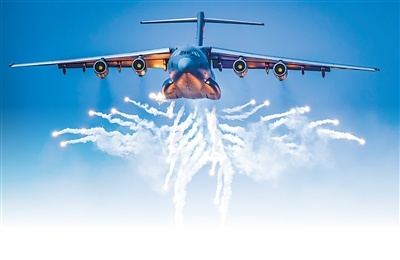
The Y-20A aircraft releases chaff during flight.
Photo by Liu Chuan
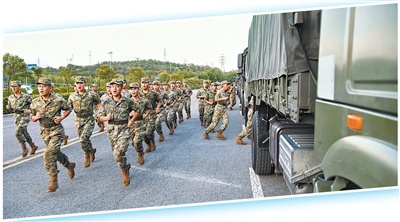
Soldiers from a certain unit of the Rocket Force are gathering to board vehicles.
Photo by Liu Zhici
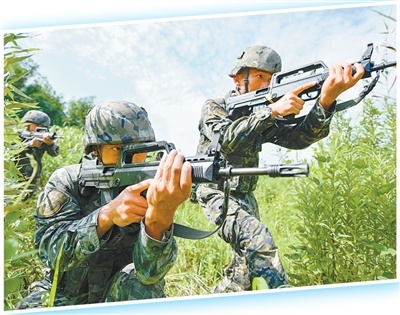
Armed police from the Anhui General Corps, Hefei Detachment, are conducting jungle search training.
Photo by Xu Wei
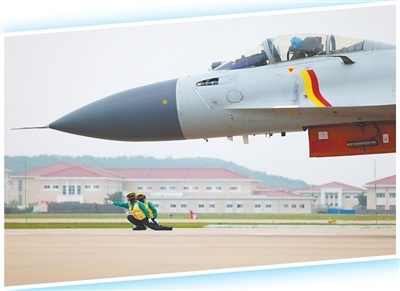
Soldiers from a certain naval unit are training in aircraft takeoff and landing procedures.
Photo by Jiang Tao
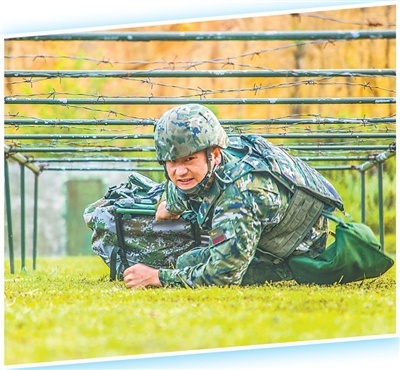
Soldiers from the Guangxi General Corps, Laibin Detachment, quickly pass through a low-profile net during training.
Photo by Guo Zhiyuan
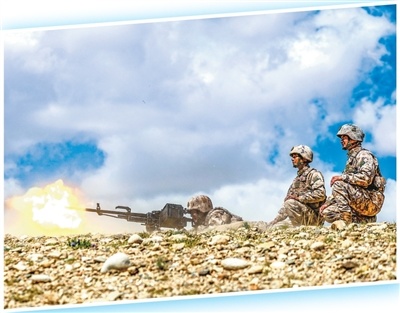
Soldiers from a certain army brigade are conducting live-fire training with heavy machine guns in the field.
Photo by Cui Huayang
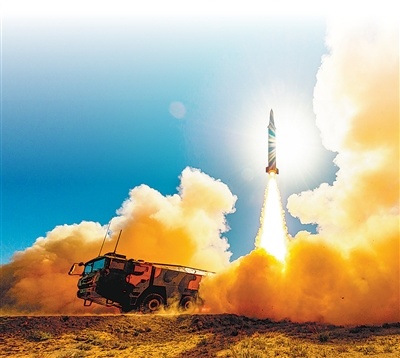
A certain brigade of the Rocket Force conducts live-fire launches during exercises.
Photo by Liu Mingsong
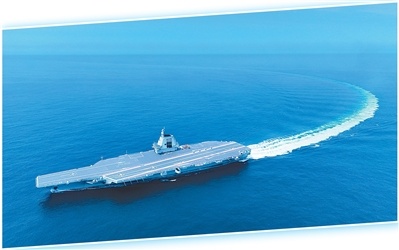
China's first domestically produced electromagnetic catapult aircraft carrier, the Fujian, during its maiden voyage test.
Photo by Ding Ziyu (Xinhua)
This year marks the 99th anniversary of the founding of the People's Liberation Army, and it is also a key year for achieving the centenary goal of military development. After 99 years of glorious history, the people's army has endured the trials of war, overcoming numerous challenges and making great sacrifices, achieving one glorious victory after another, establishing great historical merits for the Party and the people.
From the foundation of the military spirit during the Sanwan reorganization to the dream of the 10,000-ton destroyers; from the first victory in the skies during the War to Resist U.S. Aggression and Aid Korea to the strategic support of the great power's long sword... Throughout the river of time, units honored with the title of "first" have dared to fight and win, earning a glorious reputation in military history; entering the new era, new forces such as "first units" and "first ships" continue the red bloodline, guarding the vast mountains and rivers with exceptional skills.
The road is as smooth as a whetstone, and the traveler knows no bounds. In this special report, let us delve into five pioneering forces, listening to their stories of focusing on changes in technology, warfare, and adversaries, striving to achieve the centenary goal of military development.
—— Editor
Army's 83rd Group Army Certain Brigade "Red First Company" —
Let the red gene be passed down through generations
Reporter Li Longyi
The "Red First Company" was born during the Autumn Harvest Uprising in 1927. During the Sanwan reorganization, Comrade Mao Zedong personally developed six party members in this company, establishing the first party branch in our army.
In the history museum of the "Red First Company" of the Army's 83rd Group Army, a group of new soldiers is gathered around a relief sculpture, gazing intently. The relief depicts Comrade Mao Zedong raising his right fist to swear in with six new party members. The light shines down, illuminating every face on the relief.
Since the Sanwan reorganization, the phrase "The Party commands the gun" has been etched into the bones of the soldiers of the "Red First Company." For over 90 years, the company has maintained its loyal character as the "source of military spirit," steadfastly following the Party through thick and thin, never looking back despite countless difficulties.
Last autumn, during a live exercise at a critical moment, the "Red First Company" was ordered to infiltrate behind enemy lines. The night was as dark as ink, and the mountain roads were turned to mud by the rain. Before departure, the instructor brought the entire company to the sculpture and encouraged everyone, saying, "Our predecessors joined the Party amidst gunfire; today, what is a dark mountain road to us?"
In the darkness, everyone bravely moved forward. Soldier Liu Yang twisted his ankle while rushing and his ankle swelled, nearly collapsing into the mud several times. The squad leader told him to stay put for assistance. Liu Yang gritted his teeth and shook his head: "I can walk." He limped along with the team, determined not to fall behind. In the end, the entire company arrived at the infiltration point 15 minutes early, opening a path to victory.
During the exercise review, Liu Yang said, "Where there are party members, there is the party branch; where there is the party branch, there is direction." This statement expressed the common belief of all soldiers in the "Red First Company": with the Party in their hearts and guns in their hands, the military flag will always follow the Party flag.
Every quarter, the company selects six outstanding Communist Party members—this number resonates with the six predecessors on the loft of the Yejia Ancestral Hall in Shuikou, Hunan. On the training ground, the party member backbone is the first to tackle difficult tasks; in daily life, each party member mentors a new recruit; the party branch holds a "kangtou meeting" once a week—this is a habit passed down from wartime, with no podium or scripts, sitting on the beds, discussing difficulties face-to-face to promote problem-solving.
As they exited the history museum, the setting sun cast a golden hue over the training ground. The soldiers ran the 400-meter obstacle course, leaping, flipping, and sprinting, their shouts echoing in the twilight.
The evening breeze rose, carrying the "Red First Company" song: "We are in the place where the military spirit originated, shouldering the loyal and fearless responsibility. Let the battle flag that has won a hundred victories always fly high..." The gene of loyalty is deeply engraved in every soldier's bones, passed down through generations.
(Contributions by Hu Ruizhi and Qin Zhaopeng)
Naval Ship Nanchang —
Refining willpower in the waves
Reporter Jin Zhengbo
The Nanchang, hull number 101, is China's first independently developed 055-class 10,000-ton destroyer. To date, the People's Navy has equipped ten 10,000-ton destroyers.
In a certain area of the Pacific Ocean, with waves shifting and clouds swirling, the Nanchang is plowing through the waves at high speed, conducting realistic air defense exercises.
"An unidentified target is rapidly approaching us," in the ship's air missile control room, Sergeant Qiao Peng closely monitors the target situation, analyzing its trajectory and formulating a strike plan in advance. The opportunity is fleeting; Qiao Peng synthesizes various information and, seizing the moment, presses the launch button, successfully destroying the target.
In the six years since its commissioning, Qiao Peng and his comrades have forged their skills through numerous real combat drills, supporting the Nanchang's air defense network.
"I still remember the first time I prepared to fire a missile; my hands were shaking uncontrollably, but once I actually fired, I felt relieved." That year, Qiao Peng had just been appointed squad leader and was tasked with the important mission of firing multiple ship-to-air missiles. He led a team with an average age of 23, working day and night to rehearse plans, sometimes even reciting commands while eating. He knew the heavy responsibility; there was no room for carelessness on the battlefield.
On the day of the exercise, Qiao Peng directed his comrades to accurately lock onto the target, with several missiles shooting into the sky, hitting the incoming target precisely.
On the Nanchang, there seems to be an unspoken understanding from top to bottom; they are accustomed to honing their willpower in the wind and waves, using their "feet" to make up for their "shortcomings."
During a night training session, the roar of the engine suddenly filled the engine room. When Third Class Sergeant Yu Degang arrived, he found yellow lubricating oil spilling from the engine casing. In a critical situation, Yu Degang immediately worked with his comrades to handle it, until the ship slowed down and stopped. After stopping, there were no spare parts for the damaged pipeline, so he used his knowledge to rush the work, bending pipes, polishing, adjusting... A few hours later, a brand new spare part was successfully made and installed, saving the ship's "heart" and ensuring the mission proceeded smoothly.
Over the years, Yu Degang has led his team from the basics, mastering both theory and equipment performance, acquiring practical skills, and handling over ten equipment emergencies, continuously pushing towards victory.
Today, the new generation of the Nanchang's combat system is highly integrated, and its power system has been upgraded, boasting strong comprehensive combat capabilities. Officer Chi Jianjun said that as the first ship of the 055-class 10,000-ton destroyers, the Nanchang has repeatedly navigated through the waves, continuously honing its combat capabilities, with practical combat abilities steadily rising.
(Contributions by Wu Di)
Air Force "Strong Army Pioneer Flight Team" —
Flying routes no one has flown before
Reporter Ren Tongtong
The "Strong Army Pioneer Flight Team" originated from the first heroic unit to achieve air combat victory during the War to Resist U.S. Aggression and Aid Korea, setting a glorious record as the first victory in air combat for the People's Air Force.
Under the blazing sun, at an airport of a certain unit in the Northern Theater Air Force, several fighter jets take off in succession. A complex electronic countermeasure exercise involving multiple aircraft formations is about to begin, testing the pilots' comprehensive combat capabilities and tactical skills from all angles.
"In 1951, on the front lines of the War to Resist U.S. Aggression and Aid Korea, then squadron leader Li Han shot down an enemy aircraft in his first battle." The unit's leadership stated, "As a historically significant heroic unit, we must strive to fly higher and take on the new mission entrusted to us by the Party and the people in the new era."
Entering the honor room of the first flight squadron, each exhibit, though weathered by time, still shines brightly.
Since the new era, the officers and soldiers of this unit have piloted their warbirds far over the sea and across plateaus, emphasizing practical training and daring to confront challenges, always serving as the sharp blade guarding the country's air and space security.
During a competitive air combat assessment, two pilots from this unit, relying on their solid tactical skills, proactively pressed forward from the mid-range confrontation phase, continuously compressing the opponent's operational space. In the "intense battle," one aircraft was suddenly "tail-locked" by the opponent; at a critical moment, another pilot turned his aircraft head-on towards the opponent while simultaneously "launching missiles" to attack, ultimately achieving victory. In this assessment, they won the "Golden Helmet" with a record of eight victories.
"If we can't win on the battlefield, everything is zero; continuing the bloodline ultimately means forging strong winning capabilities," said staff officer Ge Junmiao. After each training session, the pilots rush to the debriefing room to review, analyzing data and discussing flight maneuvers.
"I remember once returning from a mission when the fuel warning light turned red." Staff officer Yuan Wenju recalled a cross-regional maneuver task where pilots had to land repeatedly at unfamiliar airports, facing multiple challenges such as long night flights and extreme fuel shortages.
"We relied on a strong belief and pushed through." Yuan Wenju said that during that mission, their training data achieved a comprehensive breakthrough, becoming the first unit in the Air Force to complete this training objective that year.
"To be worthy of the title 'Pioneer,' we must fly routes no one has flown before and explore fields no one has tried." The unit's leadership stated that they aim to integrate the heroic gene into their bloodline, advancing the unit's high-quality development with a spirit of urgency and seizing the moment.
(Contributions by Wang Xuefeng and Li Shiquan)
Rocket Force "Dongfeng First Brigade" —
Training winning capabilities to the extreme
Reporter Ren Tongtong
The "Dongfeng First Brigade" is the first ground-to-ground strategic missile unit of our army, a "hardcore" force in charge of major national weapons.
"Signalman, take your positions!" In the summer, as the command sounded, a "battle" began at the missile position. Soldiers from a certain battalion of the Rocket Force's "Dongfeng First Brigade" quickly rushed to their battle stations, executing precise operations, deploying equipment, checking data, and installing devices... The exercise movements were crisp and efficient, and the combat process advanced rapidly.
As the "launch" entered a critical phase, a certain instrument malfunctioned. At this moment, professional team leader Ren Jie carefully monitored the changes in relevant data while quickly issuing commands, directing the signalmen to work together to troubleshoot. Before long, the malfunction was successfully resolved, and the missile was smoothly "ignited and launched."
"Such complex training scenarios have long been routine for us," Ren Jie said. "The Dongfeng First Brigade" is the first ground-to-ground strategic missile unit of our army. In the difficult years when New China was just starting, they were formed in a crisis, starting from scratch, pioneering the way for strategic missile units, and achieving a "venting" success.
Over the years, the brigade's officers and soldiers have remained committed to their mission, not forgetting their original intentions, completing major training and exercise tasks dozens of times, becoming a strong shield guarding the country and the people.
During one exercise, the signalmen had to wear heavy protective suits and complete various operations in a confined space.
After several hours, new recruit Wang Ming was soaked in sweat, the straps of his gas mask left marks on his face, and the high-intensity running made it hard for him to breathe... During a break, Wang Ming quietly told Ren Jie, "Squad leader, I can’t hold on much longer." Ren Jie encouraged him while constantly monitoring his physical condition, helping him gradually adjust. In the end, all the soldiers in the battalion relied on their strong willpower to overcome multiple psychological and physiological challenges and successfully completed the task.
"Practice to the extreme in peacetime, so we won't be suppressed by strong enemies in wartime!" The brigade's leadership introduced that they regularly simulate various extreme situations such as equipment damage and signalman casualties during wartime. After each training session, they immediately conduct reviews to address capability gaps. In the face of ongoing equipment upgrades and other real challenges, many officers and soldiers have formed specialized task forces to improve operational procedures for each piece of equipment, conduct intensive training, and accelerate the preparation for combat capabilities, pressing the "fast forward" button on combat readiness.
(Contributions by Han Zhilin and Yang Yuanchao)
Beijing Armed Police General Corps State Guest Guard Team —
Protecting national dignity with superb skills
Reporter Li Longyi
The State Guest Guard Team is the only ceremonial unit in China responsible for the motorcycle escort of foreign heads of state and government leaders, known as "China's First Riders."
On July 1, along the straight and wide Chang'an Avenue, 21 ceremonial motorcycles escorted the vehicle carrying the recipient of the "July 1 Medal," smoothly driving towards the Great Hall of the People. The members of the State Guest Guard Team riding motorcycles, dressed in white uniforms, stood tall like pines, becoming a moving "scenery line."
Each stunning appearance is the result of rigorous training day after day. Weighing 298 kilograms, the motorcycle is a challenge that each member must face. To master this "iron lump," one must start with the most basic skill—pushing the bike. To complete the 3-kilometer push bike run, one must find the right point of force and balance to control the vehicle. "My arms often hurt so much I couldn't lift them; many comrades even dreamt of pushing the bike while sleeping," recalled soldier Xu Yupeng.
To become a qualified member of the State Guest Guard Team, one must undergo rigorous training in six major modules: driving preparation, basic driving, stunt driving, tactical fundamentals, tactical applications, and formation drills, passing through a strict "elimination system." "This process typically requires an average of 22,000 kilometers of motorcycle training, usually taking two years or even longer," said team leader Zhang Chao. "During training, motorcycle tires wear out significantly; the team consumes over 600 tires each year."
"With a heart loyal to the Party, the iron riders lead the way, with iron bones and unyielding spirit!" Every morning, Zhang Chao leads the team in reciting their loyalty oath to start the day's training. The hardest part is during the scorching summer. The surface temperature of the motorcycle approaches 70 degrees Celsius, and riding it feels like hugging a ball of fire; the helmet is airtight, sweat drips down and blurs the eyes, movements must remain precise, and formations must not scatter. Winter is no easier; the ceremonial uniforms look crisp but are actually thin, with the wind cutting through like a knife, leaving hands numb, yet the coordination of throttle and clutch cannot falter by even a fraction...
Through hard training, they have developed unparalleled skills, daring to be "China's First Riders." During events like the APEC meeting in Beijing, the BRICS leaders' meeting in Xiamen, and the Belt and Road International Cooperation Summit Forum... the young soldiers riding their iron steeds have maintained a record of "zero errors, zero mistakes, and zero accidents" during missions. "As members of the State Guest Guard Team, our mission is glorious, but the responsibility is heavy. We will continue to pursue excellence and strive for perfection, successfully completing every escort mission," said team instructor Li Zhe.
(Contributions by Yin Bo and Ji Miao)
《 People's Daily 》( August 2, 2026, Page 6)
The People's Liberation Army (PLA) conducted extensive military training exercises across various units in China in 2023, showcasing capabilities in air defense, naval operations, and VIP protection. The Y-20A aircraft was utilized for electronic countermeasures, while the 055 destroyer engaged in air defense drills. The exercises coincide with the PLA's 99th anniversary, emphasizing military readiness and modernization efforts.
- PLA conducted various military training exercises in 2023.
- Y-20A aircraft deployed for electronic countermeasures.
- 055 destroyer participated in air defense drills.
- Motorcycle units trained for VIP protection duties.
- PLA's 99th anniversary highlighted with military readiness.