
Iran exempts ships from India, China, Qatar, and Iraq from Strait of Hormuz restrictions in November 2026 and turns the passage into a negotiation tool.
 Ahmed Al-Rashid
Iran Exempts Ships from India, China, Qatar, and Iraq from Strait of Hormuz Restrictions in November 2026 and Turns the Passage into a Negotiation Tool
On November 4, 2026, the Vice Chairman of the Iranian Parliament's National Security and Foreign Policy Committee, Amir Hayat Moghadam, announced that ships from India, China, Qatar, and Iraq are crossing the Strait of Hormuz freely, while the U.S. Central Command states that the blockade of Iranian ports applies to all ships entering or leaving Iranian ports. These are not just commercial exceptions; they are an Iranian attempt to redraw the boundaries of the blockade from within a passage that Tehran cannot close without cost, nor can Washington secure without expense.
Hormuz Becomes a Political Passage System
According to reports from Al Jazeera citing officials and analysts, Iran will receive medicines from India and political support from China, while benefiting from transit fees on Indian and Chinese ships. Qatari ships, on the other hand, pass without fees, which is a clear political price for Doha's role in mediating between Tehran and Washington. It remains unclear whether the exemption pertains to the ship's flag, its owner, operator, or destination. This ambiguity is intentional; it gives Iran room to maneuver and makes each crossing a separate negotiation.
The numbers explain why these specific countries were chosen. In October, approximately 10.23 million barrels of Gulf oil crossed the strait daily, with 42 percent going to China and 13 percent to India, according to Kpler data reported by Al Jazeera. Additionally, Qatari liquefied natural gas shipments through the strait rose to 1.8 million tons in October, while Iraqi flows increased to 2.65 million barrels per day. Practically, these countries cannot treat Hormuz as a distant crisis; it is part of their energy, food, and trade security.
What Does Tehran Want from the Exemptions?
The primary goal is to break the image of a comprehensive blockade. If Washington accepts the passage of Chinese and Indian ships to or from Iran, the blockade will turn into a selective tool rather than a tightly enforced legal wall. If it prevents them, the United States will appear to be obstructing India's medicines or China's trade, which is a diplomatic cost Washington does not want as it tries to keep the war within manageable limits.
The second goal is to turn geography into revenue. China buys about 90 percent of Iran's oil exports, according to an estimate reported by Al Jazeera, so transit fees or oil swaps could provide Tehran with income while under sanctions. India, on the other hand, has a pharmaceutical industry that can fill part of Iran's shortages. This is not a strategic partnership in the rhetorical sense; it is a harsh war barter, understood by both sides and calculated in cost.
The third goal is to separate the Hormuz file from the nuclear file. Tehran has linked the reopening of the strait to seven conditions, including lifting the blockade and sanctions, while now trying to prove that freedom of navigation can be negotiated before reaching a comprehensive agreement. This raises the value of the Hormuz card in any upcoming talks, but it also creates a risk to Iran's credibility; an exemption that does not actually protect ships is not a guarantee, but a political declaration.
The Military Problem in the Exemption Announcement
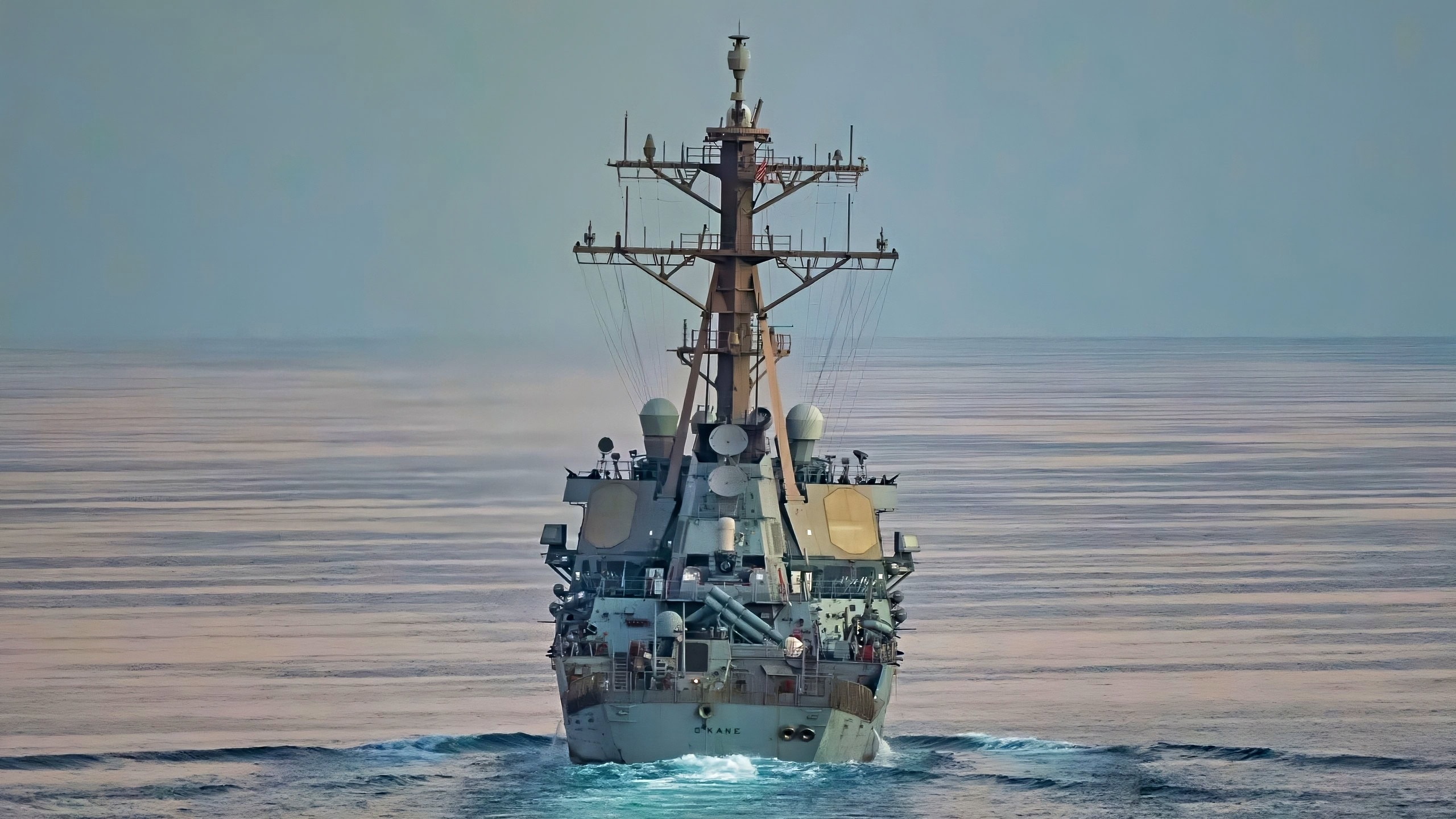
The U.S. Central Command stated that the blockade targets ships entering or leaving Iranian ports, and that humanitarian shipments pass after inspection. Here begins the gap between law and military reality. A ship may fly the Chinese flag, but it could be chartered by a European company or carry a cargo linked to an Iranian port. In an environment where more than 120 commercial vessels have been hit since the start of the war, it is not enough for Tehran to say that the ship is friendly; it must prevent the Revolutionary Guard or local units or undisciplined actors from interpreting friendship in their own way.
The incident that struck the Qatari gas tanker Al Mayeda on October 30 reminds us that an exemption does not equal protection. Qatar may be a political mediator, but its ships remain vulnerable to an unknown entity, misidentification, or sabotage that no party acknowledges. Militarily, this places the burden of verification on shipping companies and naval forces, not on press releases.
The Saudi and Gulf Dimension
Saudi Arabia, the UAE, Iraq, and Qatar cannot read this move as merely an Iranian-Asian agreement. If Tehran succeeds in establishing selective corridors for China, India, and Qatar, it may later use the model to impose arrangements concerning other Gulf exports. The intention may be to show that the security of the strait cannot be managed solely by Washington, and that Gulf states are compelled to communicate with their Iranian neighbor even while relying on the American fleet.
However, this does not mean that Iran has rebuilt complete maritime control. The ability to threaten navigation is one thing, and the ability to manage a safe and stable passage is another. Iran possesses coastal missiles, fast boats, mines, and an intelligence network, but it does not have a reliable mechanism to secure thousands of commercial voyages on its own. Here lies the triad of capability that many decision-makers in the region overlook: equipment, training, and institution. Tehran can close a route for hours, but it needs a joint institution and communication protocols to maintain a passage system for weeks.
Russia in the Background
On the same day, the Secretary of Iran's Supreme National Security Council, Mohsen Rezaei, met with Russian President Vladimir Putin in Moscow, carrying a message from Supreme Leader Ali Khamenei. The two sides discussed regional security arrangements, a gas pipeline, and the post-war phase, while Rezaei stated that Iran would not negotiate with Washington before fulfilling its seven conditions. This does not mean that Russia will take over the protection of Hormuz, as the Russian-Iranian partnership treaty does not include a mutual defense clause. However, it indicates that Tehran wants to involve Moscow, Beijing, and Doha in any new security system to avoid returning to a bilateral relationship with Washington.
The passage that everyone uses is not necessarily open; it may only be open to those who have the ability to negotiate with those who control its gate.
Conclusion
Exempting ships from India, China, Qatar, and Iraq from Strait of Hormuz restrictions is a clever but fragile maneuver. It provides Iran with medicine, money, and political support, placing Washington before two costly options, while giving Asian countries time to mitigate the energy shock. However, it does not solve the issue of navigation safety nor does it build a stable regional system. In my view, the real battle is not about whether Hormuz is open or closed, but about who defines the meaning of safe passage. Iran wants decision-making independence, Gulf states want American protection, and China and India want oil without military alignment. These interests do not coexist for long under the umbrella of temporary exemptions; when every crossing becomes a political deal, the strait becomes a permanent negotiation tool rather than a stable commercial passage.
Sources Al Jazeera, November 6, 2026: Iran Exempts Ships from India, China, Qatar, and Iraq from Hormuz Restrictions; Al Jazeera, November 6, 2026: Rezaei and Putin Meeting and Regional Security Arrangements.
Iran exempted ships from India, China, Qatar, and Iraq from restrictions in the Strait of Hormuz in November 2026, transforming the passage into a negotiation tool. This move aims to reshape the perception of the Iranian blockade and facilitate political and economic exchanges. The U.S. Central Command reiterated that the blockade applies to all ships, highlighting the complexities of maritime safety and U.S. interests in the region.
- Iran announced exemptions for ships from India, China, Qatar, and Iraq in the Strait of Hormuz.
- The U.S. Central Command stated that the Iranian blockade applies to all ships entering or leaving Iranian ports.
- Iran aims to reshape the perception of the blockade and leverage maritime passage for political and economic gain.
- The exemptions may allow Iran to receive medicines from India and political support from China.
- The situation raises concerns about maritime safety and the implications for U.S. interests.