
Iran Targets Opponent's Nuclear Facilities, Conflict Enters Dangerous New Realm, U.S. Issues "48-Hour Ultimatum" to Iran
[Global Times Special Correspondent in the U.S. Feng Yaren and Wen Yuan] On the evening of the 21st local time, U.S. President Trump issued an ultimatum to Iran, demanding that the latter reopen the Strait of Hormuz within 48 hours, or face the risk of having its energy infrastructure destroyed. According to Reuters, Trump's ultimatum expands the scope of U.S. strikes to include infrastructure that affects the daily lives of Iranian civilians. In response, an Iranian armed forces spokesperson warned that if Iran's fuel and energy infrastructure is attacked, all energy, information technology, and desalination facilities belonging to the U.S. and Israel in the Middle East will become targets. Meanwhile, Iran launched missile attacks on two cities in southern Israel in retaliation for the U.S. and Israeli strikes on its Natanz nuclear facility. These two cities are only a few dozen kilometers from Israel's Negev Nuclear Research Center. U.S. media outlet Politico stated that these developments indicate that as the conflict enters its fourth week, it is heading in a dangerous new direction.
A 48-hour "time bomb"
"If Iran fails to completely reopen the Strait of Hormuz within 48 hours from this moment without any threats, the U.S. will strike and completely destroy various power plants in Iran, starting with the largest one!" Trump stated on the social media platform Truth Social on the evening of the 21st.
In response to Trump's threat, a spokesperson for Iran's Khatam al-Anbia Central Headquarters stated on the 22nd that if Iran's critical infrastructure (fuel and energy) is attacked, the Iranian armed forces will strike all energy, information technology, and desalination facilities belonging to the U.S. and Israel in the Middle East.
Later on the 22nd, Iran's Khatam al-Anbia Central Headquarters issued a stronger statement: If the U.S. destroys Iran's power plants, the Strait of Hormuz will be completely blocked and will not reopen until the destroyed power plants in Iran are rebuilt. Additionally, Israel's power plants, energy facilities, and information and communication technology infrastructure, as well as power plants in countries with U.S. military bases in the region and companies with U.S. shareholders, will become targets for Iran.
According to Reuters, Iran's larger power plants include the Damavand Power Plant near Tehran, the Kerman Power Plant in the southeast of the country, and the Ramin Power Plant in Khuzestan Province. Their installed capacity far exceeds that of Iran's only nuclear power plant, the Bushehr Nuclear Power Plant.
Last week, in retaliation for Israel's attack on its massive South Pars gas field in the south, Iran struck the energy industrial hub of Ras Laffan in Qatar. This industrial city, heavily developed and operated by U.S. energy giants, is responsible for processing about one-fifth of the world's liquefied natural gas. Reuters believes that the threat to Gulf region infrastructure marks a dangerous new phase in the conflict.
Analysts have stated that Trump's threat is akin to dropping a 48-hour "time bomb" on the market, sharply increasing uncertainty. If this ultimatum is not retracted, global stock markets are likely to experience a sharp decline when they reopen on Monday, and oil prices will surge significantly. Iran is likely to target energy facilities in Saudi Arabia, the UAE, and Qatar, "which will exacerbate and prolong the pain caused by rising energy prices and turn the conflict into a broader regional crisis."
Iran: Transitioning from Defense to Offense
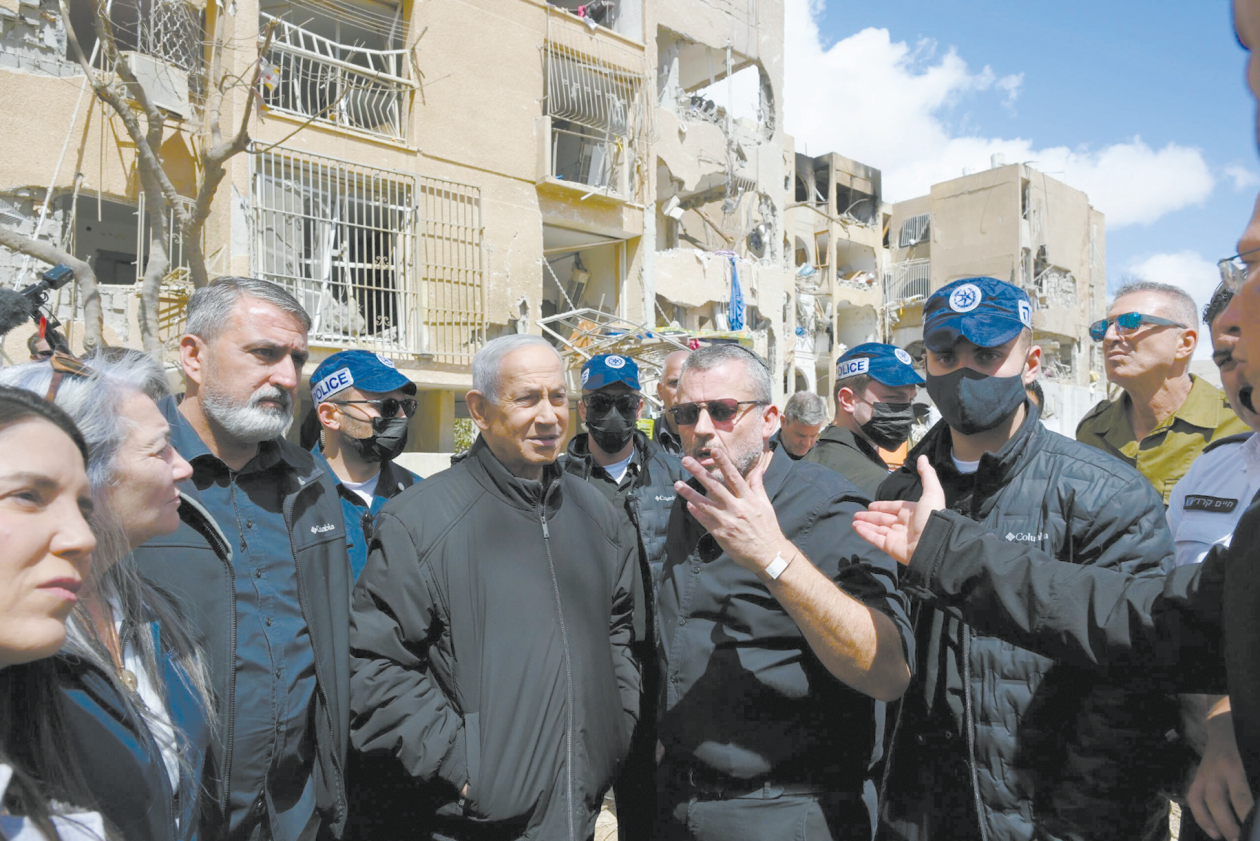
In the early hours of the 22nd, the Israeli military launched airstrikes on Tehran. Just hours earlier, Iran had launched missile attacks on two cities in southern Israel. The Iranian Islamic Revolutionary Guard Corps announced on the 22nd that during the 73rd wave of Operation "Real Commitment-4," they used various types of missiles and drones, including "Fateh," "Qader," and "Imad," to strike multiple locations in southern Israel, including Arad, Dimona, Eilat, and Beersheba.
According to the Israel Times, the airstrikes launched by Iran on Dimona and Arad on the evening of the 21st resulted in nearly 200 injuries, with 11 people in serious condition. Israeli Defense Forces spokesperson Duflin stated, "The air defense system was activated but failed to intercept the missiles. We will investigate this incident and learn from it." Israeli Prime Minister Netanyahu acknowledged in a statement, "This has been a very difficult night in our struggle for our future."
Reports citing Iranian media indicated that the targets of Iran's airstrikes were the Israeli Negev Nuclear Research Center located near Dimona and Arad, in retaliation for the earlier U.S. and Israeli attacks on Iran's Natanz nuclear facility.
The International Atomic Energy Agency stated on social media platform X that it has received reports from both sides regarding the aforementioned attacks, and there are no signs of damage at the Negev Nuclear Research Center, with no abnormal radiation levels detected at either the site or the Natanz nuclear facility. IAEA Director General Grossi called on all parties to exercise maximum military restraint to avoid any risk of a nuclear accident.
U.S. media reported that this was the first time Iranian missiles had breached the air defense systems surrounding the Negev Nuclear Research Center since the U.S. and Israel launched military strikes against Iran on February 28. "If the Israeli regime cannot intercept missiles in the heavily guarded Dimona, from a combat perspective, this marks a new phase in the battle: Israeli airspace has lost its defensive capability," wrote Iranian Parliament Speaker Ghalibaf on social media platform X on the 21st.
Commander Abdollahi of Iran's Khatam al-Anbia Central Headquarters stated on the 22nd that the Iranian armed forces have shifted their strategic focus from defense to offense, and tactical guidelines on the battlefield have also changed accordingly. He warned that the Iranian armed forces are continuously developing advanced equipment and weapons, which will completely disrupt the enemy's strategic deployments and create new "surprises" on the battlefield.
"Reliable exit strategies remain unclear"
According to the Wall Street Journal, on the 20th, Iran launched two medium-range ballistic missiles at the Diego Garcia base, a U.S.-UK joint military base located in the central Indian Ocean. The British side announced on the 22nd that one of the missiles "missed the target," while the other was "intercepted." Multiple media outlets believe that Iran's attack on the Diego Garcia base, located about 4,000 kilometers from its territory, indicates that its missile range is further than previously announced by Tehran.
Trita Parsi, co-founder of the Quincy Institute for Responsible Statecraft, told CNN that while the U.S. mainland is not under threat from Iran, this failed attack suggests that "other bases outside of Iran's range may actually be within range." He also questioned whether this incident would lead some European countries that allow the U.S. to use their military bases to reconsider their decisions.
On the day before issuing the "ultimatum," Trump posted on Truth Social, stating, "We are very close to achieving our goals and are considering a gradual de-escalation of military operations in the Middle East." However, on the same day, he told reporters at the White House that he was not seeking a ceasefire with Iran. An official told the Associated Press that the U.S. is sending three amphibious ships and about 2,500 Marines to the Middle East.
The Associated Press stated that these confusing statements and actions have deepened critics' views that the war launched by the U.S. and Israel against Iran lacks a clear, long-term strategy. Now that the conflict has entered its fourth week, its direction remains unpredictable, and even as the global economy has been severely impacted, reliable exit strategies remain unclear.
Iran launched missile attacks on Israeli cities Dimona and Arad in retaliation for U.S. and Israeli strikes on its nuclear facility. Concurrently, President Trump issued a 48-hour ultimatum to Iran to reopen the Strait of Hormuz, threatening to destroy its energy infrastructure. The situation marks a significant escalation in the ongoing conflict, with Iran's military adopting an offensive posture against U.S. and Israeli targets.
- Trump issued a 48-hour ultimatum to Iran to reopen the Strait of Hormuz or face destruction of energy infrastructure.
- Iran retaliated with missile strikes on Israeli cities, injuring nearly 200 people.
- Iran's military has shifted from a defensive to an offensive strategy, targeting U.S. and Israeli facilities in the region.