
Iran Uses "Poor People's Cruise Missiles" to Counter the US and Israel
Reference News Network March 8 Report According to a report from the American Consumer News and Business Channel website on March 5, after Israel and the United States launched attacks on Iran, American allies in the Persian Gulf heard the ominous buzzing sound of the "Shahed"-136 suicide drone (as shown in the picture), a sound that Ukrainian soldiers had long dreaded.
This drone, originally designed by Iran, has now become a staple weapon in modern warfare. Tehran's strategic partner, Russia, has used this weapon in its years-long operations against Ukraine.
Today, these drones—among which the most advanced is the long-range "Shahed"-136 drone—have become a core means for Iran to carry out retaliatory actions against the United States and its regional allies, with thousands deployed to date.
At first glance, the "Shahed" drone does not stand out compared to cutting-edge weapon technologies, and analysts sometimes refer to it as a "poor man's cruise missile." The key to its effectiveness lies in its numerical advantage. These drones are relatively inexpensive and easy to mass-produce, especially compared to the sophisticated systems used to defend against them. These characteristics make the drone an ideal choice for implementing swarm tactics and overwhelming an opponent's air defense systems—each intercepted drone means that the opponent has expended more expensive defensive resources.
Patricia Kaczynski, an analyst at the Missile Defense Project of the Center for Strategic and International Studies in Washington, D.C., pointed out: "Unmanned aerial systems like the 'Shahed'-136 allow countries like Russia and Iran to impose relatively high costs on their opponents through low-cost means. They force opponents to expend expensive interceptors to deal with cheap drones, projecting power while continuously applying psychological pressure on civilians."
Behnam Ben Taleblu, senior director of the Iran Project at the Foundation for Defense of Democracies, told reporters that compared to ballistic missiles, these drones fly at low altitudes, are slower, carry relatively limited payloads, and primarily target fixed positions.
Public estimates show that the cost of a single "Shahed" drone ranges from $20,000 to $50,000. In contrast, ballistic missiles and cruise missiles can cost millions of dollars. For Iran, which faces international sanctions and has limited access to advanced weapons, this cost advantage is crucial. Therefore, analysts point out that in a war of attrition, Tehran can use these drones to wear down an opponent's air defense systems, creating opportunities for more destructive attacks. Kaczynski stated: "The logic is to expend drones early while reserving ballistic missiles for prolonged combat."
For a long time, the United States has tried to prevent Iran from producing the "Shahed"-136 drone, and recently imposed new sanctions on suspected component suppliers in Turkey and the UAE. However, the production of the "Shahed" drone by Russia indicates that such systems can still be mass-produced even in wartime and under targeted sanctions. (Translated by Yang Xuelei)
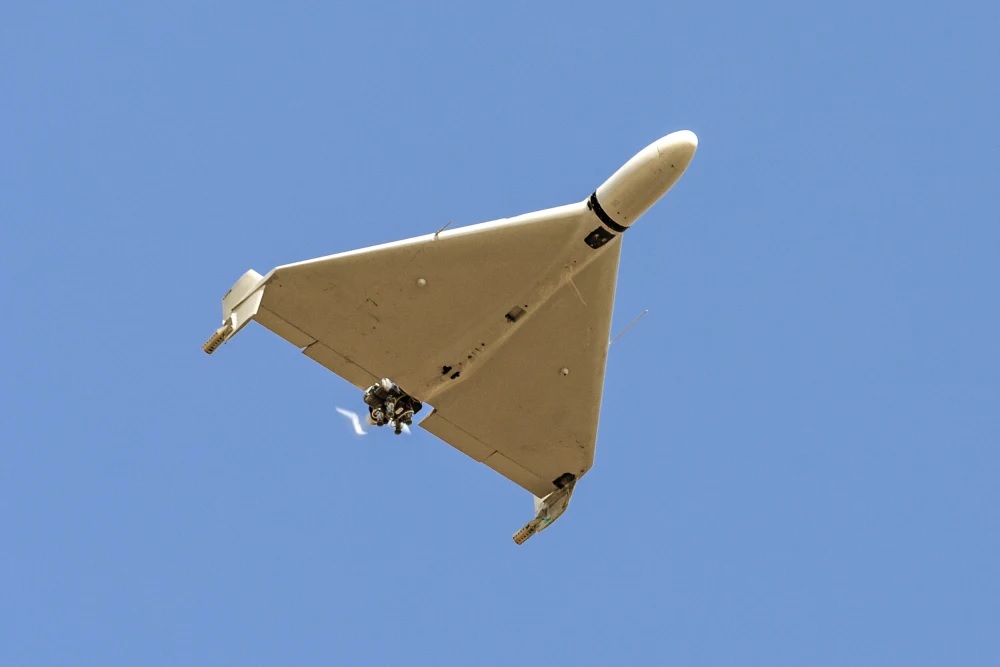
Iran's "Shahed"-136 suicide drone (AFP)
Iran has deployed thousands of Shahed-136 drones in the Persian Gulf for retaliatory actions against the US and its allies. These drones, known as 'poor man's cruise missiles', are cost-effective and designed to overwhelm enemy air defenses. Analysts note that Iran's strategy involves using these drones to exhaust costly interception resources, while retaining more advanced missile capabilities for future operations.
- Iran has deployed thousands of Shahed-136 drones for military operations.
- These drones are referred to as 'poor man's cruise missiles' due to their low cost and effectiveness.
- The cost of a single Shahed-136 drone ranges from $20,000 to $50,000, significantly cheaper than ballistic or cruise missiles.
- Iran's use of these drones aims to exhaust the air defense systems of its adversaries.
- The U.S. has attempted to prevent Iran from producing these drones, but they continue to be manufactured.