
Iran war costs: $38B, plus $2-3B per month going forward, CBO says
WASHINGTON — According to a Congressional Budget Office report published today, combat operations in Iran have cost the Defense Department around $38 billion as of August 1, and will continue to cost the department around $2-3 billion per month if the operations continue.
As the report lays out, the largest chunk of change was for the $21.7 billion it will cost the DoD to replace expended munitions — including $13.1 billion for interceptors, $7.3 billion for land-attack cruise missiles and $1.2 billion for “other munitions.” And those munitions will not be replaceable anytime soon, according to the findings.
“The U.S. has probably used between one-half and two-thirds of its inventory of certain interceptors since June 2025, spanning both conflicts; rebuilding those inventories would probably take at least five years,” even with the Pentagon’s ongoing push to speed munitions production, the report adds, referring to Operation Epic Fury and Operation Midnight Hammer.
The report said this “large expenditure” of missiles and interceptors will leave the US with a “reduced inventory of interceptors for several years.” Such a situation would “become especially problematic if a conflict arose with an opponent whose arsenal included large numbers of ballistic and cruise missiles,” namely China, the report reads.
Such munitions included Tomahawks, Joint Air-to-Surface Standoff Missiles, Terminal High Altitude Area Defense systems, Patriot systems and Standard Missile 3 and Standard Missile 6 interceptors.
Apart from munitions, CBO’s report, which came at the request of Rep. Brendan Boyle, ranking member of the House Budget Committee, estimates that the Pentagon has spent $10.4 billion on increased flying hours, $2.7 billion from increased fuel costs, $1.9 billion in equipment lost in battle and $1.5 billion in “other operational costs.”
Further, the report adds that every additional month would cost the Pentagon about $2 billion at “the level of violence seen in May and June” and estimates that it could cost the department about $3 billion at July’s level of intensity.
“Monthly costs would be higher if the conflict intensified further or DoD used expensive munitions,” the report added.
The CBO report was released hours after a Pentagon Inspector General report that put costs for the war through the end of June at $33.4 billion. Adding two more months to the IG report’s figure, at $3 billion each, roughly lines up with the $38 billion total from CBO, although both figures are missing a key cost, as neither factors in damage to bases.
The DoD did not respond to CBO’s queries on such figures. Hence, the “estimate relies on government databases and public reports and is subject to considerable uncertainty,” the report reads. The CBO report also does not include costs related to personnel killed or injured in the conflict or any “future increases in outlays for veterans’ health care and disability compensation.”
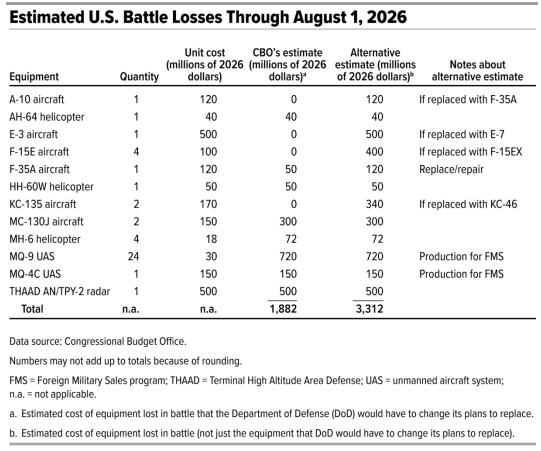
In a table located towards the end of the report, the CBO also estimates key US equipment lost through the start of August. The 42 planes and one AN/TPY-2 radar would cost roughly $3.3 billion to replace with new equipment, per researcher estimations; however, there is no guarantee the Pentagon will look to replace these systems on a one-to-one basis, leaving the dollar total somewhat speculative.
Earlier this year, the Trump administration sent a $87.6 billion supplemental request, with $67.1 billion in defense funds to cover expenses associated with the war in Iran. The CBO notes the president’s request is “not directly comparable with CBO’s estimate because the [a]dministration’s request includes other defense priorities and funding for other departments.”
“Comparing CBO’s estimate ($38.1 billion) with the [a]dministration’s request for supplemental funding is complicated by a lack of information in the latter; however, the estimate and the request are broadly similar in their costs for replacing expended munitions and for fuel,” the report reads.
The U.S. Department of Defense has incurred approximately $38 billion in costs for combat operations in Iran as of August 1, 2023, with ongoing monthly expenses projected at $2-3 billion. Significant expenditures include $21.7 billion for replacing munitions, with a notable depletion of interceptor inventory. The report highlights the financial strain on military resources and the potential implications for future conflicts.
- The total cost of combat operations in Iran is approximately $38 billion as of August 1, 2023.
- Monthly costs are projected to be $2-3 billion if operations continue.
- The U.S. has used a significant portion of its interceptor inventory since June 2025.
- The Pentagon has spent $10.4 billion on increased flying hours and $2.7 billion on fuel costs.
- 42 aircraft and 1 radar system are estimated to cost $3.3 billion to replace.