
Iran's Attack on the Muwaffaq Salti Base in Jordan Reveals the Limits of American Patriot and THAAD in 2026
 Ahmed Al-Rashid
Iran's Attack on Muwaffaq Salti Base in Jordan Reveals Limits of U.S. Patriot and THAAD in 2026
On July 17, 2026, the Muwaffaq Salti Air Base in Jordan was not just a rear support point for U.S. forces. The Iranian attack with ballistic missiles and drones turned it into a practical test of the value of U.S. air defense in the region, not in slide presentations or Pentagon statements, but in the simplest question known to every military personnel who has served in this geography: Can a fixed site remain fixed when it is within the range of a rapidly learning adversary?
The U.S. Department of Defense confirmed in its statement the deaths of two soldiers, 1st Lt. Tyler James Feehan and Pvt. Isabella Gonzales, during an enemy attack on the base, while Defense News reported that a third soldier was missing and four others were treated and then released from hospitals. Al Jazeera went further in its subsequent coverage, stating that the attack resulted in the deaths of three American soldiers, in the context of an American-Iranian war that has entered its fifth month. This discrepancy in numbers does not change the essence of the matter: Iran succeeded in imposing a direct human cost on the U.S. presence in Jordan.
A Fixed Base Within the Range of Moving Fires
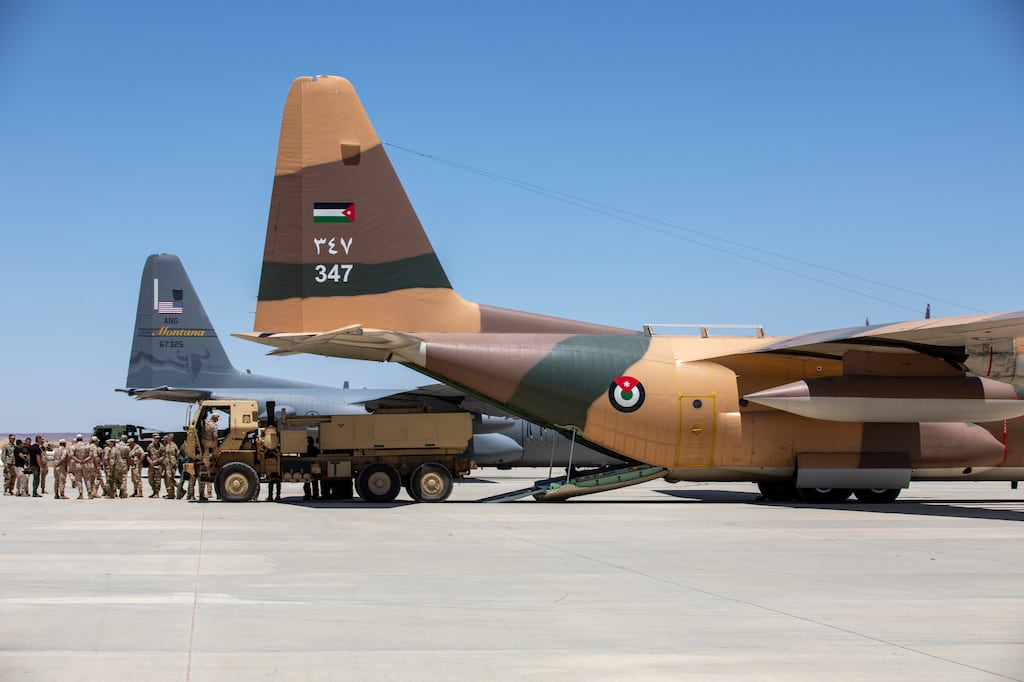
The first problem is not the courage of the soldiers or the quality of the U.S. systems. The problem lies in the design of the deployment itself. There are about 50,000 American soldiers distributed across fixed bases and facilities in the Middle East and the Gulf, many of which were built to face mortars, primitive missiles, and small drones, not precise ballistic missiles carrying large warheads coming from different trajectories. Practically, the fortifications that protect you from a local militia do not necessarily protect you from a state with a multi-layered missile stockpile.
Here lies the paradox of Patriot and THAAD. These systems were designed to intercept high-risk threats, but they do not eliminate the mathematical calculations of war. If the adversary launches ballistic missiles, cruise missiles, suicide drones, and cheap decoys in a single wave, even a high interception rate may allow a limited number of projectiles to get through. In air defense, the single projectile that gets through is the one that writes the political headline the next day.
Iran is Not Seeking a Traditional Victory
U.S. coverage over the past weeks has spoken extensively about destroying Iran's naval, aerial, and industrial capabilities. However, the attack in Jordan, along with Iranian claims of targeting sites in Kuwait, Bahrain, and Jordan, illustrates that Tehran does not need air superiority or a classic naval confrontation. It needs something less costly and more disruptive: repeated breaches of defenses sufficient to force Washington and its allies to pay a political and operational price.
This is a cost-imposing war. The Iranian drone is cheaper than the intercepting missile that takes it down. The ballistic missile is more expensive, but it remains less costly than disabling a base, evacuating the wounded, moving additional defensive batteries, and opening inquiry sessions in Congress. Therefore, the real question becomes not how many Patriot systems Washington has, but how many consecutive nights it can launch expensive interceptions before stockpiles, readiness, and political will begin to erode.
Jordan and the Gulf Between Ally and Target
Jordan in this equation is not a marginal party. The Muwaffaq Salti base is located in a country that has been trying for years to maintain a delicate balance between security cooperation with Washington and avoiding becoming an open battlefield. When Iran strikes an American base on Jordanian soil, it is not just hitting Washington; it sends a message to every Arab country hosting U.S. military infrastructure: declared sovereignty is one thing, and the ability to prevent land from becoming a war platform is another.
The same message reaches the Gulf. Kuwait stated that its air defenses faced an Iranian attack with drones, and the Revolutionary Guard spoke about targeting Patriot and MQ-9 systems and storage facilities. Even if we take Tehran's data with a grain of caution, the pattern of the message is clear. Iran wants to make U.S. bases in the Gulf and Jordan part of the engagement arena, not a safe haven for managing the war from afar.
Limits of U.S. Response
The United States responded, according to CENTCOM and coverage from Al Jazeera and Defense News, with a series of continuous strikes against Iranian operational centers, naval capabilities, drone hangars, and logistical infrastructure. In direct military calculations, this response is understandable. However, the problem is that punitive strikes do not necessarily equate to incapacitating the ability to respond. Iran is a vast country, its stockpile is distributed, and its missile system was originally designed to survive the first, second, and tenth strike.
Any air defense officer would say that silencing a mobile launch platform is harder than destroying a known storage site. And if Iran is indeed receiving intelligence or technical assistance from Russia and China, as some analysts have hinted, then Washington's problem becomes compounded. U.S. strikes reduce capability, but they may not prevent learning. Worse, each round provides both sides with information about the other's vulnerabilities.
Military Summary
The attack on Muwaffaq Salti does not mean that Iran has become stronger than the United States; this is propaganda that does not hold up. But it does mean that American superiority is no longer sufficient on its own to protect the old deployment pattern. Fixed bases, expensive air defense, and allies who want protection without becoming targets are all elements that no longer easily align.
In my view, the most important lesson for Jordan and Gulf states is not just to buy more batteries, but to rethink the philosophy of deployment, protection, and political decision-making. Arabs say: He who relies on the provisions of others will suffer prolonged hunger. In regional air defense, those who rely solely on the American umbrella will discover that the umbrella may be strong, but it is perforated when missiles rain down from multiple directions.
This is the structural tension revealed by the attack in Jordan: Washington wants bases close to impose deterrence, Tehran wants to make its proximity a burden, and Arab allies want protection without paying the price of hosting. No Patriot or THAAD system can alone resolve this contradiction.
Iran launched a ballistic missile and drone attack on the Muwaffaq Salti Air Base in Jordan on July 17, 2026, resulting in the deaths of two U.S. soldiers and injuries to four others. This attack exposed vulnerabilities in U.S. air defense systems, particularly the Patriot and THAAD systems. In response, the U.S. conducted strikes against Iranian operational centers, highlighting the ongoing military tensions between the U.S. and Iran in the region.
- Iran attacked the Muwaffaq Salti Air Base in Jordan on July 17, 2026.
- Two U.S. soldiers were confirmed killed, with a third missing and four others injured.
- The attack demonstrated vulnerabilities in U.S. air defense systems, specifically Patriot and THAAD.
- Iran's strategy aims to impose costs on U.S. military presence in the region.
- The U.S. responded with strikes against Iranian operational centers.