
J-10CE Dominates Typhoon 9-0, China's Avionics Missile Chain Begins to Be Reassessed
 Li Minghui
J-10CE Dominates Typhoon 9-0, China's Avionics Missile Chain Begins to Be Reassessed
Last week, CCTV confirmed an interesting set of data: the J-10CE equipped by Pakistan achieved a 9-0 victory against the "Typhoon" fighter in 9 simulated air combat scenarios in 2024. The South China Morning Post added on May 21 that the Chinese report did not disclose the participating countries, but Pakistan and Gulf media previously pointed to the "Zilzal-II" joint air exercise in Qatar, with the opponent being the Qatar Air Force's European "Typhoon".
This number cannot be directly translated into real combat outcomes. The rules of simulated air combat, airspace, electronic warfare restrictions, the level of AWACS participation, and missile launch determinations can all affect the results. However, I believe it still has analytical value because the J-10CE is not a concept aircraft, but an export fighter that has already been delivered and is being used by foreign air forces to train against Western 4.5 generation aircraft.
The 9-0 Score Truly Measures System Interfaces
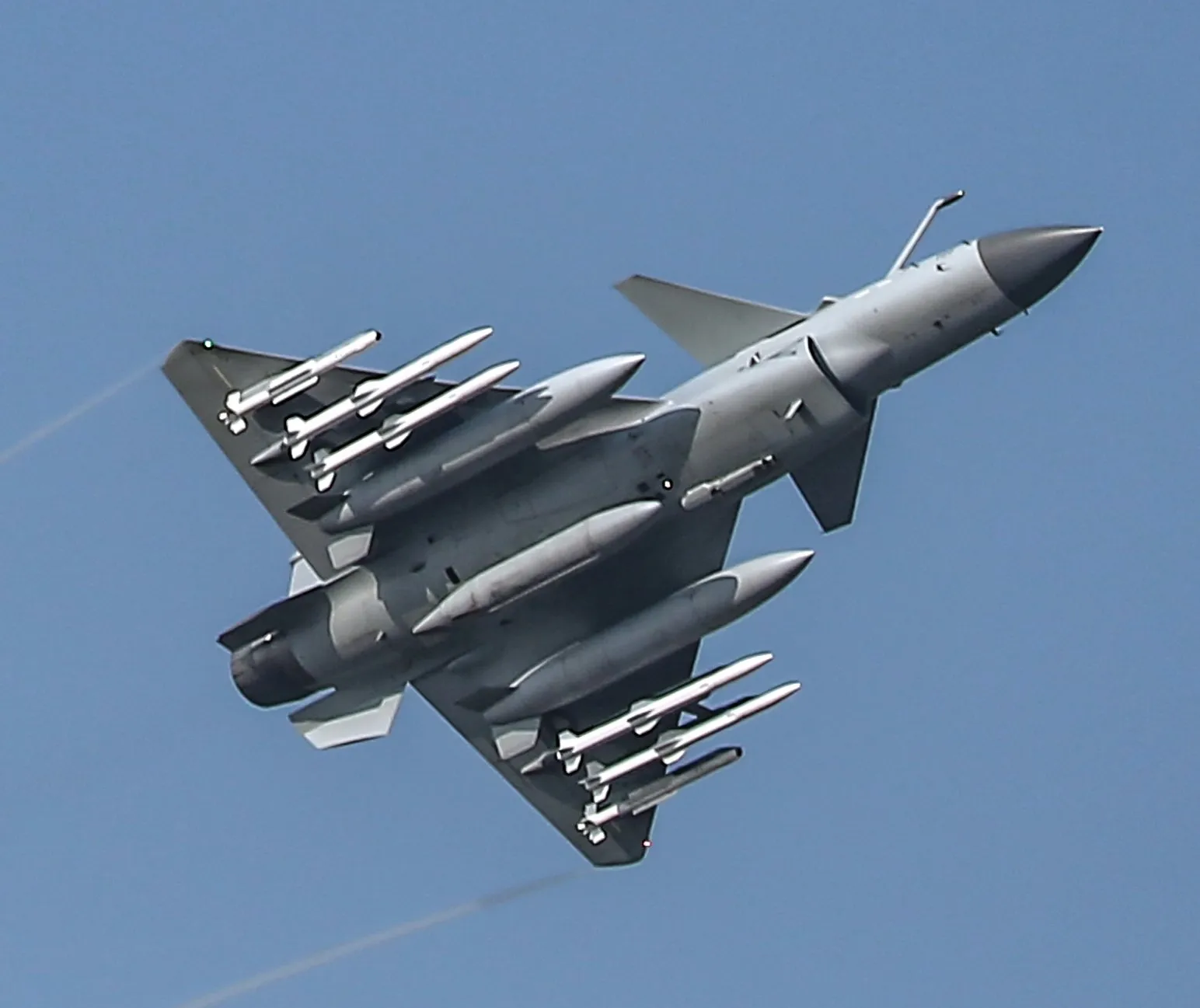
According to public statements, the 9 scenarios included 5 close-range dogfights and 4 beyond-visual-range engagements. The close-range events assess aircraft energy retention, helmet-mounted targeting, close-combat munitions, and pilot training; the beyond-visual-range events evaluate radar, data links, electronic support, air-to-air missiles, and tactical command. In other words, this is not just about the maneuverability of the J-10CE or a specific missile, but about testing an entire avionics missile chain.
The J-10CE is the export version of the J-10C, developed by Chengdu Aircraft Industry Group, featuring a canard and delta wing layout, positioned as a single-engine medium fighter, sharing a significant amount of technology lineage with the Chinese Air Force's J-10C. What truly attracts buyers is not how new the airframe is, but the active electronically scanned array radar, infrared search/track, helmet display, and weapons like the PL-10E and PL-15E that can form a relatively complete package. Public data usually places the export range of the PL-15E at about 145 kilometers; although it is limited compared to the domestic version, it is sufficient for most medium-sized air forces.
Affordability Is Not the Only Selling Point
In the past, discussions about Chinese export fighters often summarized them with the term "cost-performance ratio." This statement is not incorrect, but it is somewhat simplistic. Affordability can only explain the transaction; it does not explain why customers are willing to use it in high-intensity joint exercises against the "Typhoon." If the 9-0 data is generally reliable, it indicates that Chinese export fighters are transitioning from "aircraft that can be bought" to "systems that can be trained, maintained, and integrated into combat processes."
- First, Pakistan is not a novice customer; its feedback on the use of Chinese equipment will, in turn, influence the improvement pace of Chengdu and AVIC.
- Second, Gulf countries value not just the unit price, but also delivery speed, ammunition stockpiles, and fewer political restrictions.
- Third, European fighters excel in mature training systems, but maintenance costs, upgrade cycles, and export authorizations can affect daily operational rates.
In simple terms, if aircraft like the J-10CE can maintain availability in high-frequency training, their market persuasiveness will be stronger than maximum speed and range displayed on airshow panels. Military exports ultimately sell the question of "can it fly every day, who will repair it if it breaks, and can ammunition be replenished."
Also Has Reverse Significance for the PLA
This matter should not only be viewed from the export perspective. The overseas use of the J-10CE will provide indirect references for the PLA's own J-10C, J-16, and future unmanned wingman systems. The training environments of foreign militaries differ from those of China, especially in terms of opponent tactics, maintenance systems, pilot languages, and ground support habits. Chinese engineers have previously relied more on feedback from domestic forces, and now they have an external sample pool.
The South China Morning Post previously reported that CCTV mentioned engineers from AVIC Chengdu Design Institute provided on-site technical support during the conflict between Pakistan and India. This detail is more worth pondering than the 9-0 score. It indicates that Chinese military exports are now accompanied by deeper operational support services, rather than just delivering the aircraft and ending the engagement. For buyers, this is after-sales service; for Chinese military industry, this is data on the edge of real combat.
Shortcomings Need to Be Viewed Calmly
I do not agree with interpreting this report as "the J-10CE completely surpasses the Typhoon." The batches of Typhoons, radar models, missile simulation conditions, and pilot experience have not been disclosed. If the rules favor one side, the 9-0 score could be exaggerated. One point cannot be avoided: the J-10CE is still a single-engine medium fighter, and its range, payload, and sustained high-intensity operational capabilities cannot be compared to those of twin-engine heavy platforms.
However, it at least proves that Chinese fighter exports have entered a new stage. Previously, external doubts were about whether Chinese aircraft could fight; now the more realistic question has become whether it can continuously generate usable combat power at a lower cost. The real unanswered question is whether, in the next similar exercise, if AWACS, electronic warfare aircraft, and multiple mixed batches are included, the J-10CE can still maintain this advantage.
The J-10CE aircraft of the Pakistan Air Force achieved a 9-0 victory against Typhoon fighters in simulated air combat held in Qatar in September 2024. This performance highlights the capabilities of the J-10CE, which is equipped with advanced avionics and missile systems. The results may impact the perception of Chinese military exports and their integration into foreign air forces.
- J-10CE achieved a 9-0 victory against Typhoon fighters in simulations.
- The simulations took place in Qatar.
- The report indicates the involvement of the Pakistan Air Force.
- The J-10CE is equipped with advanced avionics and missile systems.
- The performance of the J-10CE may influence future military procurement decisions.