
Japan and the United States Complete 15-Day Mine Clearance Training in Mutsu Bay in 2026, Reaffirming Northern SLOC Defense
 Tanaka Takashi
Japan and the U.S. Complete 15-Day Mine Clearance Training in Mutsu Bay During 2JA 2026, Reaffirming Northern SLOC Defense
On the gray surface of Mutsu Bay, a U.S. Navy rubber boat is heading towards the Japan Maritime Self-Defense Force's mine countermeasure vessel "Awaji." A photo released by DVIDS, taken on July 20, may not stand out as much as aircraft carriers or hypersonic weapons. However, the essence of the Mine Warfare Exercise 2JA 2026, conducted from July 9 to 24, lies precisely in this unremarkable close-range operation.
What the 15 Days of Training Demonstrated
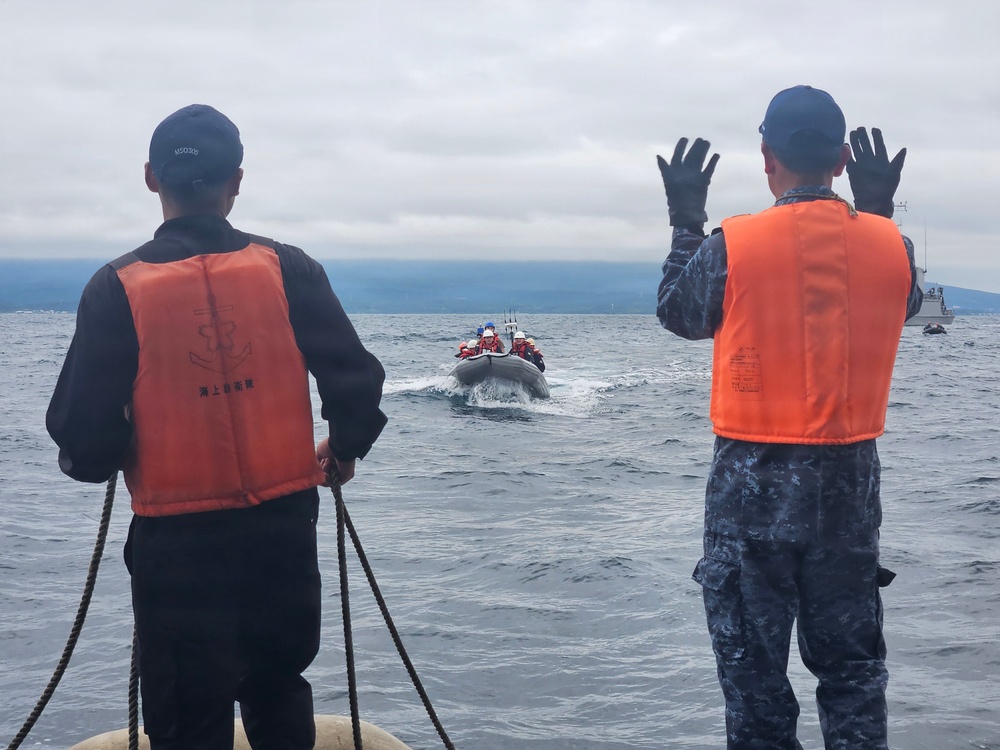
According to a DVIDS announcement from the U.S. 7th Fleet, Japan and the U.S. conducted 2JA 2026 in Mutsu Bay off the coast of northern Japan, jointly training in the detection, identification, and neutralization of simulated minefields. The U.S. side deployed the Avenger-class mine countermeasure vessel USS Chief (MCM-14), personnel from the 5th Explosive Ordnance Disposal Group, and Mine Countermeasures Group 7.
The Japan Maritime Self-Defense Force (JMSDF) had a more substantial lineup. The Mogami-class frigate "Niyodo" (FFM-7), the Uraga-class mine warfare support vessel "Bungo" (MST-464), the Awaji-class mine countermeasure vessel "Awaji" (MSO-304), the Hirashima-class mine sweeper "Hatsushima," six Sugashima-class mine sweepers, YDT-02, as well as P-1, P-3C, MCH-101, and multiple underwater disposal teams participated. The mix of new and old equipment reflects the reality of the JMSDF's mine countermeasure forces.
Mutsu Bay is More Than Just a Training Area
A July 3 announcement from the Ministry of Defense's Maritime Staff Office explained that the JMSDF has been conducting mine warfare training in Mutsu Bay since 1964, and this marks the 45th iteration. This number is significant. During the Cold War, Japan's mine warfare capabilities were tied to the question of how to defend the Soya, Tsugaru, and Tsushima Straits. While today's focus seems to have shifted to the southwestern islands, the northern waterways, including the Tsugaru Strait, influence the U.S. military's reinforcements, civilian shipping, and anti-submarine patrols.
Mines are inexpensive and can create politically ambiguous pressure. Unlike missile launches, which immediately become news footage, merely suspecting a few mines in ports or straits can significantly disrupt commercial shipping insurance, route selection, and the action plans of escort vessels. In defending SLOCs (Sea Lines of Communication), the ability to sink enemy ships is not enough; the capability to restore the sea to a usable state is also necessary.
The Weakness of Japan-U.S. Integration is Speed
This 2JA exercise is part of an annual series following February's MINEX 1JA, positioned as training for Japan and the U.S. to align their procedures for mine clearance, neutralization, and underwater disposal. In my view, what is being questioned here is not the number of vessels but the speed of command, communication, and risk assessment. Mine clearance operations require caution, but during a crisis, the timelines for port recovery and fleet operations must run concurrently.
- The U.S. side's mainstay was the USS Chief and EOD Mobile Unit 5, demonstrating the readiness of forward-deployed forces.
- The JMSDF combined mine countermeasure vessels, patrol aircraft, and MCH-101 to confirm surface search capabilities.
- The selection of Mutsu Bay as a northern waterway can be read as a quiet correction to the focus on the southwestern region.
U.S. Navy Colonel Scott Wells positioned the JA series as a joint capability that has been ongoing for "decades." It is not that old training remains; rather, old issues are returning in a different form.
Less Visible Forces Wear Out Faster
In discussions about Japan's defense, the Type 12 enhanced version, F-35, and Aegis-equipped ships attract attention. This is understandable, but mine warfare units are constrained by personnel, vessel age, training areas, and port support. From the names of the participating ships, it appears that the JMSDF still maintains a robust mine warfare culture. However, this does not imply infinite capacity.
If we consider scenarios such as a Taiwan contingency or a crisis on the Korean Peninsula, what will be needed in Japan's coastal waters is not a "port that cannot be attacked," but rather a "port that can resume operations even after a halt." The small boat operations captured in the photos of 2JA 2026 represent, in that sense, the foundation of the alliance. The true risk lies not in the mines themselves, but in the mundane foundation being sidelined from political priorities during peacetime.
The U.S. Navy and Japan Maritime Self-Defense Force completed a 15-day joint mine warfare exercise in Mutsu Bay from July 9 to July 24, 2026. The exercise involved various vessels, including the USS Chief and several Japanese mine countermeasure ships, focusing on mine detection and neutralization. This training reaffirms the defense of northern sea lines of communication.
- The U.S. and Japan completed a 15-day mine warfare exercise in Mutsu Bay.
- The exercise involved multiple vessels and personnel from both nations.
- The training focused on mine detection, identification, and neutralization.