
Japan Wants to "Loosen" Arms Sales, with Multiple Agendas
[Global Times Special Correspondent Chen Yang, Global Times Reporter Liu Yang] Japan is moving further down the path of re-militarization, breaking through the restrictions of its "peace constitution." According to recent reports from Japanese media, the Japanese government plans to officially amend the "Three Principles on Transfer of Defense Equipment" this month, completely lifting the restrictions on the export of lethal weapons, which has raised alarms among neighboring countries. Chinese Foreign Ministry spokesperson Mao Ning warned at a press conference on the 7th that this move marks a fundamental shift in Japan's post-war weapons export policy, undermining the institutional safeguards against the resurgence of Japanese militarism.
Export restrictions are being gradually dismantled
According to reports from Kyodo News and other media, the government of Prime Minister Kishi Nobuo plans to officially amend the "Three Principles on Transfer of Defense Equipment" within this month. The relevant content includes no longer limiting exports to five types of "non-combat use defense equipment" such as rescue and transport, and in principle allowing the export of weapon products, including lethal weapons; establishing exceptions for exporting weapons to conflict countries, thereby retaining export space; and allowing weapon exports without prior approval from the National Diet, changing to post-reporting, which weakens the original important "brake mechanism."
There has been much criticism within Japan regarding this proposal. Hiroshi Shiratori, a professor at Hosei University, stated that exporting lethal weapons without the need for Diet approval could make Japan a "country that exports war." Senior lawyer Kazuko Ito expressed that once the economy becomes dependent on the military-industrial sector and even war, it will be difficult to break free.
The shift in Japan's weapons export policy mentioned by Chinese Foreign Ministry spokesperson Mao Ning clearly shows the intention of Japanese right-wing forces to deliberately break through the restrictions of the "peace constitution" and revive militarism.
During the Cold War, Japan adhered to the "Three Principles on Weapons Exports" based on the "peace constitution," which effectively sealed off the channels for weapons exports. However, with the rise of right-wing forces in Japan, related prohibitions have been gradually overturned. In 2006, the government of Junichiro Koizumi, under the pretext of combating terrorism, provided armed patrol boats to Indonesia for the first time, breaking the ban on weapons exports. In 2014, the government of Shinzo Abe replaced the "Three Principles on Weapons Exports" with the "Three Principles on Transfer of Defense Equipment," significantly relaxing restrictions on the export of military equipment and technology through vague wording. The "Three Principles on Transfer of Defense Equipment" established "five categories of restrictions," which in principle allowed the export of non-lethal weapons for rescue, transport, surveillance, monitoring, and mine clearance, marking a dangerous shift from "principle prohibition" to "principle permission."
Under the framework of the "Three Principles on Transfer of Defense Equipment," Japan took the opportunity to provide air defense radar to the Philippines, achieving the first export of such military equipment. Subsequently, by amending the Self-Defense Forces Law, Japan provided second-hand patrol boats and coast guard vessels to the Philippines for "surveillance and monitoring," labeled as "non-lethal vessels."
In recent years, Japan has intensified its efforts, repeatedly amending the "Three Principles on Transfer of Defense Equipment" and its implementation guidelines, not only relaxing restrictions on joint development of weapons but also allowing lethal products manufactured in Japan to be directly exported to authorized countries that grant Japan "production licenses." This has opened the door for Japan to export lethal weapons on a large scale. In 2023, the Japanese government allowed the re-export of "Patriot 3" air defense missiles to the United States, marking the first export of lethal weapon products by Japan since World War II, indicating that the restrictions on the export of "non-combat use" weapons have been broken. In 2024, Japan further relaxed joint development restrictions, allowing the next-generation fighter jets jointly developed by Japan, the UK, and Italy to be directly exported to third countries, clearing obstacles for the export of large offensive weapons.
What weapons might be exported
An unnamed Chinese military expert told Global Times reporters that rebuilding an independent defense industrial system has long been one of the important goals of Japanese right-wing forces in promoting Japan's re-militarization and reviving militarism. Over the years, the Japanese government has continuously supported its domestic defense industry and developed a relatively complete domestic equipment system, covering a range from firearms, artillery, and main battle tanks to fighter jets, transport aircraft, and anti-submarine patrol aircraft, as well as globally leading conventional submarines and destroyers, frigates, and other naval combat weapons.
However, the scale of the Self-Defense Forces' equipment has been limited, and domestic weapons could not be mass-produced to share development costs, leading to exorbitant prices that affected the development of Japan's defense industrial capabilities. The Japanese Ministry of Defense believes that only by opening up the international weapons export market can the current predicament of Japan's defense industry be resolved, which has become one of the reasons for the Kishi Nobuo government's amendment of the "Three Principles on Transfer of Defense Equipment."
For example, the Air Self-Defense Force's current F-2 fighter jet is a Japanese-made fighter based on the American F-16, developed primarily by Mitsubishi Heavy Industries. Due to the restrictions of the "Three Principles on Weapons Exports" at the time, this aircraft could only be supplied to the Japan Air Self-Defense Force, with a final procurement quantity of only 94 units. In contrast, the F-16 has a production volume of over 4,500 units, allowing for significant cost dilution through mass production. As a result, the unit cost of the F-2 is more than twice that of the F-16. Similar situations have also occurred with the Japan Ground Self-Defense Force's main battle tanks and self-propelled anti-aircraft guns. For example, the unit price of the Type 90 main battle tank is about $8.5 million, which is twice that of the contemporaneous American M1 series main battle tanks, and the procurement quantity of the new generation Type 10 main battle tank is even smaller and more expensive, with a unit price equivalent to three times that of the internationally popular South Korean K2 main battle tank.
According to U.S. Defense News, the Japanese-made domestic weapons are not only expensive but also cannot be improved based on extensive usage experience through exports to other countries, resulting in their overall performance never reaching international first-class standards. "No country would be willing to purchase second or third-rate products at a higher price." Reports indicate that this "few but expensive" model is backfiring on Japan's defense industry itself. Over the past 20 years, more than 100 Japanese companies have exited the defense industry, including Komatsu Ltd. (which stopped developing armored vehicles in 2019) and Sumitomo Heavy Industries (which ceased production of machine guns in 2021).
Some analysts believe that if the Kishi Nobuo government successfully completes the amendment of the "Three Principles on Transfer of Defense Equipment," many of the Self-Defense Forces' current equipment could immediately be included in the export list. Especially in the current context of severe shortages in Western defense industry production capacity, Japan's relatively abundant manufacturing capacity may fill the market gap.
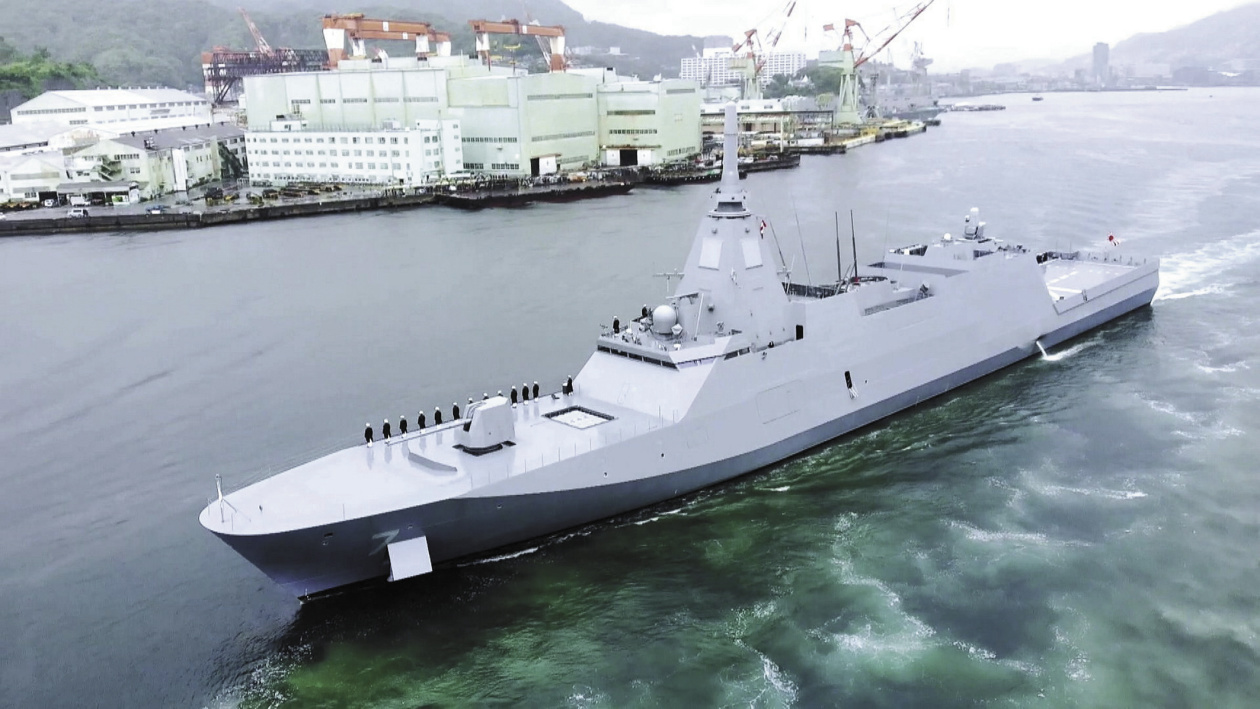
For example, in naval combat weaponry, Japan has already negotiated a major export deal for the new generation "Mogami" class missile frigates with Australia, and New Zealand is also considering purchasing similar vessels. Meanwhile, due to the cancellation of the U.S. Navy's "Constellation" class frigate project, many American experts have suggested that the U.S. should abandon the independent development of the next-generation frigate and instead directly procure the "Mogami" class frigates from Japan, allowing the U.S. Navy to concentrate its limited resources on high-end vessel construction. Additionally, the "Soryu" class conventional submarines are also one of the main weapon models that Japan is actively promoting for export.
In terms of ground weapons, Japan's domestically developed Type 10 main battle tank, Type 03 air defense missile, and Type 12 ship-based anti-ship missile also have certain competitiveness in the international arms market. Furthermore, the new generation domestically developed P-1 anti-submarine patrol aircraft and C-2 transport aircraft, developed according to the principle of "parallel development and shared technology," are also key aviation equipment that the Ministry of Defense is promoting for export.
Attempting to build a security network in the Asia-Pacific centered on Japan
Experts emphasize that it is worth noting that Japanese media have repeatedly advocated in recent years that Japan should emulate South Korea's model of entering the international arms market, believing that this move can not only generate substantial profits from arms trade but also provide an opportunity to develop its own defense industry. Japan is attempting to leverage the relaxation of weapons export restrictions to allow Japanese military enterprises to gain space in the international market, promote the military industry as a new economic growth point, and enhance the international competitiveness of Japanese companies through technological cooperation, thereby feeding back into Japan's domestic military expansion. Additionally, exporting main battle weapons often represents a further strengthening of diplomatic and military cooperation between two countries. Currently, Japan is focusing on promoting its weapons to the United States, Australia, and the Philippines, intending to strengthen relationships through equipment exports and build a security network in the Asia-Pacific centered on Japan, enhancing Japan's regional military security influence and shifting its military strategy from strictly defensive to proactive intervention.
Mao Ning stated at a Foreign Ministry press conference that China is "seriously concerned" about Japan's attempt to amend the "Three Principles on Transfer of Defense Equipment." She noted that many international scholars and insightful individuals in Japan are deeply worried about the related trends, believing that this marks a fundamental shift in Japan's post-war weapons export policy, seriously violating the provisions of internationally effective documents such as the Cairo Declaration, the Potsdam Proclamation, and the Japanese Instrument of Surrender, and severely contravening Japan's constitution and existing domestic regulations, undermining the institutional safeguards against the resurgence of Japanese militarism. Mao Ning stated that various signs indicate that Japanese right-wing forces are pushing security policies towards an offensive and expansionist direction. The acceleration of Japan's re-militarization is a fact and reality, with actual routes and actions that threaten regional peace and stability. The international community must remain highly vigilant and resolutely resist Japan's "new militarism" actions.
Japan plans to modify its defense export principles to allow the export of lethal weapons, marking a significant shift in its post-war military policy. This change will eliminate the requirement for parliamentary approval for arms exports and aims to strengthen Japan's defense industry. The move has raised concerns among neighboring countries, particularly China, regarding the resurgence of Japanese militarism.
- Japan plans to modify its defense export principles to allow the export of lethal weapons.
- This change is seen as a significant shift in Japan's post-war military policy.
- The modification will eliminate the requirement for parliamentary approval for arms exports.
- Japan aims to strengthen its defense industry and expand its international arms market.
- The move has raised concerns among neighboring countries, particularly China.