
Japan's First Tomahawk Launch Gives China a 400 Missile Problem
 Marcus Chen
Japan's First Tomahawk Launch Gives China a 400 Missile Problem
One missile left JS Chokai on July 29. The number that matters is 400.
Japan's Ministry of Defense says the Maritime Self-Defense Force destroyer JS Chokai (DDG-176) successfully fired a Tomahawk cruise missile in the Pacific with U.S. Navy support. Naval News reported the launch on July 30; Stars and Stripes added that the ship had spent roughly five months being modified for the weapon and is expected to return to Japan around September. The War Zone noted that Japan has now joined the small group of U.S. allies that have fired Tomahawk from a surface combatant.
This was not just a qualification shot. It was the first visible proof that Japan's post-2022 counterstrike policy is moving out of cabinet documents and into vertical launch cells.
The Launch Was Small and the Architecture Is Not
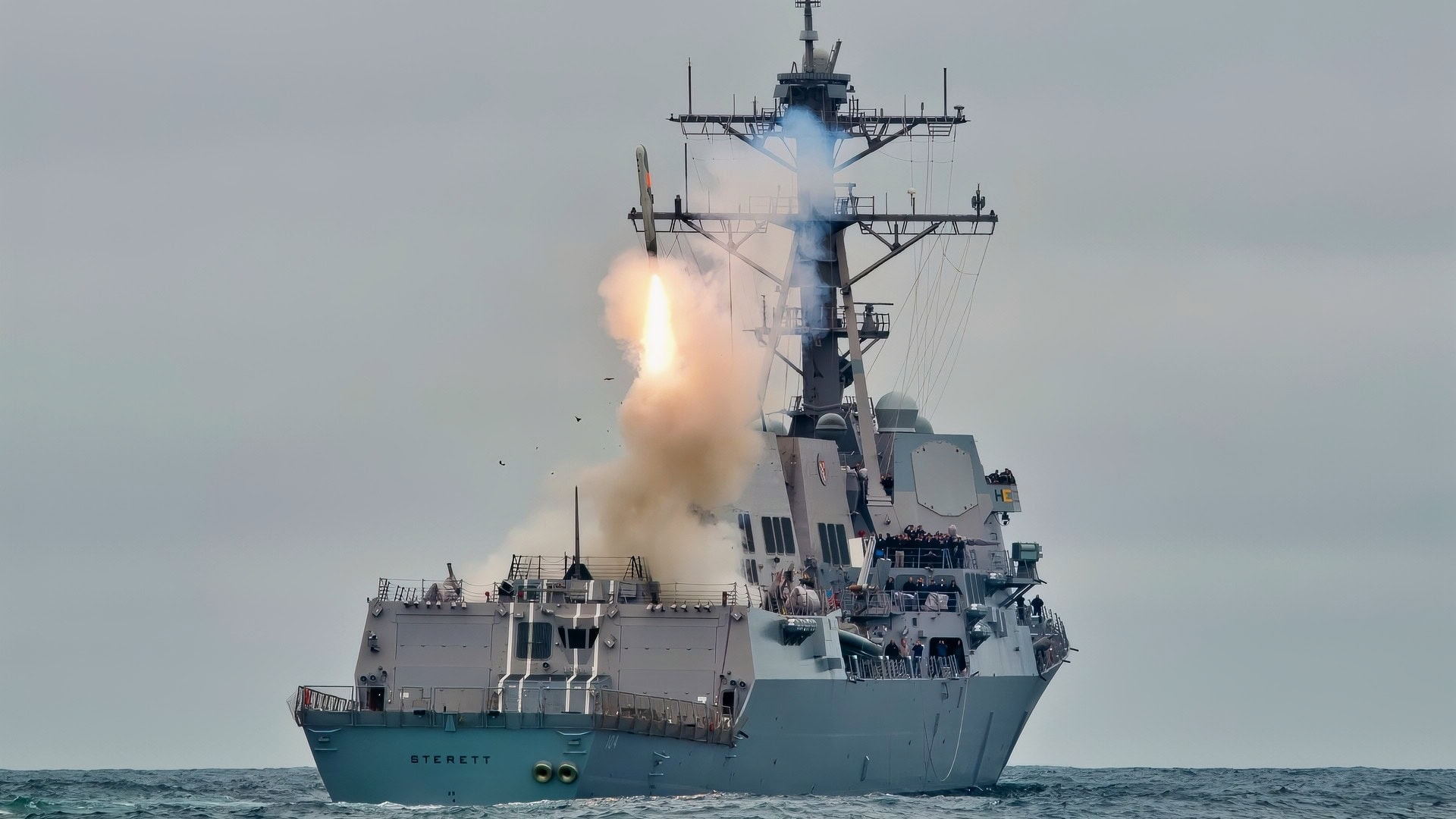
JS Chokai is a Kongo-class Aegis destroyer. That matters because Japan does not need to invent a new strike fleet from scratch. Its Aegis ships already carry Mk 41 vertical launch systems and combat systems close enough to U.S. Navy architecture that the problem becomes integration, certification, command-and-control, and magazine management rather than a clean-sheet shipbuilding program.
The first hull is now through that gate. Stars and Stripes reported that two more of Japan's eight Aegis-equipped destroyers, JS Kirishima and JS Haguro, have already begun similar work. Funding is also allocated for JS Myoko and JS Atago. The remaining three ships are not confirmed, but the direction is obvious: Tokyo is turning air-defense destroyers into ships that can also put precision conventional fire hundreds of miles inland.
Anyone who has served on a destroyer knows the weapon is only part of the problem. The launch button is the easy piece. The harder part is maintaining the software load, the targeting chain, the rules of engagement, the training cycle, and the reload plan after the first salvo. Japan's test proves the first piece. It does not yet prove the whole kill chain.
The Range Changes Chinese Planning
Tomahawk gives Japan reach it did not previously have at sea. The Block IV missile is generally described as a land-attack weapon with a range near 1,000 miles and a 1,000-pound warhead. Block V improves survivability and adds variants useful against maritime targets. Japan's planned purchase, approved by Washington in 2023, covers 200 Block IV and 200 Block V missiles in a deal worth roughly $2.35 billion. Admiral Akira Saito said on July 28 that Tokyo remains on track to buy the 400 missiles by March 2028, according to Stars and Stripes.
Draw a 1,000-mile circle from a Japanese destroyer operating east of Taiwan or south of Kyushu and the map gets uncomfortable for Beijing. Coastal air bases, logistics hubs, command nodes, missile brigades, and naval facilities that used to sit outside Japan's conventional reach now have to be treated as targets in a crisis. China already plans for U.S. Tomahawks. It now has to plan for Japanese Tomahawks launched from Japanese-controlled platforms under Japanese political authority.
That last clause is the real change. U.S. firepower in the first island chain is powerful but politically filtered through Washington. Japanese firepower is geographically closer and politically tied to the defense of Japan's own territory, including the Nansei Islands. In a Taiwan contingency, Chinese planners cannot assume Japan stays passive if missile launches, air operations, or naval movements threaten Japanese bases and sea lanes.
The Magazine Is Still the Limiting Factor
Four hundred missiles sound like a lot until they are placed against the target set. A single major air base can require multiple weapons if the goal is not a symbolic crater but temporary operational paralysis: runways, fuel storage, aircraft shelters, command facilities, air-defense nodes, and repair equipment. Multiply that by several bases, add ports and missile sites, and the number shrinks quickly.
Then add launch cells. Japan's destroyers must still carry Standard Missiles for air defense, SM-3 or SM-6 interceptors for missile defense, anti-submarine weapons, and other loads. Every Tomahawk in a Mk 41 cell is a cell not carrying something else. In wartime, a Japanese Aegis destroyer defending itself against Chinese air and missile attack cannot be treated as a floating Tomahawk warehouse.
That is why the test should be read as a threshold, not as a finished deterrent. Japan is buying enough missiles to complicate Chinese planning, not enough to run an independent deep-strike campaign for weeks. The capability works best as part of a combined U.S.-Japan firing network that forces the People's Liberation Army to distribute defenses, harden command nodes, and spend interceptors across a wider set of threats.
Washington Has Its Own Supply Problem
The uncomfortable part is that Japan's new magazine depends on the same American industrial base already under pressure. Stars and Stripes cited a May 27 Center for Strategic and International Studies analysis that estimated the United States had fired more than 1,000 Tomahawks, about a third of an estimated 3,000-missile stockpile, during the war with Iran. If that estimate is close, then Japanese deliveries are competing with U.S. replenishment needs at exactly the wrong time.
This is the recurring problem in Indo-Pacific deterrence: concepts outrun production. Washington wants allies to bring more firepower. Tokyo is doing that. But the missile comes from a production line that also has to support U.S. destroyers, submarines, and future crises. If annual output cannot replace wartime expenditure at speed, a 400-missile Japanese buy becomes both an allied strength and a supply-chain liability.
Japan knows this, which is why Tomahawk is a bridge. Tokyo is also developing upgraded Type 12 anti-ship missiles, hypersonic glide weapons, and other standoff systems. But bridges matter only if the far side is reached before the crisis. Between now and 2028, Japan will have a partial imported strike capability while its domestic missile portfolio matures.
The Operational Meaning
China should not panic over one Japanese launch. It should adjust its planning for five modified Japanese destroyers, two future Aegis System Equipped Vessels, 400 imported cruise missiles, and a Japanese political class that has already crossed the doctrinal line into counterstrike.
For the United States, the test is good news with a warning label. A Japanese destroyer that can shoot Tomahawk adds real allied firepower. It also adds demand for targeting data, deconfliction, maintenance support, and missile production. Interoperability is not free. It consumes staff work, bandwidth, and magazines.
The shot from JS Chokai proves Japan can enter the long-range strike game. It does not prove Japan can sustain it. That is still the difference between a demonstration and deterrence. Beijing now has a 400-missile problem. Tokyo and Washington have to make sure it becomes more than a 400-missile press release.
Japan's Maritime Self-Defense Force destroyer JS Chokai successfully launched a Tomahawk cruise missile in the Pacific on July 29, 2023. This marks Japan's entry into long-range strike capabilities, with plans to acquire 400 Tomahawk missiles by March 2028. The development poses new challenges for Chinese military planning, as Japan's missile capabilities are now politically tied to its defense strategy.
- Japan's JS Chokai successfully launched a Tomahawk missile on July 29, 2023.
- Japan plans to acquire 400 Tomahawk missiles by March 2028.
- The missile launch signifies a shift in Japan's military capabilities under its counterstrike policy.
- Japan's Aegis destroyers are being modified to launch Tomahawk missiles.
- The launch impacts Chinese military planning regarding potential targets.