
Japan’s island-defense glide missile seen at Camp Fuji
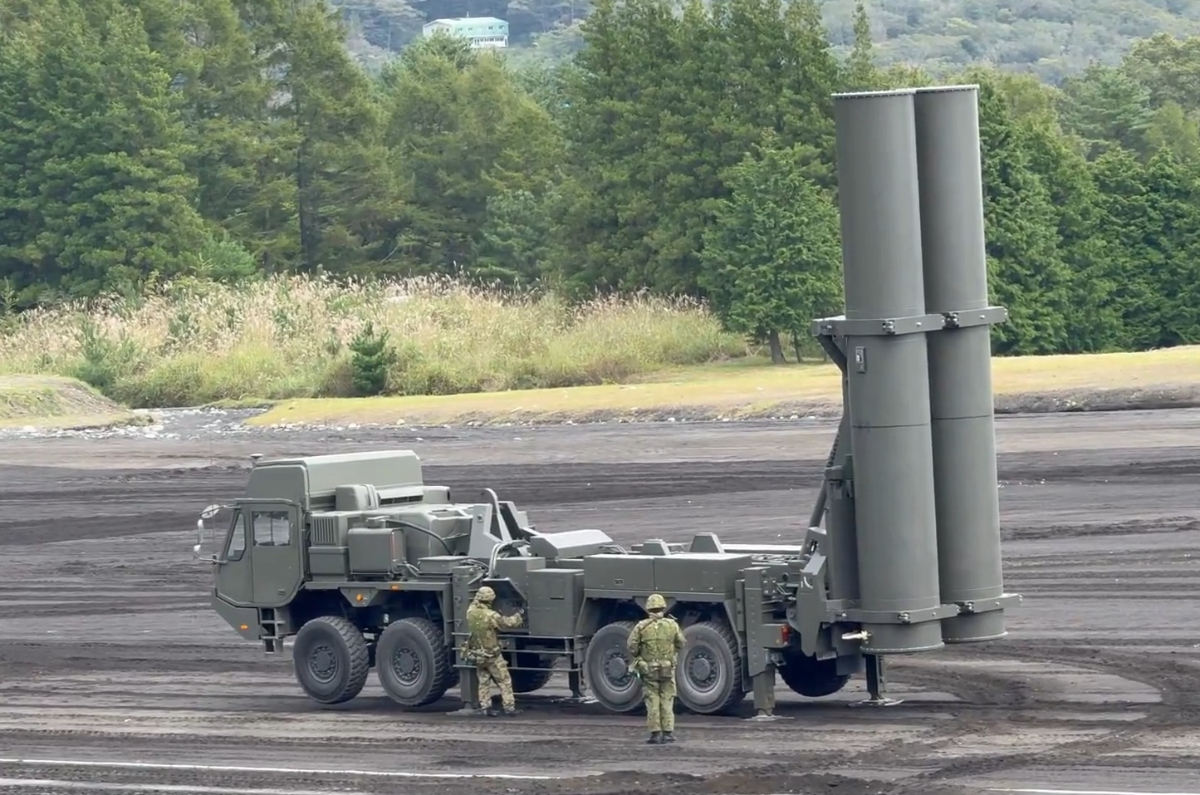
New video from Camp Fuji shows Japan’s Type 25 Hyper Velocity Gliding Projectile launcher driving onto a firing site, raising its missiles into launch position and packing up again, giving a rare look at how the country’s first domestically built long-range strike missile is operated.
The three-minute clip was posted on X by Japanese military photographer @yahou5, who described it as the full sequence from arrival through moving into firing posture to withdrawal. It shows a heavy 8×8 truck carrying two large missile canisters on its back. The post was tagged with Camp Fuji and the Japan Ground Self-Defense Force’s Fuji School, which runs the service’s artillery training.
Japan deployed the weapon to Camp Fuji in Shizuoka Prefecture on March 31, the same day the Defense Ministry gave it its official name. Developed as the Hyper Velocity Gliding Projectile for island defense, it was redesignated the Type 25 HVGP, also known as 25HGP. The unit at Camp Fuji is the Field Artillery Training Unit, which is using the first systems to train crews and work out how the weapon will be used.
Defense Minister Shinjiro Koizumi said at the time that the deployment, together with the Type 25 surface-to-ship missile sent to Camp Kengun in Kumamoto, was the first time domestically produced stand-off missiles had been delivered to Japanese military units. Stand-off weapons are meant to hit an enemy force from outside the range of its own weapons.
The HVGP works differently from a cruise missile. A rocket booster carries it to high altitude, where the warhead section separates and glides toward the target at very high speed, maneuvering on the way down. That combination of speed and an unpredictable flight path makes it harder to intercept than a conventional ballistic missile. Japanese outlet Jiji Press has described it as a type of hypersonic glide weapon, flying at more than five times the speed of sound.
The Defense Ministry says the current Block 1 version has a range of several hundred kilometers. Japanese media have reported figures of up to 900 km (560 miles). The ministry is developing longer-range versions, with a goal of 1,000 to 2,000 km, and a later Block 2 with a more advanced glide body is planned for the 2030s.
The launcher made its first public appearance at the Fuji Firepower Review, Japan’s largest annual live-fire demonstration, at the East Fuji Maneuver Area on June 7. There, it raised its two launch tubes upright to show its firing posture. No missile was fired.
Camp Fuji is only the first stop. The Defense Ministry plans to form new HVGP units at Camp Kamifurano in Hokkaido and Camp Ebino in Miyazaki Prefecture on Kyushu during fiscal 2026, which ends in March 2027.
The deployment has drawn attention from local officials. The ministry told the town of Oyama, home to Camp Fuji, that launch equipment would be stationed there, but it has declined to say whether warheads are kept at the base.
Content preview only. Full article available at source. View Full Article
Japan's Type 25 Hyper Velocity Gliding Projectile launcher was deployed at Camp Fuji on March 31, 2023, demonstrating its operational capabilities. The launcher, carried by an 8×8 truck, raised its missiles into launch position and then packed up after the demonstration. This marks the first deployment of domestically produced stand-off missiles to Japanese military units, with plans for further units to be established in the coming years.
- Japan's Type 25 Hyper Velocity Gliding Projectile launcher was deployed at Camp Fuji.
- The launcher demonstrated its operational capabilities by raising missiles into launch position and packing up again.
- The Type 25 HVGP is designed for island defense and has a range of several hundred kilometers, with future versions planned to extend this range.
- The deployment marks the first time domestically produced stand-off missiles have been delivered to Japanese military units.
- The Defense Ministry plans to form new HVGP units at additional camps by fiscal 2026.