
JNIM strikes five villages in Mali — 25 dead near Bandiagara in 2026
 Marie Dubois
JNIM strikes five villages in Mali — 25 dead near Bandiagara in 2026
On May 21, between 5 PM and 6 PM, violence returned through the paths of Bandiagara. Logo, Soulakanda, and Dimbal, in the municipality of Dimbal, then Ogossagou and Kouroundé, in the municipality of Bankass, were attacked almost simultaneously by fighters from the Group for Support of Islam and Muslims, JNIM, linked to al-Qaeda. The initial tolls remain incomplete. RFI, citing local elected officials, civil society members, and dozo leaders, spoke of about twenty dead; AFP, reported by several African media, later mentioned at least 25 killed, injuries, burned villages, and stolen livestock.
This detail about the livestock is not secondary. In central Mali, stealing herds after burning a concession strikes at the survival capacity of a village, not just its immediate security. It forces families to leave the area, fuels displacement towards Bankass, and transforms an attack lasting a few hours into lasting pressure on the human landscape of the Dogon plateau.
An attack against the dozos, not just against five villages
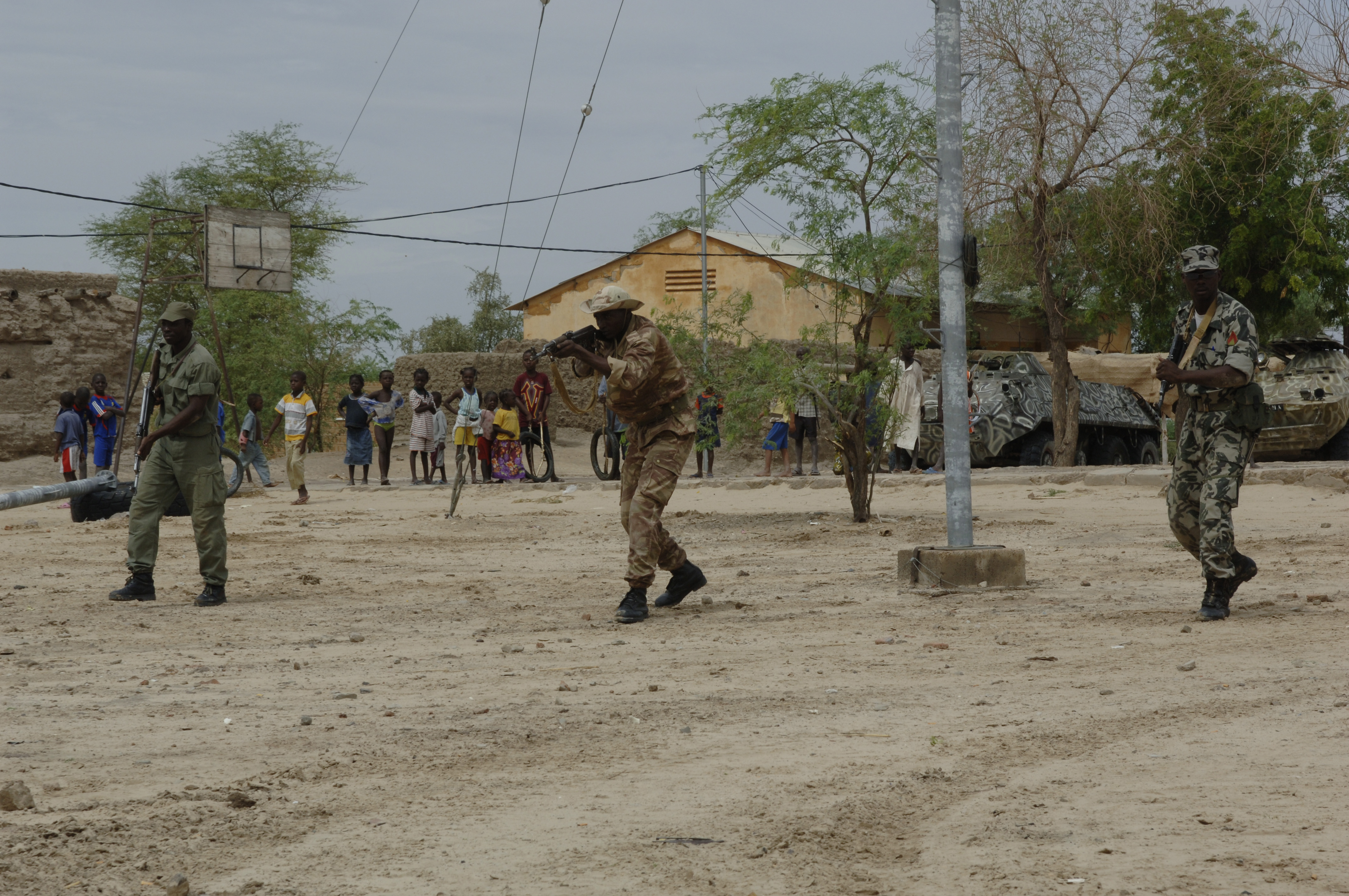
On paper, the Malian state still has a national army, security forces, aircraft, and Russian support from Africa Corps. On the ground, in certain localities of Bandiagara, it is the traditional dozo hunters who hold the front line. The fighting reported on May 21 directly opposed them to the jihadists. A dozo leader interviewed by RFI lamented the army's lack of response; Bamako had not issued any official statement regarding these attacks at the time of the first reports.
This is where the military heart of the matter lies. JNIM does not only attack civilians or isolated militias. It punishes villages that refuse its local agreements and that host dozo bases. It imposes a brutal alternative: accept a form of neutrality under duress, or become a target. This is not a classic conquest. It is administrative control through fear.
From experience, an army can lose a locality without immediately losing the war. But when it allows entire villages to negotiate alone with the enemy, it loses something more valuable: the belief that its presence will change the survival calculations of the inhabitants. In the Bankass-Bandiagara-Mopti loop, this doubt circulates quickly, often faster than military columns.
The continuity of the May massacres
The attack on May 21 does not occur in a vacuum. In early May, jihadist attacks in the same large area had already caused more than fifty deaths according to sources cited by RFI. Le Monde reported that between May 6 and 8, at least 70 people had been killed in villages in central Mali. On May 7, the Associated Press was already reporting deadly attacks against two villages in the center, against a backdrop of escalating violence following the national offensive on April 25.
The sequence is therefore readable. After striking Bamako, Kati, Gao, Sévaré, and other strategic points on April 25 with the tactical support of the Azawad Liberation Front, JNIM returns to exert local pressure in the center. The capital faces the threat of a road blockade; the North sees Kidal and Tessalit become symbols of retreat for Bamako; the center, meanwhile, absorbs daily punishment. This is the old Malian geography: announcements are made in Bamako, but the war is measured between the paths, the burned granaries, and the deserted markets.
The choice of Bandiagara is also political. The Dogon country has become for years an area where self-defense, community reprisals, and the absence of the state mutually feed each other. JNIM exploits this gap with a constant method: isolate the villages, identify local armed relays, then propose agreements that resemble peace because they reduce fighting for a few weeks. In reality, these agreements shift sovereignty.
Bamako and Africa Corps facing a war too broad
Since the death of General Sadio Camara in the attacks of April 25, Assimi Goïta has combined the presidency and the Ministry of Defense. This accumulation can give an image of control, but it mainly reveals the scarcity of men capable of holding the system. Sources from Le Monde describe a weakened regime, a capital under pressure, and nearly 200 additional Russian soldiers arriving in Bamako in early May, in addition to those already present.
The problem is not just the number of soldiers. A Russo-Malian column can escort tankers to Bamako, hold an airport, or reinforce an axis. It cannot be simultaneously in Kati, Anéfis, on the road to Ségou, in the villages of Bankass, and in every hamlet where JNIM sends ten motorcycles and a few armed men. The Sahel does not lack staff maps; it lacks continuous presence.
This overload explains why the dozos remain indispensable despite all the risks they entail. For Bamako, they provide local depth to an army that is too stretched. For JNIM, they offer a politically useful target: by striking the dozos, the group can present its offensive as a fight against militias accused of abuses, while terrorizing the villages that refuse its authority.
The operational risk of the coming weeks
The available intelligence remains partial. The tolls vary, Malian authorities communicate little, and several local accounts cannot yet be independently verified. But the trend is clear enough: JNIM now combines three simultaneous pressures. It threatens access to Bamako, accompanies or exploits rebel gains in the North, and imposes village-by-village negotiations in the center.
For Malian forces, the immediate danger is not a straight jihadist march on Bamako. This scenario attracts headlines, but it poorly describes the observed tactics. The most serious danger is a layered strangulation: roadblocks, attacks on recalcitrant villages, civilian flight, exhausted local militias, and then the return of JNIM as the arbiter of security and markets.
The next area to watch is the Bankass-Bandiagara-Mopti axis, with its secondary paths towards Burkina Faso. If the villages that have refused local agreements do not receive credible protection quickly, others will follow the same path as Logo, Soulakanda, Dimbal, Ogossagou, and Kouroundé. On the ground, a promise of reinforcements that arrives after the burial is not worth a section present before the first shot is fired.
Sources
- RFI via PressAfrik, May 23, 2026, on the attacks claimed by JNIM near Bandiagara.
- AFP via The Standard and NAMPA, May 22, 2026, on the toll of at least 25 dead in five villages.
- Le Monde, May 13, 2026, on the weakening of the Malian junta after the attacks of April 25.
- AllAfrica and Centre4S, May 25, 2026, on the jihadist expansion of the Sahel towards the Gulf of Guinea countries.
JNIM launched attacks on five villages in Mali on May 21, 2026, resulting in at least 25 deaths and numerous injuries. The villages of Logo, Soulakanda, Dimbal, Ogossagou, and Kouroundé were targeted, with reports of destruction and livestock theft. Local dozo hunters faced jihadists directly, highlighting the absence of a timely military response from the Malian army. This incident is part of ongoing violence in the region, exacerbating local tensions and displacement.
- JNIM attacked five villages in Mali, resulting in at least 25 deaths.
- The attacks occurred on May 21, 2026, between 5 PM and 6 PM.
- Villages were burned, and livestock was stolen, impacting local survival.
- The Malian army's response was criticized for its absence during the attacks.
- The attacks are part of a broader pattern of violence in the region.