
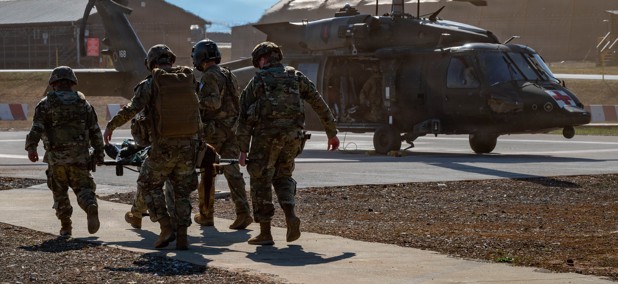
As the Pentagon finalizes its review of U.S. force posture in Europe, one relatively small commitment deserves protection from the budget axe: the roughly 600 American troops serving in NATO’s Kosovo Force. They barely register in a debate about brigades and billion-dollar line items, but they keep a hard-won peace in the Balkans, and pulling them out would save almost nothing while handing Moscow a cheap strategic win.
KFOR was deployed in June 1999 under NATO command, after the alliance bombed Yugoslavia to stop the violence perpetrated by Slobodan Milosevic’s Serbian forces against ethnic Albanians. Kosovo declared independence in 2008, but Serbia, backed by Russia and China, still refuses to recognize it.
The Europe posture review is a legitimate exercise. After years of urging European allies to shoulder more of their own conventional defense, the Trump administration is right to ask hard questions about where American forces add unique value and where Europe can step up given suitable time to develop their capabilities and capacities. But KFOR is a mission in which the American role is not easily replaced, because it is as much political as military, and where a wrong call risks instability on Europe’s southeastern flank.
Start with the threat. Even while absorbing heavy losses in Ukraine, Vladimir Putin has not given up on destabilizing Europe. The Balkans, Europe’s soft underbelly, are a favored arena: cheap to stir, a place to distract Western attention from Ukraine. Moscow has long used Serbia as a lever against Kosovo’s stability. In 2017, a Russian-made train was sent toward northern Kosovo, a rolling provocation that bore the slogan “Kosovo is Serbia.” Russia runs a so-called humanitarian center near Kosovo that is suspected of serving as a Russian intelligence station. Close Serbian-Russian intelligence ties give Moscow access to local nationalist forces prepared for provocations. In 2023, an armed attack on Kosovo police in the north, which Pristina blamed on Serbian-backed militants, heightened fears that Russian-aligned actors were exploiting the tension; earlier that year, Russia’s Minister of Foreign Affairs warned that “a major explosive situation is brewing in the heart of Europe.”
Tensions have repeatedly flared. In May 2023, clashes between Serb protesters and Kosovo police injured more than 90 NATO peacekeepers and prompted Serbia to raise its military alert level. That September, an attack in Banjska, where heavily armed Serb gunmen killed a Kosovo police officer and barricaded themselves in a monastery, showed how quickly a local flare-up can become a regional crisis.
The danger has not passed. Serbian strongman Aleksandar Vucic conceded defeat in Serbia’s Oct. 25 parliamentary election, but Belgrade’s foreign-policy direction is uncertain and there are concerns that its views on Kosovo will not change. In October, Russia’s ambassador to the UN warned that the situation in Kosovo “remains persistently tense and is literally teetering on the brink.”
Still, Kosovo and Serbia have remained at peace since 1999, in large part because of KFOR. In the words of a bipartisan group of U.S lawmakers, the force functions as “a political deterrent to those seeking to stoke ethnic violence.” An American drawdown from KFOR may embolden nationalist agendas in Kosovo and Serbia as well as separatist ambitions in Republika Srpska, the Serb-dominated region in nearby Bosnia.
The American presence in KFOR is valued precisely because it is American. U.S. troops have anchored KFOR since its creation, and Washington currently leads Regional Command East, a position of real operational weight, not symbolism. The U.S. has traditionally provided the 600 or so American troops—often Army National Guardsmen—an economy-of-force mission with minimal cost or effect on the U.S. Army’s ability to execute missions elsewhere around the globe. The mission accounts for less than 1 percent of the total U.S. troops in Europe.
KFOR’s value becomes plain when contrasted with Operation Althea in neighboring Bosnia. EUFOR, an EU-led force with roughly 1,500 troops, has struggled to respond decisively to repeated provocations by Republika Srpska leader Milorad Dodik, who’s backed by Moscow and Belgrade. EU ambassadors rejected Bosnian appeals to help enforce an arrest warrant against him in 2025, citing political risk. Dodik has openly mocked EUFOR’s patrols. Lacking an American anchor and a unified chain of command willing to act, EUFOR has too often had to manage crises rather than deterring them.
KFOR, by contrast, has demonstrated it can surge forces when tested, providing genuine deterrence. After the 2023 Banjska incident, NATO increased its peacekeeping presence in Kosovo. Serbia drew down its border deployment, ending the crisis.
The Pentagon is right to ask what the value of an American military presence is worth. For KFOR, the answer is plain: a few hundred U.S. troops are successfully maintaining a quarter-century-long peace that Russia would love to see unravel. Lawmakers from both parties already understand that. The Pentagon should, too, and keep KFOR intact.
Mark Montgomery, a retired U.S. Navy rear admiral, serves as a senior director at the Foundation for Defense of Democracies’ (FDD), where Ivana Stradner is a research fellow.
The U.S. maintains approximately 600 troops in NATO's Kosovo Force (KFOR) to uphold peace in Kosovo, a mission critical since its inception in June 1999. Tensions in the Balkans, exacerbated by Russian influence, pose risks of destabilization, making the American presence vital for regional stability. Recent incidents have underscored the ongoing threats to peace, reinforcing the need for continued U.S. involvement in KFOR.
- The U.S. maintains approximately 600 troops in NATO's Kosovo Force (KFOR).
- KFOR has been crucial in maintaining peace in Kosovo since its deployment in 1999.
- Tensions in the Balkans are influenced by Russian support for Serbia against Kosovo's independence.
- Recent incidents have highlighted the potential for conflict in the region, including attacks on Kosovo police.