
Kopre Mountain in Adamawa — 21 jihadists killed but Boko Haram still stretches the Nigerian front in 2026
 Marie Dubois
Kopre Mountain in Adamawa — 21 jihadists killed but Boko Haram still stretches the Nigerian front in 2026
On August 27, in the mountainous area of Kopre, north of Hong in Adamawa State, the Hadin Kai operation struck a camp presented by the Nigerian army as a stronghold of Boko Haram and ISWAP. The military's reported toll speaks of more than 21 fighters killed, two successive clashes, and the destruction of a logistics depot containing motorcycles, bicycles, jerrycans of fuel, assault rifles, and ammunition. Tactically, the raid is clear-cut. Strategically, it tells a different story: the insurgency is no longer just surviving in the classic Lake Chad corridor; it continues to seek deeper pockets further southwest, where the terrain, secondary roads, and border communities offer useful retreats.
This is what needs to be observed. Not just the death toll, which is impossible to independently verify at this time, but the geography of the operation.
A real but local military success
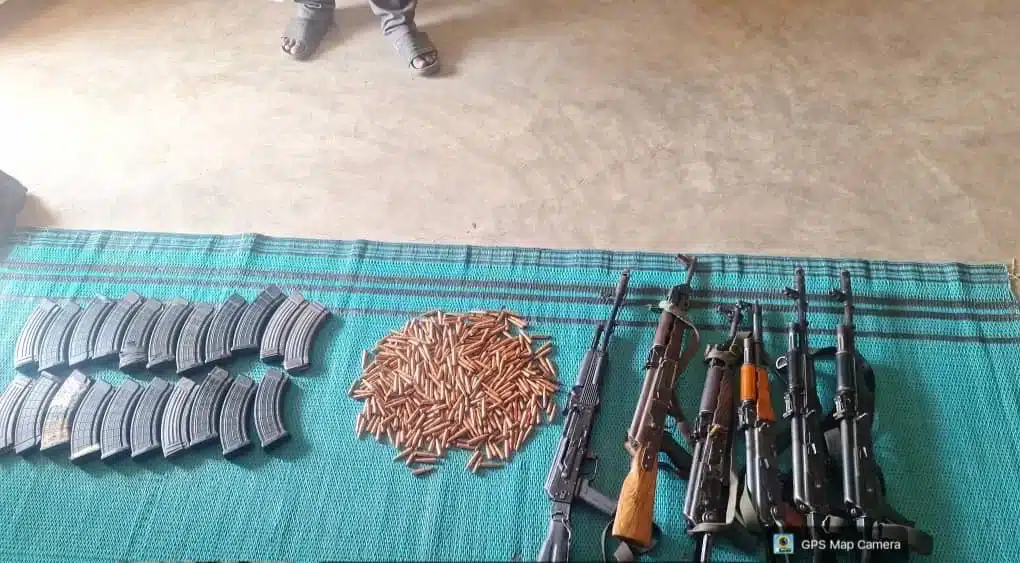
According to Captain Mohammed Goni, spokesperson for the Joint Task Force North East, the assault was prepared based on credible intelligence regarding jihadist activities in the Kopre Mountain area. Elements of the ONSA Tactical Team supported the Hadin Kai troops, with the engagement of soldiers recently assigned to the 226th battalion in sector 4 of Adamawa. The detail matters: when an army deploys new units in difficult terrain, it indicates that it believes the adversary is using the space as a sanctuary, not just as a transit zone.
- Two armed contacts were reported during the raid.
- The military claims to have regained immediate control of the camp and destroyed its logistical infrastructure.
- The seized equipment indicates light mobility, typical of groups that rely on dispersion, raids, and opportunistic resupply.
In other words, we are not facing a heavy base comparable to the large island strongholds of Lake Chad. We are looking at an advanced node, likely designed to hide men, store fuel, prepare kidnappings, and launch short movements before retreating.
Why Hong and Kopre matter more than their size
Hong is not Maiduguri. This is precisely why the situation deserves attention. Borno State remains the historical heart of the insurgency, but the operational interest of Adamawa lies in its margins: the hills, the paths, the small connections to Askira-Uba, Mussa, and Lassa, and the porosity between administrative zones that political maps suggest are impermeable. On the ground, they are not.
Marie Dubois would write that a modest mountain in northern Adamawa often holds more value than a presidential speech in Abuja. From such a terrain, one can observe approaches, quickly disperse motorcycles, hide fuel, and protect hostages without needing to hold a town. For a guerrilla that does not need to occupy for long to exert influence, this is sufficient.
The fact that the operation is officially linked to the search for individuals kidnapped in Mussa and along the Lassa axis reinforces this interpretation. The mass kidnappings in the spring and early summer in southern Borno were not just acts of social terror. They also revealed the existence of still-functional retreat corridors in this pivotal area between Borno and Adamawa.
The issue is not just Boko Haram, but the mechanics of sanctuary
Local reports use the labels Boko Haram and ISWAP interchangeably. Caution is warranted. We do not yet know if the targeted camp belonged to a cell clearly affiliated with ISWAP, Boko Haram's JAS version, or an opportunistic cooperation between criminal and jihadist networks. The uncertainty is not a detail; it changes the doctrinal reading. However, whether affiliated or not, the observed logic remains the same: low signature, mobility on two wheels, dispersed storage, and use of terrain to compensate for firepower inferiority.
The regional context supports this. According to the Africa Center for Strategic Studies, the Lake Chad basin has recorded an annual increase in jihadist lethality, while Al Jazeera noted in May that Boko Haram has partially reconstituted itself while security attention focused on ISWAP and its more sophisticated capabilities. When one faction attracts drones, the other recaptures forgotten villages. This is an old law of these theaters.
We find here a classic signature of Sahelian and northeastern Nigerian insurgencies: regular forces gain engagement but still struggle to permanently close off space after engagement. Destroying a camp is one thing. Holding the paths, protecting rural schools, and preventing the return of kidnappers is another.
What the raid says about Nigeria in 2026
The interest of this operation is therefore not to prove that the army has regained the initiative everywhere. It is to show where the pressure must be applied. If Abuja sends reinforcements and tactical teams to Kopre Mountain to find civilians kidnapped several weeks or months earlier, it indicates that part of the problem has shifted to intermediate spaces, less visible than Lake Chad but no less dangerous.
The most concerning figure may not be 21. It is the 42 children kidnapped in Mussa in May, then the dozens of students and teachers taken in Lassa in June, several of whom were still reported missing according to testimonies relayed in July and August. An insurgency that can still repeatedly kidnap schoolchildren and then hold captives long enough to impose silence on families retains a social and territorial depth. Even when it loses a camp.
In this type of war, the destruction of a refuge only counts as a victory if the road, the market, and the school reopen behind the soldiers.
The next test will be permanence
The raid on Kopre Mountain is therefore a good tactical news for the Nigerian army, but a conditional good news. If the pressure eases, the groups will return in fragments, with fewer men but the same motorcycles, the same jerrycans, and the same ability to slip between Adamawa and southern Borno. The upcoming season, with more passable routes and exhausted rural communities, will again favor this type of mobility.
The sector to watch is not just Maiduguri. It is the string of Hong-Lassa-Askira-Uba-Mussa, this border where intermittent state presence is enough to allow a sanctuary to be reborn. It is here that Nigeria will know if Kopre was the beginning of a lockdown or simply another strike in a mountain that learns too quickly to be silent.
On August 27, 2026, the Nigerian Army's Hadin Kai operation killed 21 jihadists at Kopre Mountain in Adamawa. The military engaged in two armed confrontations and destroyed a logistical depot containing motorcycles, bicycles, and weapons. This operation highlights the ongoing insurgency's expansion into southern Adamawa, indicating a shift in jihadist tactics and operational geography.
- 21 jihadists killed during the operation
- Two armed engagements reported
- Logistical depot destroyed, including motorcycles and weapons
- Operation linked to credible intelligence on jihadist activities
- Focus on the geographical significance of the operation in Adamawa