
Kuwait Airport Attack 2026 Drives IBCS Worth $2.5 Billion to the Heart of Gulf Defense
 Ahmed Al-Rashid
The 2026 Kuwait Airport Attack Drives IBCS Worth $2.5 Billion to the Heart of Gulf Defense
On June 3, 2026, Kuwait was no longer reading the Iran War from a distant operations room. The strike that hit Kuwait International Airport, killing one person and injuring dozens, according to reports from Reuters and the Associated Press, transformed the air defense question from a matter of missile procurement to a matter of command and control. This is not a technical detail. When drones hit a civilian passenger building while the U.S. Central Command claims it intercepted several Iranian threats in the region, the failure lies in the decision chain, not just in the launch tube.
Here, the $2.5 billion deal for Kuwait to acquire the Integrated Battle Command System gains its true meaning. The United States approved in May an emergency package worth $8.6 billion for Israel, Qatar, Kuwait, and the UAE, which included Patriot missiles for Qatar, APKWS for Israel, Qatar, and the UAE, and IBCS for Kuwait. However, the airport attack made the Kuwaiti part of the package more significant than its financial size. Kuwait needs not only more interceptions but also an operational mind that connects radars, launchers, and warning centers into a single picture.
From Patriot Missile to Decision Network
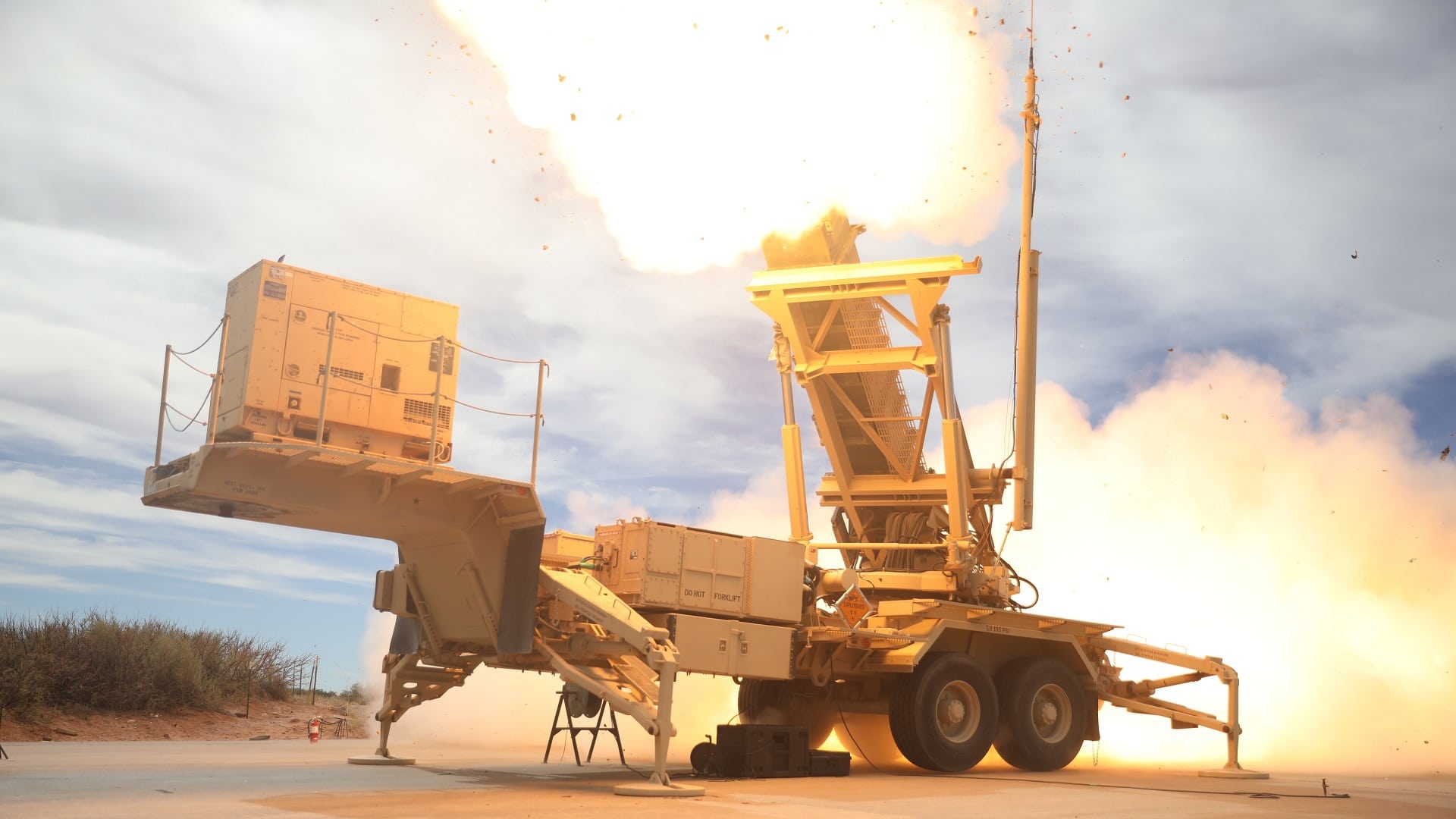
Militarily, the common mistake in the Gulf is to view air defense as a shopping list: Patriot here, THAAD there, long-range radar at an American base, and a short-range battery near an oil facility. This thinking is valid for official pictures, but it does not hold up long against a composite attack of drones, ballistic missiles, cruise missiles, and time-sensitive alerts. IBCS was originally designed to break these separate islands. Its value is not in being a new missile, but in allowing a sensor somewhere to direct a weapon elsewhere without the entire system being a prisoner of its old control center.
The notification of the deal, as reported by Breaking Defense, mentions six separate engagement operation centers and two hosted centers within the Kuwaiti package. These are small numbers compared to the number of missiles fired in a major war, but they are significant if we understand them as a shift in mindset. Kuwait, which relies on Patriot and a heavy American presence at Ali Al-Salem and Camp Arifjan and other support facilities, needs to reduce the time between detection, classification, and the order to fire. Every second here equals the difference between a drone falling in an open area and a drone hitting a passenger terminal.
The Attack Revealed a Political Problem Before a Technical One
The Iranian message was not directed solely at Kuwait. Anwar Gargash, the diplomatic advisor to the UAE president, stated that the attack does not target one country but all Gulf states. This sentence is the essence of the matter. Tehran strikes a point in Kuwait or Bahrain, but it tests the decision-making of Riyadh, Abu Dhabi, Doha, and Muscat before testing the capabilities of the batteries. Will the Gulf respond as a single system, or will each country continue to negotiate its risk ceiling individually?
In my view, Kuwait is the most troubling link in the Iranian calculation because it combines three elements: an important American base, a small geographical area, and a civilian space that cannot afford repeated closures. Hitting Kuwait International Airport is not like hitting a military site in the desert. The airport is an economic and symbolic artery, and striking it tells the average Kuwaiti that the war they heard about in the news is now at the door of travel, work, and returning home. Here, Tehran succeeds in shifting the pressure from the general to the citizen.
However, we must not confuse media success with military success. If the Iranian goal is to force Kuwait to expel or restrict the American presence, that is a difficult bet. The history of the Gulf indicates that fear of Iran often drives small countries closer to Washington rather than away from it. The difference this time is that Washington itself is asking its partners to accept higher risks while selling them urgent solutions. This is a profitable equation for the arms industry, but it is not necessarily a complete security recipe.
The $8.6 Billion Deal Is Not a Unified Gulf Architecture
The emergency American package looks massive on paper: about $4.01 billion for Qatar to replenish Patriot systems, $2.5 billion for Kuwait for the IBCS, nearly $992.4 million for Israel in APKWS, another deal for Qatar of the same value, and $147.6 million for the UAE. The problem is that this package does not constitute a unified Gulf air defense. It is four or five rapid bilateral deals, each with a prime contractor, operational logic, and political calculations.
Practically, Kuwait can own IBCS and still lack an IBCS culture. The system requires data sharing, rules of engagement, crew training, and clear authorities when there is jamming or conflict between an American alert, a Kuwaiti alert, and an alert from a Gulf neighbor. Any military officer who has served in the region knows that the hardest thing is not buying the radar, but convincing institutions to trust the information coming from another operations room. In the Gulf, sovereign sensitivity is sometimes stronger than operational logic.
Therefore, the question after the airport strike is not whether Kuwait buys enough, but whether it can turn the purchase into a living command system. IBCS could be an important start, especially if followed by Saudi Arabia and the UAE with similar systems or integrative links. However, if Kuwait remains alone trying a new standard while the rest of the countries stay within the traditional Patriot structure, we will end up with a new layer of complexity instead of a new layer of protection.
What to Watch for in the Coming Weeks
- The speed of converting U.S. approval into an actual contract and delivery schedule, as political approval does not mean the equipment will arrive in Kuwait.
- Whether the Kuwaiti package will include connections with American and regional radars or remain within Kuwaiti borders only.
- The reaction of Saudi Arabia and the UAE, and whether they will follow Kuwait on the IBCS path or prefer different command and control solutions.
- The stock of PAC-3 MSE and PAC-2 missiles in the Gulf, as the density of attacks makes ammunition, not the platform, the choke point.
In conclusion, the Kuwait airport strike did not prove the failure of Patriot, nor did it decisively prove Iran's military success. However, it demonstrated that Gulf air defense cannot remain a collection of valuable batteries operating with separate minds. The old military adage says that a weapon that does not see the complete picture fires late or in the wrong place. Kuwait now faces a painful opportunity: to make the strike a reason to build a real decision network, or to settle for purchasing a new system added to a long archive of excellent equipment that operates without a common doctrine.
Main Sources
- Defense News and Reuters, June 3, 2026, Gulf tensions escalate as Iran hits Kuwait, US strikes near Hormuz.
- Associated Press, June 3, 2026, Kuwait says Iranian drones hit airport and killed 1 as ceasefire is tested again.
- Breaking Defense, May 4, 2026, US clears $8.6 billion arms sales to Middle East countries.
- ISC Defence Intelligence, May 4, 2026, State Department emergency FMS authority for Patriot APKWS and IBCS sales.
- Gulf News, June 3, 2026, Anwar Gargash calls for unified GCC position against repeated Iranian attacks.
Iranian drones attacked Kuwait International Airport on June 3, 2026, killing one and injuring dozens. The incident has prompted Kuwait to reconsider its air defense strategy, particularly the acquisition of the Integrated Battle Command System (IBCS). This attack highlights the broader implications for Gulf security and the need for a unified response among Gulf states against Iranian threats.
- Iranian drones attacked Kuwait International Airport on June 3, 2026.
- One person was killed and dozens were injured in the attack.
- The incident raised concerns about air defense capabilities in the Gulf region.
- Kuwait is seeking to enhance its air defense with the Integrated Battle Command System (IBCS).
- The attack is seen as a test of regional responses to Iranian aggression.