
Liaoning Aircraft Carrier's Exercises in the Western Pacific Strengthen Denial Capabilities: How Far Is the PLA Carrier Group from Actual Combat?
 Li Minghui
Liaoning Aircraft Carrier's Exercises in the Western Pacific Strengthen Denial Capabilities: How Far Is the PLA Carrier Group from Actual Combat?
On November 10, Taiwan's defense department disclosed that the PLA's Liaoning aircraft carrier group and other naval forces have recently conducted training with a regional denial nature in the Western Pacific. The significance of this news lies not in the fact that "the Liaoning has gone to sea" itself, but in the training location and mission direction: the carrier group has begun to be included in operational simulations in the air and maritime areas east of Taiwan. It is important to emphasize that current public information does not prove that live-fire attacks were conducted during the exercises, nor does it provide details on the complete formation, the number of aircraft, or specific routes.
What Does the Liaoning's Presence East of Taiwan Mean?
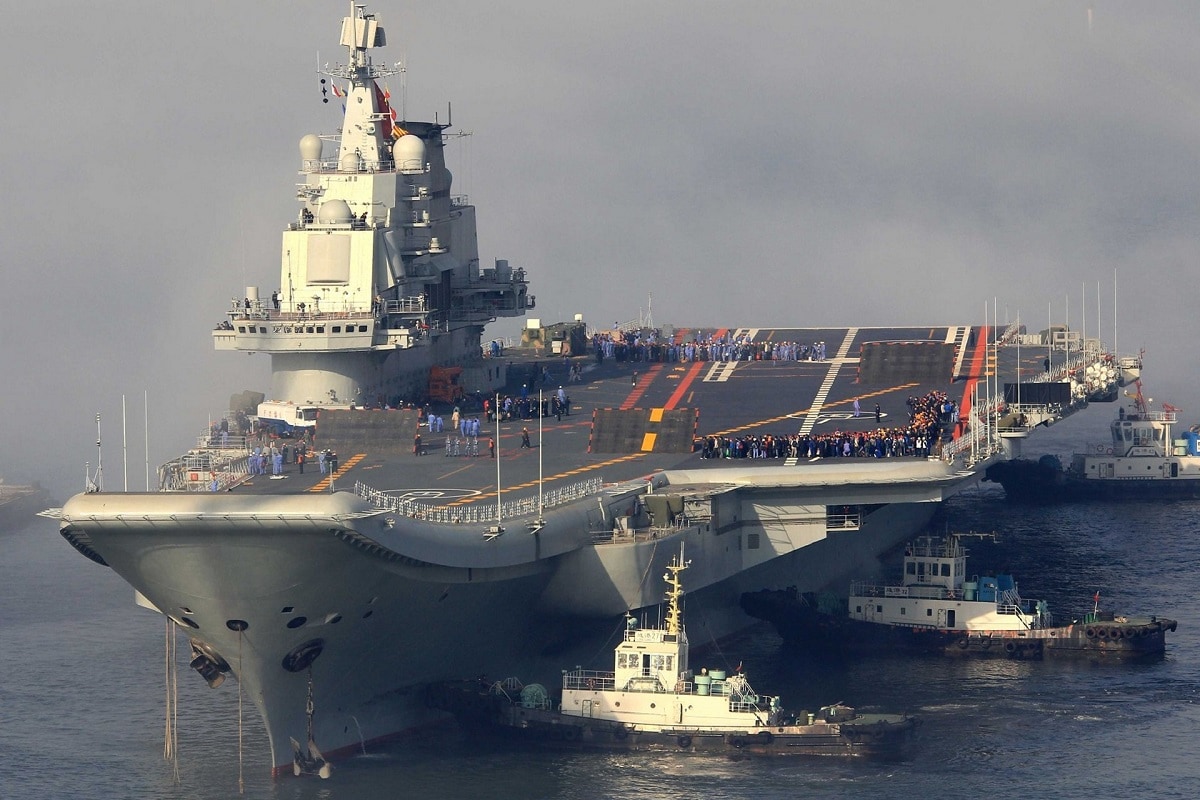
In past discussions about the Taiwan Strait conflict, attention has typically focused on the Taiwan Strait and the western side of the island. The Liaoning's activities in the Western Pacific expand the issue to the reinforcement routes east of Taiwan. Theoretically, carrier aviation, escort vessels, and land-based long-range firepower can create reconnaissance and air defense pressure from multiple directions, forcing Taiwan and external intervening forces to allocate more early warning aircraft, fighter jets, and surface vessels to monitor maritime maneuvering targets.
This falls under "regional denial," not simply a blockade. Anti-access aims to prevent external forces from reaching the battlefield, while regional denial continues to restrict their maneuverability and combat efficiency once they have entered. For the PLA, the most realistic use of the carrier group may not be to undertake the main offensive alone, but rather to serve as mobile aviation and sensor nodes, in conjunction with land-based missiles, long-range aviation, submarines, and maritime police forces, transforming the area around Taiwan into a more complex multi-axis battlefield.
Three Aircraft Carriers Change Training Scheduling
The Liaoning and Shandong carriers still use ski-jump takeoff, with the main carrier-based aircraft being the J-15 series; the Fujian carrier, on the other hand, employs electromagnetic catapults, theoretically allowing for more flexible use of heavier carrier-based aircraft and providing development space for platforms like the J-35 and KJ-600. After the Fujian is commissioned in November 2025, the Chinese Navy will nominally have three active aircraft carriers, but "three carriers in service" does not equate to "three mature battle groups" capable of simultaneously executing high-intensity operations.
- The main advantage of the Liaoning is its accumulated experience in long-range navigation and carrier-based aircraft coordination;
- The Shandong provides a second ski-jump carrier training platform, improving rotation and maintenance arrangements;
- The core challenge for the Fujian is whether the catapult, carrier-based aircraft, and formation command system can work together stably.
In simple terms, the primary benefit of having three aircraft carriers is not a threefold increase in combat power on paper, but rather greater training flexibility. As long as one is under maintenance or modification, the other two can still undertake training and deployment tasks. This is crucial for establishing a sustained presence in the Western Pacific, but there remains a gap to true long-range aerial combat, which involves sortie rates, spare parts support, pilot training, and command and control in complex electromagnetic environments.
The Real Shortcoming Is the System, Not the Hull
What the U.S. and Taiwan are currently most concerned about is not whether the Liaoning can reach a certain maritime area on the map, but whether it can continuously generate effective sorties over several days or even longer, and connect early warning, fighter jets, escort vessels, and land-based sensors. The mere presence of an aircraft carrier does not automatically equate to air superiority or maritime control.
The author believes that there is an easily overlooked misinterpretation of this training: equating "regional denial training" directly with "the PLA has already developed mature capabilities to blockade Taiwan." Public information is still insufficient to support this conclusion. Whether the training included joint service target designation, sustained sorties of carrier-based aircraft, and long-range resupply currently lacks clear answers. For the PLA, what is more worth observing next is not the Liaoning's reappearance, but when the Fujian can form a stable grouping with the J-35 and KJ-600, and whether the three aircraft carriers can maintain continuous rotation in different maritime areas. These details will determine whether the presence of aircraft carriers in the Western Pacific is merely a display or a sustainable combat capability.
Sources and Information Boundaries
Main sources: Reuters, November 10, 2026; statements from Taiwan's defense department; Army Recognition, compiled on November 18, 2026; ISW "China & Taiwan Update," November 13, 2026. The specifics of the exercise's formation, live-fire usage, and outcomes await confirmation from public information.
The Chinese aircraft carrier Liaoning and other naval forces conducted area denial training exercises in the western Pacific on November 10, 2026. This training is significant as it involves operational scenarios near Taiwan, expanding the focus beyond the Taiwan Strait. The exercises aim to enhance the operational capabilities of the People's Liberation Army Navy, although no live-fire activities were confirmed.
- The Liaoning carrier group conducted area denial training in the western Pacific.
- The exercises involved the Liaoning, Shandong, and Fujian aircraft carriers.
- No evidence of live-fire exercises was reported.
- The training aims to enhance operational capabilities against Taiwan.
- The report emphasizes the importance of continuous naval presence in the western Pacific.