
Liaoning Aircraft Carrier's June Training in the Western Pacific Evades Japanese Cameras, PLA's Far-Sea Surveillance Pressure Increases
 Li Minghui
Liaoning Aircraft Carrier Conducts Training in the Western Pacific in June, Eluding Japanese Surveillance; PLA Navy's Pressure on Maritime Monitoring Chain Increases
What caught my attention this time is not that the Liaoning aircraft carrier has gone to the Western Pacific again, but a small detail: Chinese reports indicate that the Japanese Ministry of Defense did not release clear photos of the Liaoning carrier group as it has in the past while tracking it, and public records have shifted more towards trajectory maps, takeoff and landing counts, and textual descriptions. This statement carries a clear propaganda tone and should not be simply interpreted as a failure of the Japanese reconnaissance system. However, from a military technology perspective, it at least indicates one thing: the PLA Navy's aircraft carrier group is increasing the cost of continuous surveillance for its opponents during its operations in distant seas.
The Real Issues Behind the Lack of Photos
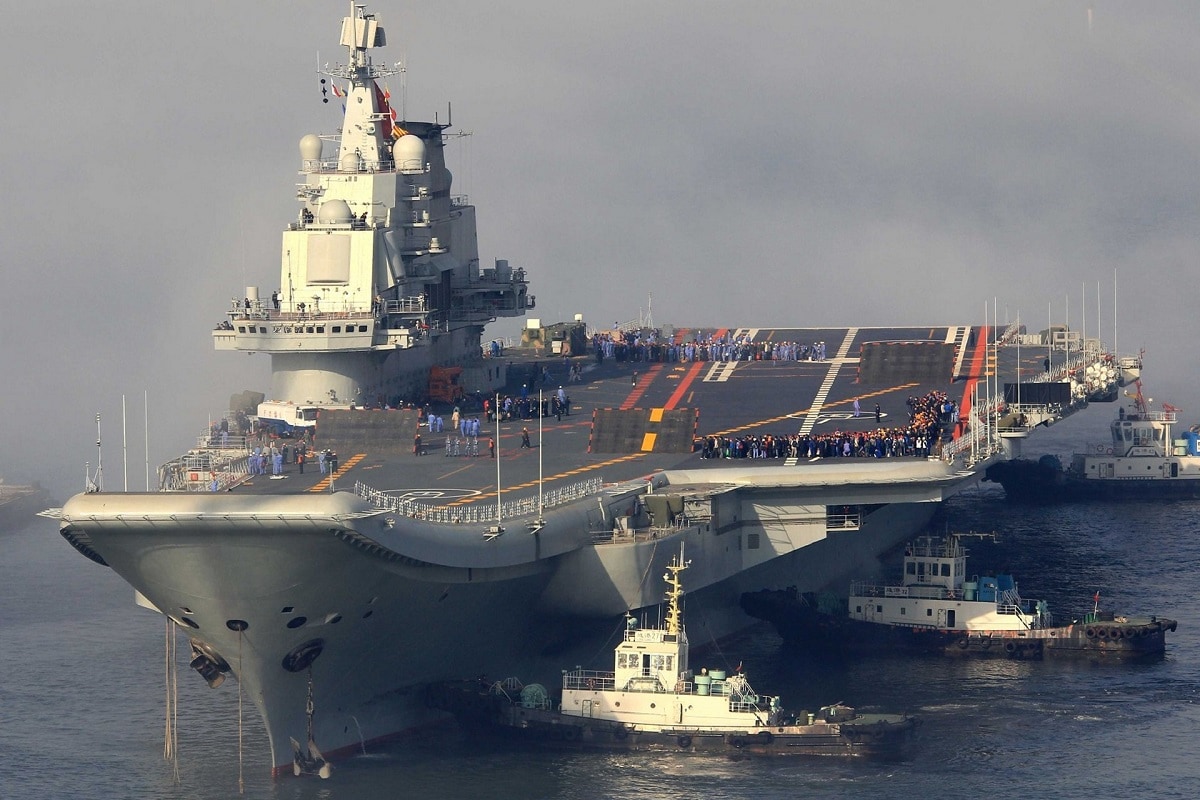
According to CCTV Military Comprehensive CCTV-13, the Liaoning aircraft carrier group recently completed training in distant seas, during which the Japanese side conducted continuous tracking and monitoring of the group, but the number of clear photos in public materials has significantly decreased. The Chinese side explains this by citing enhanced group system capabilities, improved electronic countermeasures, and the elongation of the Japanese monitoring chain after entering the more open waters of the Western Pacific. I believe the first two points should be viewed with caution, while the third point is closer to the essence of the issue.
The Japan Maritime Self-Defense Force's monitoring of Chinese vessels excels in fixed channels such as the Miyako Strait and the Bashi Channel. Once vessels enter these narrow waterways, land-based radars, P-1 patrol aircraft, P-3C, frigates, and intelligence links can form a relatively stable relay. However, once the carrier group passes through these channels and enters the open waters of the Western Pacific, the problem becomes another engineering question: how many aircraft sorties, how much vessel operating time, and how many satellite windows are needed to ensure that targets are not lost and can be approached to a distance suitable for photographic identification.
The Liaoning Carrier Group is No Longer Just a Single Ship Training
This is also the most significant change in the Liaoning in recent years. In the early days, the outside world was more concerned about whether the J-15 could take off and land safely, what its sortie rate could reach, and how much the ski-jump deck limited it. These issues still exist, but the training focus has clearly shifted to the group system. Chinese reports mention coordinated training involving the aircraft carrier, destroyers, amphibious assault ships, and supply ships, indicating that it is no longer just about aviation tasks, but is testing air defense, anti-submarine, anti-surface, resupply, and electromagnetic management under distant sea conditions.
- The Liaoning itself remains a ski-jump takeoff platform, and the fuel and payload of its carrier-based aircraft are limited, which is an objective shortcoming.
- The Type 055 or Type 052D destroyers provide area air defense and long-range detection, determining the quality of the outer layer of the group's protection.
- The Type 901 comprehensive supply ship determines how long the carrier group can stay in distant seas, not just how far it can go.
- Electronic reconnaissance and communication control determine whether the group can reduce the probability of being continuously located.
In simple terms, the combat capability of an aircraft carrier is not about the tonnage of a single ship, but whether a system can operate continuously. The significance of the Liaoning is not just as a training ship; it is accumulating a complete set of operational manuals for distant sea use for the Shandong and Fujian carriers. In this manual, how to make it difficult for opponents to see clearly and follow closely is as important as how to launch more J-15s.
Electronic Warfare Claims Need to Be Tempered
The Chinese reports link the reduction of Japanese photos to strong electronic warfare capabilities, which is an attractive judgment, but there is insufficient public evidence. Electronic warfare can certainly affect radar searches, communication returns, and coordinated positioning, but causing a mature maritime and aerial surveillance force to completely lose photographic opportunities is usually not achievable by a single electromagnetic suppression. A more reasonable explanation is a combination of multiple factors: the carrier group's route is more flexible, the operational sea area is farther, the available platforms for the Japanese side are thinned out, and combined with Chinese communication control and the expanded alert radius of the group, makes close visual confirmation more difficult.
This does not diminish the military value of the event. On the contrary, if it is not mythologized, it can better reveal the real progress of the PLA Navy. The Liaoning has not become a nuclear-powered aircraft carrier like the U.S. Navy's Nimitz class, and the J-15 has not escaped the limitations of ski-jump takeoff, but the maturity of the group in sustained operations in distant seas, cross-service coordination, and counter-reconnaissance is gradually improving. This change is not as striking as the launch of a new ship, but it is closer to actual combat capability.
Implications for the First Island Chain
What Japan is truly worried about is not the inability to capture one or two photos, but the change in resource consumption of the surveillance chain. In the past, when Chinese aircraft carriers passed through the First Island Chain, the Japanese side could more confidently intercept, track, and release photos in fixed channels. Now, if the Liaoning carrier group can maneuver over a larger area in the Western Pacific and conduct joint training with amphibious assault ships or surface ship groups, the Japanese side will need to expand its monitoring resources from point-based channels to area-based seas.
This has direct implications for Japan, the United States, and Taiwan. For Japan, the pressure to deploy anti-submarine aircraft, early warning aircraft, and frigates in the southwestern islands will increase; for the United States, while Chinese aircraft carriers are not yet tools for decisive battles in the open ocean, they can already create more uncertainties within the Second Island Chain; for Taiwan, the carrier group may not need to approach the island to constrain the surveillance and air defense resources in the eastern offshore.
I still believe that the Liaoning's shortcomings should not be overlooked. The ski-jump deck, conventional power, and insufficient fixed-wing early warning capabilities will all limit its high-intensity combat ceiling. However, this training in the Western Pacific reminds us that what is most worth observing in the development of the PLA Navy's aircraft carriers may not be what the next ship will look like, but whether Japan and the United States can still monitor the entire process of the Chinese carrier group from departure to return at the same low cost.
Main references: CCTV Military Comprehensive CCTV-13 reports on the Liaoning's distant sea training, long-term public vessel monitoring reports from the Japanese Ministry of Defense, and HiWars public intelligence compilations.
The Liaoning aircraft carrier group conducted training exercises in the Western Pacific in June 2023, with Japan tracking the group but failing to capture clear images. This indicates an increase in the operational capabilities of the Chinese military, as they are able to operate more flexibly and effectively in broader maritime areas. Japan's monitoring resources are being stretched as a result of these developments.
- The Liaoning aircraft carrier group completed training exercises in the Western Pacific in June 2023.
- Japan's defense ministry tracked the carrier group but released fewer clear images than before.
- The Chinese military's capabilities in electronic warfare and operational flexibility have increased.
- The Liaoning carrier group is now operating as a coordinated fleet rather than a single vessel.
- Japan's monitoring resources are being stretched as the Chinese carrier group operates in broader areas.