
Liaoning's 170th Aircraft Carrier Operations Indicate the Normalization of the Chinese Navy in the Western Pacific
 Tanaka Takashi
China's Navy Normalization in the Western Pacific Demonstrated by Liaoning's 170 Takeoffs and Landings
Approximately 590 kilometers southwest of Miyako Island. What first caught my attention regarding the position of the Chinese aircraft carrier "Liaoning," as reported by the Ministry of Defense's Joint Staff Office on June 1, was not the distance itself, but the figure indicating that around 170 takeoffs and landings of carrier-based fighters and helicopters were confirmed over the three days from May 26 to 28. An average of over 50 takeoffs and landings per day should be viewed not merely as a show of force, but as training to sustain carrier air operations for a certain period.
Composition of the Liaoning Strike Group
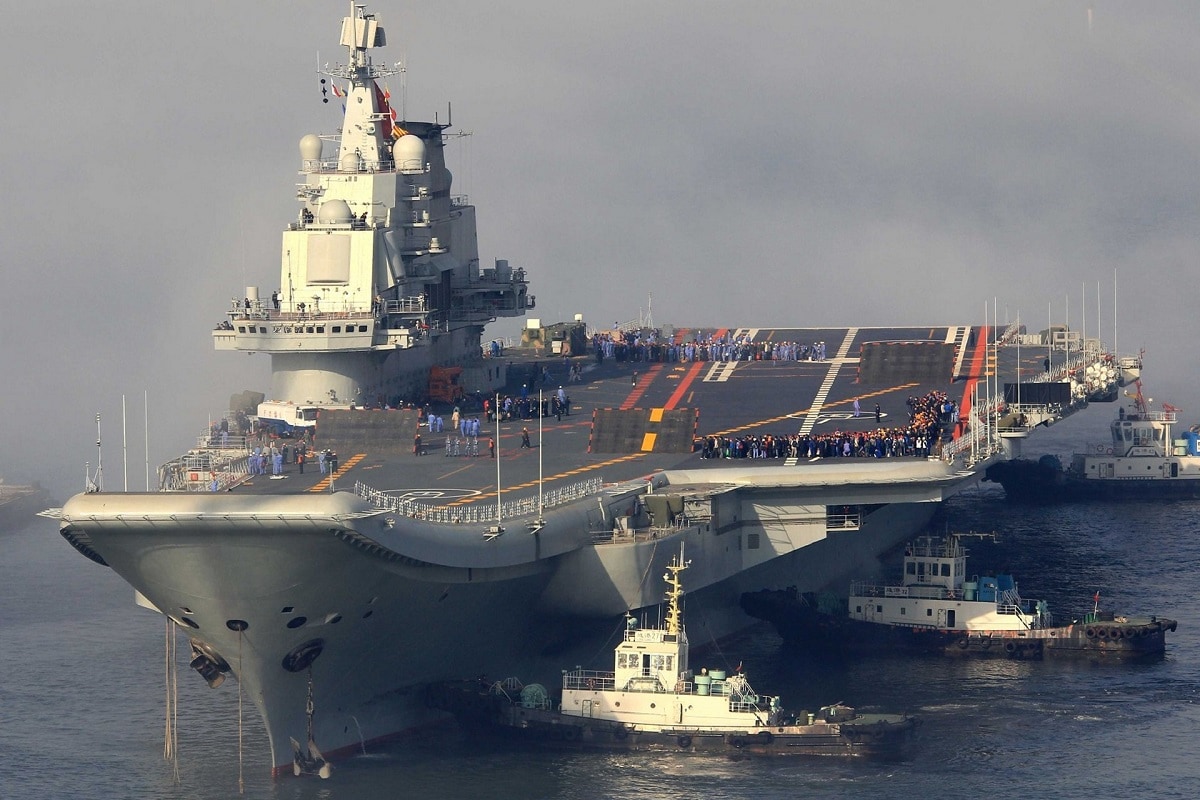
According to the Ministry of Defense's materials from May 28, the Japan Maritime Self-Defense Force confirmed five vessels, including the "Liaoning," around 880 kilometers southwest of Okinotorishima at around noon on May 25. The composition included the Kuznetsov-class aircraft carrier "Liaoning," one Renhai-class missile destroyer, one Luyang III-class missile destroyer, one Jiangkai III-class frigate, and one Fuyu-class fast combat support ship. The Jiangkai III-class 545 is believed to be the new Type 054B frigate "Luohua," which is considered to be the same vessel that passed between Okinawa and Miyako Island into the Pacific on May 19.
This formation cannot be misread by focusing solely on the aircraft carrier. The Renhai-class is responsible for long-range air defense and anti-ship strikes, the Luyang III-class serves as the core of fleet air defense, the Type 054B complements anti-submarine, air defense, and command communications, and the Fuyu-class is responsible for at-sea replenishment. In other words, this operation should be seen not merely as "the Liaoning has come out," but as confirmation of a sustained operational package centered around the aircraft carrier.
The Significance of the Number 170
The approximately 170 takeoffs and landings include both fighters and helicopters. The exact breakdown from the Chinese side is unclear, and it is prudent to treat the number of takeoffs of the J-15 fighter alone with caution. Nevertheless, this figure presents two practical issues for Japan.
- First, the Japan Maritime Self-Defense Force's escort ships and patrol aircraft must continuously record not only the aircraft carrier itself but also the frequency and direction of takeoffs and landings, the formation of escort ships, and the position of supply ships.
- Second, the line of activity extending from south of Miyako Island to east of the Philippines integrates the defense of the southwestern islands with monitoring in the Luzon Strait area.
From the perspective of the Japan Maritime Self-Defense Force, this is not a "point" approach but rather "line" pressure. The southwestern front connecting Okinawa, Miyako, Ishigaki, and Yonaguni, and the waters east of the Philippines are often treated as separate maps in peacetime. However, if the Chinese aircraft carrier continues to conduct air operations along this line, information sharing among Japan, the United States, and the Philippines must occur on the same operational map.
Temporal Overlap with Japan-Philippines Cooperation
Interestingly, the activities of the Liaoning coincided almost exactly with the acceleration of Japan-Philippines defense cooperation. On May 31, the Japanese Ministry of Defense announced that Defense Minister Koizumi and Philippine Defense Secretary Teodoro met in Singapore and reached a broad agreement on discussions regarding the transfer of decommissioned Abukuma-class escort ships and the transfer of one TC-90 aircraft within the fiscal year 2027. In early May, the Japan Ground Self-Defense Force conducted its first live-fire exercise of the Type 88 anti-ship guided missile from within Philippine territory at Balikatan 26.
There is no need to definitively ascertain China's intentions. However, if we separate capabilities from intentions, in terms of capabilities, the Chinese Navy is entering a stage where it can continue carrier air operations outside the Taiwan Strait and the East China Sea. In terms of intentions, placing a carrier strike group in waters where Japan, the U.S., and the Philippines are enhancing security cooperation exerts political pressure. Even if it is coincidental, it may appear that way to the recipients in Tokyo and Manila.
Challenges for Japan
The response Japan should take is not to possess an aircraft carrier to counter the aircraft carrier. Rather, it is to connect the anti-ship firepower of the southwestern islands, P-1 patrol aircraft, submarines, space and electronic information, and the operations of U.S. drones and bombers on the same timeline. The fact that 170 takeoffs and landings of the Liaoning were counted is a result of surveillance capability, but in a crisis, the question is what decisions will be made by which command after "counting."
It has been reported that no abnormal approaches by fighters or vessels were confirmed during this navigation. This point should be taken calmly.
There is no need to overreact. However, it is also a mistake to take it lightly. The Liaoning is not the newest aircraft carrier in the Chinese Navy, and its takeoff method is ski-jump style, which has limitations. Nevertheless, it conducted approximately 170 takeoffs and landings over three days and moved through the western Pacific accompanied by a new frigate believed to be a Type 054B. This challenges the view that "the old aircraft carrier poses a limited threat."
The real issue lies not in the combat capability of the Liaoning itself, but in the fact that the Chinese Navy is lowering the psychological threshold for routinely operating aircraft carriers across a wide area from south of Japan to east of the Philippines. Japan's weaknesses are not limited to the number of vessels. When a crisis spreads as a line, the speed of decision-making in Tokyo, Yokosuka, Naha, Manila, and Guam must align on the same line.
The Chinese aircraft carrier Liaoning conducted approximately 170 takeoffs and landings of fighter jets and helicopters from May 26 to 28, 2023, in the West Pacific, indicating a shift towards regular naval aviation operations. The carrier group, consisting of five ships, was observed southwest of Okinawa, with implications for regional security dynamics as Japan and the Philippines enhance their defense cooperation. This operational activity reflects the growing capabilities of the People's Liberation Army Navy.
- Liaoning conducted approximately 170 aircraft operations from May 26 to 28, 2023.
- The carrier group included 5 ships: Kuznetsov-class carrier Liaoning, Renhai-class destroyer, Luyang III-class destroyer, Jiangkai III-class frigate, and Fuyue-class support ship.
- The operations indicate a shift towards regular naval aviation operations in the West Pacific.
- Japan and the Philippines are enhancing defense cooperation around the same time as these operations.
- The presence of the carrier group poses a psychological pressure on regional security dynamics.