
Lockheed installs engine in Germany’s first F-35 fighter jet
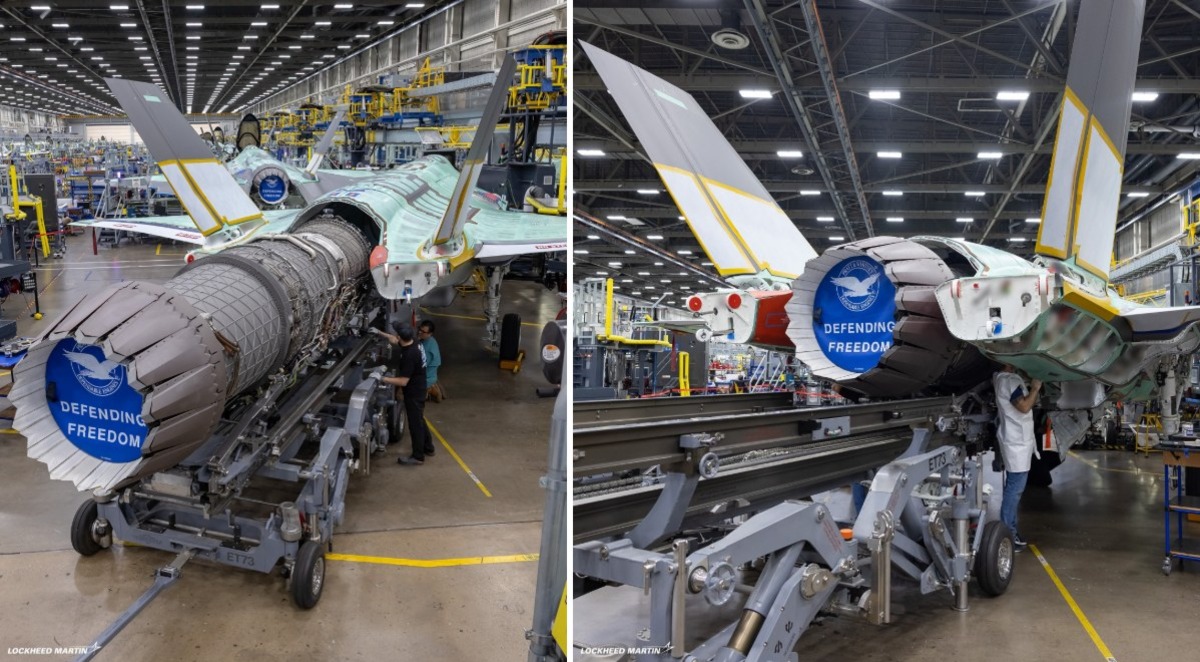
The most consequential fighter jet Germany has ever ordered just crossed a milestone that brings it meaningfully closer to the flight line. Lockheed Martin announced that the engine powering Germany’s first F-35 has been installed, confirming that the aircraft is progressing through final production and moving toward delivery of what will be Berlin’s first fifth-generation stealth combat aircraft.
Lockheed Martin Europe, the European division of the Virginia-based defense giant that builds the F-35, posted the announcement on social media, describing the engine installation as “another key production milestone on the path to delivering advanced 5th Gen capability for Germany.”
The post included photos taken on the production floor showing the aircraft with its Pratt and Whitney F135 engine, the most powerful fighter engine in the Western world, positioned for installation and then seated in the airframe.
The F135 engine at the heart of Germany’s first jet is not a component that can be sourced elsewhere or substituted. Developed by Pratt and Whitney, a division of RTX Corporation, it produces around 191 kilonewtons (43,000 pounds) of thrust in afterburner, making it the most powerful engine ever fitted to a single-engine fighter aircraft. It is also deeply integrated into the F-35’s stealth architecture, with the engine’s exhaust nozzle and inlet geometry specifically shaped to reduce the aircraft’s radar signature from the rear and front aspects. The F135 is not simply bolted in. Its installation represents the point at which the aircraft transitions from an airframe into a functioning weapons system.
Germany’s decision to buy the F-35 was one of the most significant defense procurement choices in the country’s post-Cold War history, announced in the immediate aftermath of Russia’s full-scale invasion of Ukraine in February 2022. Berlin selected the F-35A, the conventional takeoff and landing variant, to replace its aging Tornado aircraft in the nuclear sharing role, the NATO arrangement under which Germany maintains the ability to deliver American nuclear weapons from its own aircraft using its own pilots. The Tornado had been Germany’s nuclear delivery platform for decades, but the aircraft was approaching the end of its operational life and no European alternative offered the combination of stealth, survivability, and nuclear certification that the mission requires.
Germany ordered 35 F-35A aircraft in a deal valued at approximately $8.4 billion, a figure that covers not just the jets themselves but the training, logistics, simulators, weapons, and support infrastructure that a new platform requires. That order made Germany one of the most significant new F-35 customers in Europe, joining the Netherlands, Norway, Denmark, Belgium, Italy, Poland, Finland, and Switzerland in a growing bloc of NATO allies operating or committed to operating the aircraft. The collective weight of that customer base has given the F-35 program a degree of strategic entrenchment in European air power planning that would be extraordinarily difficult and expensive to reverse.
The production milestone announced by Lockheed follows the standard flow of F-35 final assembly, a meticulously sequenced process at the Fort Worth line that takes a completed airframe through systems installation, engine mating, and a series of ground tests before the aircraft is cleared for its first flight. Engine installation typically precedes final systems checkout, fuel system testing, and the ground run-ups that verify the powerplant’s integration with the aircraft’s flight control and propulsion management software. After those milestones clear, the jet moves to flight test before formal acceptance by the customer nation.
For the Luftwaffe, the F-35A represents a generational leap in capability. Germany’s current fleet, centered on the Eurofighter Typhoon and the aging Tornado, gives it respectable conventional air combat and strike power, but neither aircraft is a stealth platform. The F-35’s low-observable design, which uses carefully shaped surfaces and radar-absorbent materials to dramatically reduce its detectability on enemy radar, gives it access to defended airspace that fourth-generation fighters cannot safely enter. In a conflict with a sophisticated adversary operating advanced surface-to-air missiles, that difference is not a marginal performance advantage. It is the difference between an aircraft that survives its mission and one that does not.
Content preview only. Full article available at source. View Full Article
Lockheed Martin installed the engine in Germany's first F-35A fighter jet, marking a significant milestone in its production. This aircraft, part of a 35-unit order valued at $8.4 billion, will enhance Germany's military capabilities as it transitions from the aging Tornado to a fifth-generation stealth platform. The F-35A's advanced features, including the powerful Pratt and Whitney F135 engine, are crucial for modern air combat.
- Germany's first F-35A has had its engine installed.
- The F-35A is a fifth-generation stealth combat aircraft.
- Germany ordered 35 F-35A aircraft for approximately $8.4 billion.
- The F135 engine is the most powerful fighter engine in the Western world.
- The F-35A will replace Germany's aging Tornado aircraft.