
MARSS and EOS at Eurosatory 2026 Reveal the Transformation of Gulf Defense Against Drones
 Ahmed Al-Rashid
MARSS and EOS at Eurosatory 2026 Reveal the Transformation of Gulf Defense Against Drones
On June 16, 2026, the most important news in Paris was not a new tank or a longer-range gun, but a command and control platform named NiDAR. According to Jane's, MARSS, after coming under the umbrella of Australian EOS, achieved success in protecting military facilities in the Middle East. This detail may seem small to those who read defense exhibitions with a catalog eye, but from a military perspective, it touches the real wound in the Gulf: the problem is no longer just a lack of heavy missiles, but a lack of the link that sees the cheap drone, understands it quickly, and chooses a means of destruction that costs tens or hundreds of times less than it.
From the Paris Exhibition to Gulf Bases
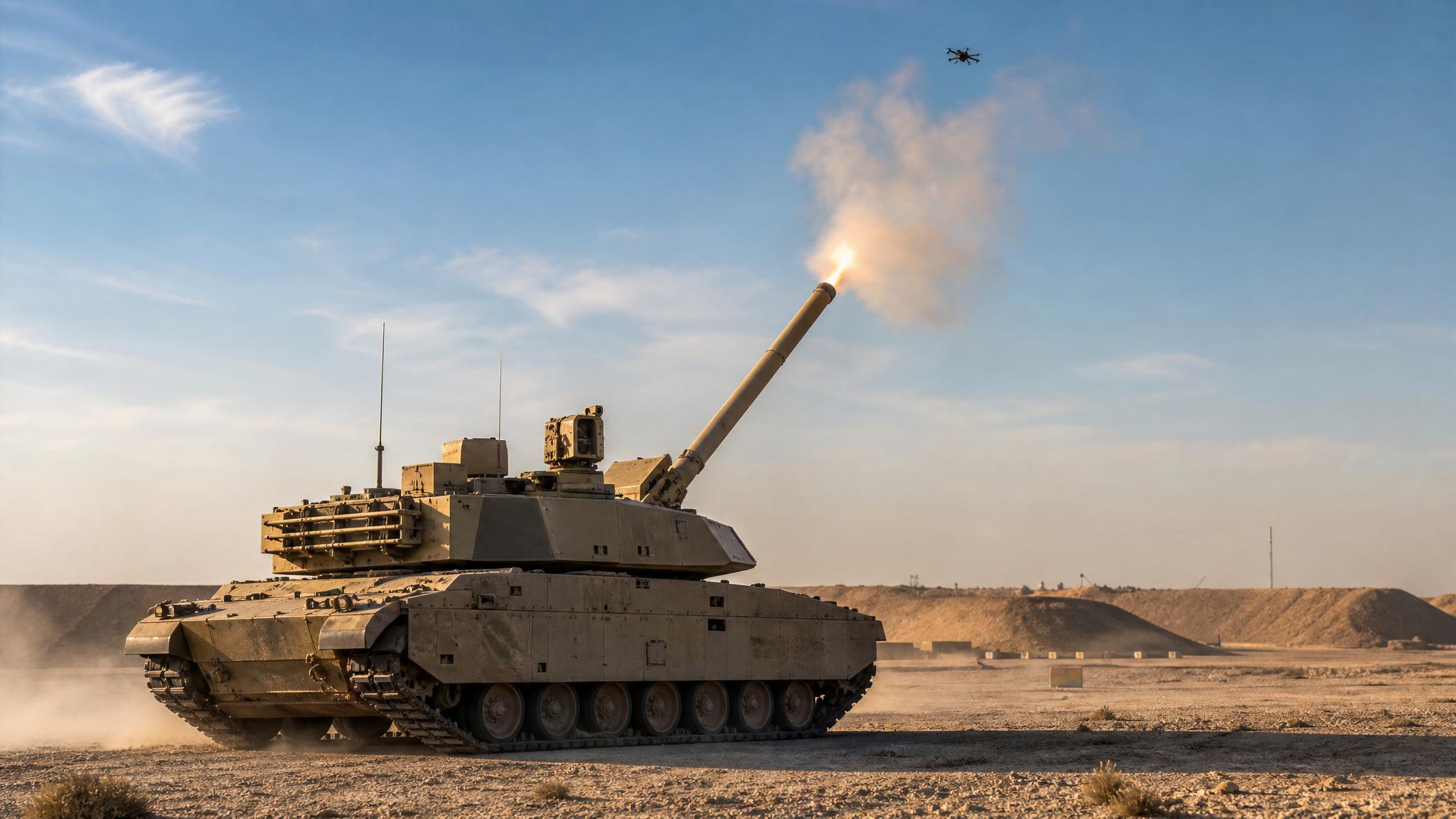
The appearance of MARSS at Eurosatory 2026 coincided with EOS's announcement on June 15 of the completion of its acquisition of MARSS's defense business. The deal, according to the company's statement, combines EOS's influences, from remote weapon systems to directed energy, with the MARSS command and control and sensor integration platform. Almost the next day, another line appeared in the picture: BAE Systems chose MARSS to provide the command and control solution for the BATS counter-unmanned systems system. These are not just stacked brand names; they express a market moving from purchasing radar alone or guns alone to buying a complete chain that starts with detection and ends with engagement.
Any officer who has served in the region knows that an airbase or oil port does not always fall to a large ballistic strike. Sometimes a small swarm of drones, a low flight path, or a decoy target that consumes attention is enough. Therefore, it is no surprise that Gulf countries, after months of pressure from Iranian missiles and drones, are now viewing short-range air defense as a daily survival issue, not as a small supplement alongside Patriot or THAAD.
What NiDAR Actually Adds
The value of NiDAR is not that it is just another radar. The value lies in its attempt to integrate radars, electro-optical cameras, radio frequency sensors, electronic warfare means, and guns or missile effects into a single operational picture. BAE describes BATS as a C2-based software system that supports decision-making, detects unmanned activity through sensors, classifies the threat level, and then recommends or employs the most suitable effect while keeping the human in the loop. Here is the critical point: in a drone attack, the operator does not have the luxury of a long meeting. A decision that used to take minutes must now approach seconds.
But we should not deceive ourselves. There is no C2 platform, no matter how smart, that can turn a poorly trained army into a cohesive force. Software reduces chaos, but it does not eliminate the need for clear rules of engagement, trained crews, continuous maintenance, and real connectivity between air forces, air defense, and facility protection. In my view, this is the issue that will separate a country that buys a system and takes a picture with it from a country that builds a layered defense that operates at three in the morning when targets arrive from multiple directions.
Kuwait as an Example of a Larger Trend
Just a few days after the attacks on Kuwait, Washington approved a potential sale worth $1.98 billion of counter-unmanned systems platforms for Kuwait, with Anduril as the prime contractor. The package includes Roadrunner-Munition and Anvil-Kinetic, launch boxes, Lattice command and control, long-range surveillance towers, Pulsar electromagnetic warfare systems, and tactical operations centers. This mix reveals that the Gulf lesson is no longer confined to the question: how many Patriot batteries do we have? It has become: do we have a relatively low-cost layer that can deal with the drone before we are forced to use a million-dollar missile?
What is happening with MARSS/EOS and BAE in Paris, and with Kuwait in the path of U.S. military sales, points to the same trend. The Gulf market is looking for systems that protect not just the capital, but airports, desalination plants, oil ports, aircraft bases, and command centers. These targets are broad, repetitive, and some are civilian in nature, and cannot all be covered by the traditional air defense philosophy that was originally born to counter larger aircraft and missiles.
The Old Gulf Dilemma in a New Dress
However, it should be noted that an abundance of suppliers can become a problem in itself. The Gulf wants American, British, Australian, Korean, Turkish, and sometimes Israeli systems, and each supplier comes with its own software, encryption, maintenance contracts, and data transfer policies. If there is no national or Gulf command structure capable of forcing these systems to communicate with each other, we will find ourselves facing a modern version of the old problem: excellent equipment on isolated islands.
Practically, defense against drones is not measured only by the speed of the effect or the range of the radar. It is also measured by who has the authority to engage, how friendly fire is prevented near a civilian airport, how the electronic signature library is updated, and who pays the bill for munitions during a long saturation attack. These are boring questions for politicians, but they are the real war for those standing in the operations room.
Beyond the Deal
Jane's announcement of MARSS's success in the Middle East, EOS's statement about integrating NiDAR with the company's effects, and BAE's selection of the platform within BATS all indicate that Gulf air defense is entering a less showy and more complex phase. The next question will not be whether the state has purchased a system against drones, but whether it has linked it to early warning systems, air defense, base protection, military police, and civil defense.
In armies, we say that a weapon that does not fit into a clear command system becomes a stylish burden. And this is exactly the Gulf test now. The region can buy the best C-UAS solutions on the market, but possessing the loop from detection to decision to engagement does not mean having the culture to operate it. Between the desire for independence from the American umbrella and the daily need for Western suppliers, data, and software, small drones will continue to reveal the great contradiction: the Gulf is rapidly buying technology, but building the institution that makes it fight efficiently takes longer than any defense exhibition.
Sources
- Jane's, June 16, 2026 report on MARSS and EOS and the success of air defense in the Middle East.
- EOS, announcement of the completion of the acquisition of MARSS on June 15, 2026.
- Military Embedded Systems, MARSS selected as C2 provider for BAE Systems BATS on June 17, 2026.
- Breaking Defense, details of the potential $1.98 billion counter-drone deal for Kuwait.
- BAE Systems, description of the BATS counter-unmanned systems.
MARSS and EOS unveiled the NiDAR command and control platform at Eurosatory 2026, highlighting advancements in Gulf defense against drones. The Gulf states are increasingly prioritizing short-range air defense systems in response to drone threats. Kuwait is expected to acquire $1.98 billion in drone defense systems from the U.S., indicating a shift towards integrated defense solutions. BAE Systems has chosen MARSS to provide command and control for its BATS system, emphasizing the need for comprehensive defense strategies.
- MARSS and EOS showcased the NiDAR platform at Eurosatory 2026.
- The Gulf states are shifting focus to short-range air defense systems due to drone threats.
- Kuwait is set to purchase $1.98 billion in drone defense systems from the U.S.
- BAE Systems selected MARSS for its BATS system for unmanned systems defense.
- The integration of various sensors and systems is crucial for effective drone defense.