
Me and My Navy - Written on the Occasion of the 77th Anniversary of the People's Navy
Xinhuanet Beijing, April 22 - Title: My Navy and I - Written on the 77th Anniversary of the People's Navy
Xinhuanet reporters Li Bingxuan, Zhai Xiang, Li Jie
My Navy has never been just a simple title.
Dreams, missions, pride, these few words are filled with deep emotions -
This is a cry from a nation that has suffered greatly, striving to strengthen itself at sea; it is a vivid portrayal of countless soldiers cutting through waves and pursuing dreams in the deep blue; it is a symphony of fate resonating with the fortunes of the nation shared by billions of Chinese sons and daughters.
April 23 this year marks the 77th anniversary of the establishment of the People's Navy. Let us raise the flag and sound the naval horn. This is not only a holiday for naval personnel but also a shared holiday for all those who care for and love the People's Navy.
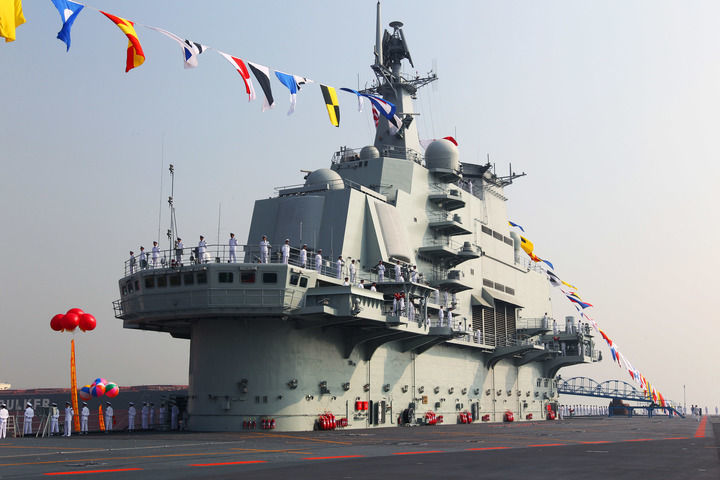
↑ On September 25, 2012, China's first aircraft carrier, the Liaoning, was officially delivered to the navy after completing construction and trial voyages as planned at the Dalian Shipyard of China Shipbuilding Industry Corporation. This is the Liaoning flying the full flag, with crew members standing in formation, full of spirit. Photo by Xinhuanet reporter Zha Chunming
Dreams
Recently, Chen Yuwen, who has just turned 30, fulfilled a wish.
In front of a display featuring a giant photo of China's first aircraft carrier, the Liaoning, Chen Yuwen solemnly donated a letter of reply to the China People's Liberation Army Navy Museum.
An aircraft carrier has never just been a warship.
For naval officers and soldiers, it is the totem of the People's Navy, a symbol that concentrates the strength and emotions of hundreds of thousands of naval personnel.
For the people of the nation, it is a projection of the collective consciousness of billions of Chinese sons and daughters striving to strengthen themselves at sea.
For the international community, it is a symbol of a country's comprehensive strength, a strong shield for defending national sovereignty, security, and development interests.
In 1999, less than 5 years old, Chen Yuwen saw the appearance of an aircraft carrier in a newspaper: a wide deck filled with warplanes, the bow cutting through the surging waves. That giant vessel planted a dream in his young heart: to see China's own aircraft carrier. He took pocket money from his piggy bank and, with the help of his family, sent 140 yuan to the former General Equipment Department of the PLA in four installments, hoping to contribute to the construction of an aircraft carrier.
To the surprise of his family, they soon received a reply. The letter expressed gratitude for his support of national defense construction and returned the donation in full according to relevant regulations.
“They returned my money but accepted my dreams and expectations,” Chen Yuwen said.
When China's aircraft carrier program began, the world had been developing aircraft carriers for nearly a century. Although starting late, it has been catching up and moving forward:
On September 25, 2012, China's first aircraft carrier, the Liaoning, was officially delivered to the navy;
On December 17, 2019, China's first domestically produced aircraft carrier, the Shandong, was commissioned;
On November 5, 2025, China's first fully self-designed and built catapult aircraft carrier, the Fujian, will be commissioned...
In just over a decade, the Chinese navy has stepped into the "three aircraft carrier era."
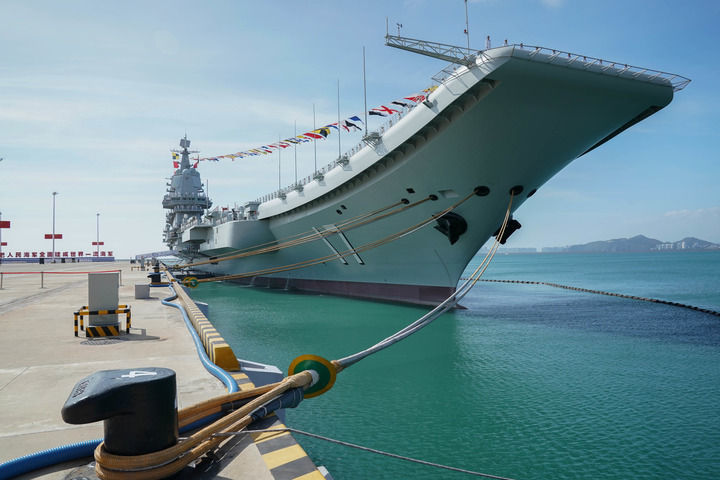
↑ On December 17, 2019, China's first domestically produced aircraft carrier, the Shandong, was delivered to the navy at a military port in Sanya, Hainan. With the approval of the Central Military Commission, China's first domestically produced aircraft carrier was named "Shandong" of the People's Liberation Army Navy, hull number "17." Photo by Xinhuanet reporter Li Gang
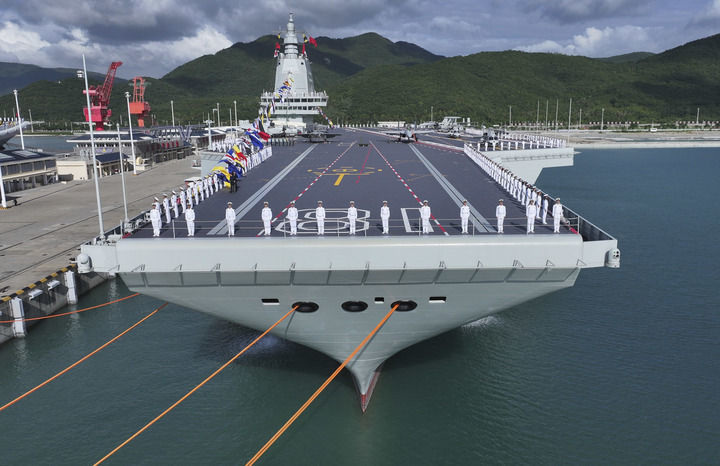
↑ On November 5, 2025, the commissioning ceremony for China's first electromagnetic catapult aircraft carrier, the Fujian, was held at a military port in Sanya, Hainan. Photo by Xinhuanet reporter Li Gang
Chen Yuwen has been following every step the People's Navy takes in the news. He often thinks of that 140 yuan and that letter. He said he never expected the process to be so fast.
Having China's own aircraft carrier has never been just one person's dream, but a shared dream of a generation. In front of the aircraft carrier display at the navy museum, looking at the crowd around him, Chen Yuwen stood still for a long time.
More fortunate was that he received an invitation from the People's Navy to visit the Liaoning. As the car approached the dock, seeing the "big ship" he had longed for with his own eyes for the first time, he unconsciously stood up and craned his neck to look.
Standing on the wide deck of the Liaoning, looking at the prominent "16" on the bow, Chen Yuwen felt a surge of emotions.
At that moment, he seemed to see the "Flying Shark" soaring into the sky against the sea breeze.
At that moment, he seemed to see himself running into the post office to wire money with his pocket money.
At that moment, he seemed to see the audience in front of the navy museum display, young parents holding their children, elderly people with gray hair, and young people wearing red scarves...
He said that he only wanted to contribute a little back then, but now he finds himself in such a vast history and reality.
Indeed, the Chinese nation's longing for the sea has a long history. From Zheng He's seven voyages to the West, to modern China being repeatedly invaded by great powers, the Chinese have always dreamed of having a strong navy.
On April 23, 1949, the People's Navy set sail from Baima Temple in Taizhou, Jiangsu. The dreams of countless innocent children are the inexhaustible source of its construction and development. It is under the support of countless dreams that the People's Navy cuts through waves and sails into the deep blue.
“The story of my navy and I comes to a close here. But this is also the beginning of a new story,” Chen Yuwen said.
↑ On April 23, 1949, the Navy of the East China Military Region was established at Baima Temple in Taizhou, Jiangsu. This is the site of the founding conference (historical photo). Photo by Xinhuanet
Mission
As a missile support engineer in a naval unit, Liu Shenghua has ensured that missiles have reached many places around the world with warships. However, most of his 33-year military career has been spent in underground storage facilities in the mountains.
“Every time I load a missile onto a warship, it feels like sending a son off to battle, hoping he will achieve great things and waiting for good news,” Liu Shenghua describes his feelings towards missiles.
Liu Shenghua's connection with missiles began over 30 years ago. At that time, the technical preparation procedures for missiles were unimaginably complex. A missile had to go through more than a dozen steps from unboxing to testing completion. “Every step felt like walking on a tightrope; a slight mistake would mean starting over. Even a smooth process would take dozens of hours,” Liu Shenghua said.
Once, during a mission to rapidly load multiple missiles of a certain type, Liu Shenghua and his comrades wore airtight protective suits and gas masks, taking turns to operate. The masks were filled with moisture, and sweat dripped down the neck of the signalman. After eight hours of continuous work, when the last signalman took off his protective suit, he looked as if he had been pulled out of the water. He collapsed on the ground, gasping for breath, but with a silly smile on his face: “We did it!”
Since then, Liu Shenghua has had a fixation: to ensure the most advanced missiles.
Over 20 years ago, during a hot and humid summer, Liu Shenghua and his comrades embarked on a learning journey for a certain type of imported missile. After months of practical training, the foreign technical supervisor had strict requirements, with standards that were precise down to the operation of a single screw. During that time, they followed experts for practical operations during the day and collectively reviewed and summarized at night, without a single day of rest. In the end, all Chinese trainees passed the graduation assessment with excellent results.
When parting, the foreign technical supervisor shook Liu Shenghua's hand and said, “You are the best students I have ever taught because you have a sense of responsibility; you understand why you need to learn. Previously, we were teacher and students, but from now on, we are colleagues.”
A few years ago, Liu Shenghua welcomed his long-awaited "new partner" - a new type of domestically produced missile.
At the commissioning ceremony, the red banner reading “Commissioning means forming combat capability” was particularly eye-catching. More than 40 technical signalmen stood in neat rows, dressed in military uniforms. “I swear to guarantee 100% safety, 100% reliability, 100% precision, 100% timeliness, 100% confidentiality, and 100% completion!” The oath echoed in the storage facility. Liu Shenghua stood in the ranks, his blood boiling.
Equipment is advancing, and the support concept is also upgrading - from “supporting equipment” to “supporting combat capability,” from “usable” to “easy to use, durable, and effective.” Liu Shenghua said that those once unattainable dreams are now becoming a reality.
Now, Liu Shenghua has more and more highly educated young comrades around him. They wear new-style protective suits, operate new detection equipment, manage ammunition with information technology, analyze fault patterns using big data, and improve support efficiency with intelligent devices.
Once, a young comrade asked, “Liu, how did you endure such hardship back then?”
Liu Shenghua thought for a moment and said, “It wasn't endurance; it was faith. Faith that one day, our equipment would be world-class.” The comrade nodded, his eyes shining.
Liu Shenghua said that seeing them is like seeing the future.
Liu Shenghua and his comrades are just a microcosm of the countless soldiers in the combat ranks of the People's Navy who have never sailed far.
They stand at the dock, welcoming and sending off warships with ropes time and again; they guard the mountain tops, always vigilant in watching over the country's vast maritime territory; they root themselves in the inland, silently standing guard to protect the ever-present radio waves...
It is this silent dedication and support that has created the deep blue tracks of warships cutting through waves, the peaceful and tranquil vast maritime territory, and the People's Navy's strong steps towards the sea.
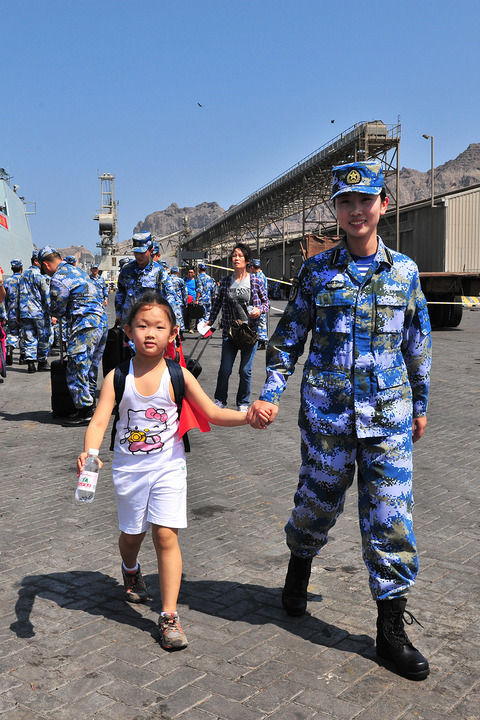
↑ On March 29, 2015, the 19th escort fleet of the Chinese navy, the Linyi, arrived at the port of Aden, Yemen, where female crew members helped evacuating children board the ship. Photo by Xinhuanet (Xiong Libing)
Pride
Li Yufei once again held the hand that had brought her safety and warmth.
Eleven years ago, far away in a foreign land, Li Yufei held this hand when she was just 4 years old. Because of that hand-holding, a photo was captured, becoming a classic moment in the history of the People's Navy.
“You were this tall back then, and now you're taller than me,” said Senior Corporal Guo Yan from a naval unit, smiling at “Little Yufei,” which has been her unchanged name for this “post-2000” girl over the past 11 years. The “sister” that Li Yufei calls out has also remained the same.
In the spring of 2015, the civil war in Yemen broke out. The Central Committee of the Communist Party and Chairman Xi made a decisive decision, ordering the 19th escort fleet, which was carrying out escort missions in the Gulf of Aden, to go to Yemen for evacuation. In just 10 days, three ships of the People's Navy traveled through three countries, four ports, and one island, successfully evacuating 621 Chinese compatriots and foreign citizens from 15 countries safely.
On March 29 of that year, the Linyi arrived at the port of Aden, Yemen, and female crew member Guo Yan was assigned to the security inspection team, responsible for accompanying evacuees on board after security checks. She recalled that as they approached the shore, thick smoke was still rising from the hills; getting closer, the sounds of explosions were clearly audible. The compatriots waiting at the port waved the national flag and shouted, “Long live the motherland.”
Li Yufei and her parents were among the first to pass through security. At just 4 and a half years old, Li Yufei walked at the front of the line. Worried that she might not be steady on the gangway, Guo Yan took Li Yufei's hand and accompanied her step by step forward. This was the warm moment captured by the camera.
In 2024, the art-loving Li Yufei sketched the scene of the two holding hands during the evacuation and presented the drawing to Guo Yan. This special gift was carefully treasured by Guo Yan.
Guo Yan said that during the second evacuation, a stray bullet hit a crane about 20 meters from the bow of the ship, and as the evacuation was nearing its end, unidentified armed men attempted to approach the warship. “The situation was very dangerous at that time. But we were not afraid; we had full confidence in our motherland and believed we would complete the mission.”
During the Spring Festival of 2018, the film “Operation Red Sea,” based on the Yemen evacuation, was released, and Guo Yan went to see the popular film with her mother. “My mom cried when she watched it, saying it was so dangerous. Although the movie exaggerated some plot points, I felt like I was back in that moment of carrying out the mission; those scenes will stay with me for a lifetime,” Guo Yan said.
When the evacuation mission was received, the Linyi, which was on an escort mission, was nearing resupply, and the main food supplies on board were nearly exhausted. The officers and soldiers actively saved ingredients, leaving limited resources for the evacuated compatriots. During the evacuation journey, space on the ship was limited, and many officers and soldiers voluntarily gave up their beds, replacing them with clean sheets and quilts for the compatriots to rest, while they themselves slept on the floor in the ship's passageway.
Guo Yan remembers that a compatriot who was evacuated from Yemen specially returned to the Linyi to visit the troops. When everyone lined up on the deck to welcome him, he bowed deeply and said, “For you, this may just be a mission, but for us, it is a second life.”
“Later, the evacuated personnel were mainly foreign citizens, and after a Japanese citizen boarded the ship, he solemnly bowed to the five-star red flag,” Guo Yan recalled.
For Li Yufei, her memories of the evacuation are somewhat vague, but she always remembers the feeling of being cared for. She watched cartoons on the Linyi, enjoyed a hearty lunch, and received a tiger toy, building blocks, and chocolate from the navy uncles and aunts. During the journey, Li Yufei saluted several times, saying she wanted to join the navy when she grew up.
That experience became the most special lesson in Li Yufei's growth. In elementary school, there was a chapter in the textbook about the Yemen evacuation, and the teacher asked her to come to the podium to share her personal experience with her classmates. When writing essays, she often mentioned those memories. Now, she frequently follows reports about the navy. “Back then, it was the People's Navy that gave me a sense of security,” Li Yufei said, “We have never lived in a peaceful era; we just live in a peaceful country.”
My navy and I still have many touching stories waiting to be written.
At 77 years old, the People's Navy is still in its prime.
The People's Liberation Army Navy celebrated its 77th anniversary on April 23, 2024, reflecting on its historical significance and achievements. The report highlights the delivery of China's first aircraft carrier in 2012 and the ongoing development of its naval capabilities, marking a significant milestone in the nation's military history. The narrative emphasizes the collective dreams of the Chinese people for a strong navy and the importance of naval power in national defense.
- The People's Navy was established on April 23, 1949.
- The first aircraft carrier, Liaoning, was delivered in 2012.
- China is entering the 'three aircraft carrier era' with multiple carriers in service.