
Military Conflict Escalates Suddenly, Both Countries Take a Strong Stance, US-Iran Memorandum of Understanding Faces Crisis
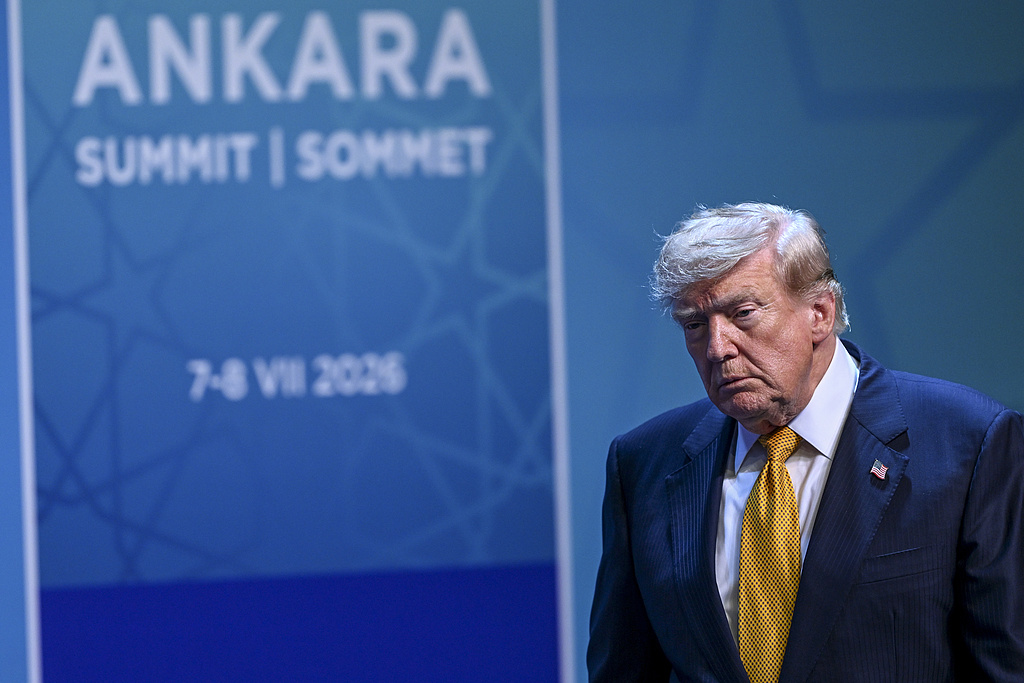
[Global Times Special Correspondent in the U.S. Feng Yaren, Global Times Special Correspondent Wang Yi] "In my view, it has ended." This is what U.S. President Trump said on the 8th during the NATO summit in Ankara, Turkey, regarding the memorandum of understanding with Iran. On the 7th local time, the U.S. military launched airstrikes on over 80 targets within Iran, and just hours before the attacks, the U.S. revoked the license that allowed Iran to sell oil. The Pentagon stated that this was a dual response to Iran's attack on three commercial vessels passing through the Strait of Hormuz. U.S. officials revealed that the scale and intensity of the military action on the 7th far exceeded previous conflicts, aiming to send a "strong signal" to Iran. The Iranian Foreign Ministry condemned the U.S. on the 8th for violating the ceasefire agreement, stating that a series of U.S. actions rendered the "important and fundamental" content of the agreement ineffective. In response, the Iranian Islamic Revolutionary Guard Corps launched airstrikes on 85 U.S. military targets within Bahrain and Kuwait. According to reports from the Wall Street Journal and CNN, the latest military actions between the U.S. and Iran represent the most serious escalation since the two countries signed the memorandum of understanding, and Trump's latest remarks are seen as the clearest indication yet that the ceasefire agreement is on the verge of complete collapse. On the 8th, international oil prices surged over 6%, while gold and silver prices fell in response.
The scale of U.S. military strikes far exceeds previous actions
The latest round of mutual strikes comes at a time when the U.S. and Iran have suspended negotiations, and Iran is currently holding a grand funeral ceremony for its former Supreme Leader Khamenei, who was killed in a U.S. attack. On the morning of the 7th local time, three commercial vessels were attacked off the coast of Oman, prompting a "strong response" from the U.S. military.
The U.S. Central Command announced on the 7th that it had struck over 80 targets in Iran, including Iran's air defense systems, command and control networks, coastal radar positions, anti-ship missile facilities, and over 60 small fast boats of the Islamic Revolutionary Guard Corps in the Strait of Hormuz and surrounding areas, claiming the aim was to weaken Iran's ability to continue attacking international trade routes. The command warned in a statement: "Central Command forces remain in a state of readiness, and if Iran does not comply with or fulfill the agreement, it will be held accountable."
The New York Times reported on the 7th, citing an anonymous U.S. official, that Trump approved and ordered the airstrikes against Iran during the NATO summit in Turkey. On that day in Ankara, Trump met with several high-ranking U.S. officials, including Chairman of the Joint Chiefs of Staff Dan Kane, Defense Secretary Hegseth, and Secretary of State Rubio. They believed that the U.S. military action was a response to Iran's attack on non-military vessels, accusing Iran of choosing a provocative path despite knowing the consequences. According to the Wall Street Journal, a senior U.S. official stated that the scale of this round of attacks was 4 to 5 times larger than the military strikes implemented after the ceasefire agreement was signed last month, but the U.S. still considers the ceasefire agreement to be in effect.
Before the U.S. military launched a series of strikes, the U.S. Treasury Department announced on the 7th that it was revoking the 60-day authorization issued to Iran on June 21 for oil production, delivery, and sales—an important component of the U.S.-Iran memorandum of understanding.
On the 8th, in response to related questions during the NATO summit, Trump stated that the memorandum of understanding with Iran "has ended," repeatedly accusing the Iranians of being "sick," "evil and violent," and saying he "doesn't want to deal with them anymore," calling negotiations with Iran "a complete waste of time." However, he also stated, "If they want to talk, I will let our excellent negotiators continue to talk to them, but I don't see (any hope for negotiations)." Trump also mentioned on the 8th that he might re-implement a maritime blockade against Iran and carry out further strikes. "We hit them hard last night, very, very hard. We might hit them hard again tonight. I will give them a little warning... we'll see what happens."
Intensive responses from Iranian military and political departments
According to reports from Iranian news outlets on the 8th, Iranian Parliament Speaker Ghalibaf severely condemned the U.S. for seriously violating the U.S.-Iran memorandum of understanding, emphasizing that the "era of Washington's bullying and extortion" has ended, and Iran "will not yield." Earlier that day, Iranian President Raisi, who had just returned from a visit to Iraq, compared U.S. foreign policy to its behavior as a World Cup host, criticizing the U.S. for consistently "distorting rules, bullying opponents, creating obstacles, and cheating."
According to the Iranian news agency, the Iranian Foreign Ministry issued a statement on the 8th stating that the U.S. military's attacks on southern Iran, along with the U.S. decision to revoke Iran's oil sales license, violations of Iran's arrangements in the Strait of Hormuz, and Israel's ongoing military aggression and terrorism against Lebanon, have rendered the important and fundamental terms of the ceasefire memorandum meaningless. The statement said: "The treacherous U.S. must bear full responsibility for the dangerous consequences of this escalation."
On the 8th, the Central Headquarters of the Iranian Armed Forces, Khatam al-Anbiya, issued a statement saying that any country providing support for U.S. military attacks on Iran will become a "legitimate target" for Iran, while reiterating that the shipping routes set by Iran are the only safe passage for tankers and commercial vessels through the Strait of Hormuz. Later that day, the Iranian Islamic Revolutionary Guard Corps stated that it had conducted airstrikes on 85 U.S. military targets within Bahrain and Kuwait. Iranian Army Chief of Staff and Deputy Minister of Coordination Rear Admiral Habibollah Sayyari warned on the 8th that any hostile forces attempting to land on Iranian shores would turn Iran's coast into a "hell" from which invaders could not escape. He said: "All of the U.S. president's statements are intended to indicate that nothing can stop its military presence on the Iranian coast. But our response is very clear: 'Come if you dare!'"
Escalation of the situation raises concerns
The mutual strikes between the U.S. and Iran have raised concerns about the outbreak of a full-scale war. According to CNN, the latest escalation has led Hegseth to cancel a planned visit to Israel. The European Union Aviation Safety Agency on the 8th advised airline operators to avoid Iranian, Iraqi, and Lebanese airspace, stating, "If the existing ceasefire agreement breaks down, Iranian airspace may face imminent threats." EU High Representative for Foreign Affairs and Security Policy Borrell stated on the 8th: "The U.S.-Iran exchanges of fire have made the already difficult ceasefire negotiations even more complicated." She noted that foreign ministers from EU member states are scheduled to meet with Gulf state foreign ministers on the 13th to discuss navigation issues in the Strait of Hormuz and the Red Sea.
Qatari scholar Saloum analyzed for Al Jazeera that the U.S. seems to be sending signals indicating that its military actions are limited, and the memorandum of understanding remains technically valid. However, Trump's remarks have made the situation ambiguous. Retired U.S. Navy senior officer Harlan Ullman believes that Iran may be provoking the U.S. by intensifying its attacks to exacerbate divisions among the U.S. and other NATO member states.
The European Business Magazine analyzed that Trump's announcement of the "end" of the ceasefire agreement does not equate to the resumption of war. He nominally allows negotiators to continue negotiations, and both sides clearly wish to avoid a complete closure of the Strait of Hormuz. However, the market has long been accustomed to this pattern: optimism, collapse, attacks, and a surge in crude oil prices again. Until a lasting agreement is reached between the U.S. and Iran regarding the Strait of Hormuz, the global economy will continue to pay the price for this peace that no one truly believes in. Whenever the market rises on hopes of peace, it creates space for the U.S. and Iran to continue bargaining rather than reaching an agreement. This forms a vicious cycle that fuels marginal policies, and the U.S. claim of "wasting time" is the purest form of war brinkmanship.
The U.S. military conducted airstrikes on over 80 Iranian targets on July 7, 2023, in response to Iranian attacks on commercial vessels. Iran retaliated with airstrikes on 85 U.S. military targets in Bahrain and Kuwait. President Trump declared the U.S.-Iran memorandum of understanding 'over' during a NATO summit, signaling a significant escalation in hostilities between the two nations.
- U.S. conducted airstrikes on over 80 Iranian targets in response to attacks on commercial vessels.
- Iran retaliated with airstrikes on 85 U.S. military targets in Bahrain and Kuwait.
- Trump declared the U.S.-Iran memorandum of understanding 'over' during a NATO summit.
- International oil prices surged over 6% following the escalation.
- Iran's military warned that any supporting nations for U.S. actions would be legitimate targets.