
Navy, Marines: it’s easier to buy new amphibious ships than fix old ones faster
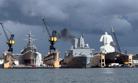
The Marine Corps thinks it will need 40 amphibious ships—up from the Navy’s current 31—to achieve its long-sought goal of keeping three Amphibious Ready Groups with embarked Marine Expeditionary Units deployed at all times.
The shift in strategy reflects the Navy’s struggle to reduce the amount of time its ships and submarines spend under repair. Few U.S. warships meet the service’s goal of being ready to go 80 percent of the time, and, on average, amphibious ships are out of service more often than not.
“If I'm sitting at 31 today, the only way for me to realistically increase that inventory is for me to build new ships and do a service-life extension on some of the ships that I currently have in the inventory, so that I am able to keep to maintain an inventory while I'm building new ships,” Shon Brodie, the Marine Corps’s deputy director of Maritime Expeditionary Warfare, told reporters Wednesday.
Brodie said the vice chief of naval operations and the assistant commandant of the Marine Corps have drawn up a plan that would increase the number of amphibious ships by about 25 percent in exchange for a lower readiness level.
This larger amphib fleet would include 13 big-deck amphibious assault ships and 27 smaller dock ships, up from today’s nine and 22, he said.
The Navy and Marine Corps are to sit down with lawmakers this month to discuss how to fund the project, Brodie said.
That may not be realistic, said Bryan Clark, senior fellow at the Hudson Institute, just because of the massive expense it would require to operate and maintain 40 amphibs.
“And because maintenance costs grow, the Navy can't do all the work it needs to do on a ship, some of which is also deferred to a future availability,” Clark said. “The result is a readiness spiral where ships decline in material condition.”
A new Hudson Institute fleet design study suggests 35 amphibs, taking into consideration that those ships are vulnerable to a near-peer adversary and probably not a self-contained solution once the shooting starts.
“Larger surface combatants need to devote nearly all their weapons capacity to defense once the shooting starts, which necessitates them defending carriers that can conduct offensive operations at range and scale,” he said.
At the same time, the Navy isn’t giving up on doing a better job maintaining the ships it has.
“We're marginally better than we were before, and the expectation is that we can increase beyond marginally better here over the next couple of maintenance cycles,” Brodie said.
But the kicker is that not everything is within their control. If ARG deployments get extended, as they have been quite frequently recently, that increases wear-and-tear on the ships and loads down already delayed maintenance periods.
“So you've got to bring the ship back on time, get it in maintenance on time,” to make the plan work, Brodie said.
The aim is to enable the services to keep deployed three Amphibious Ready Groups-Marine Expeditionary Units, the three-ship formations that carry more than 2,000 Marines and their aircraft and weapons.
Commandant Gen. Eric Smith laid out his case for a 3.0 MEU-ARG presence in a 2025 oped in Defense One. Smith argued that national security required “one from the East Coast, one from the West, and one patrolling from Okinawa, Japan. (If you ask our combatant commanders what they need, the answer isn’t a total of three ARG/MEUs; it’s closer to five or six.) 3.0 is the minimum required to provide our nation and the Joint Force with a capability that can serve as both a warfighting formation and a cross-service integrator.
“It’s what keeps pressure on our adversaries, supports the maritime fight, and gives combatant commanders and national decision makers scalable options they can employ without delay to buy time, create decision-space, and if required to do so, be first to fight.“
The Marine Corps plans to increase its amphibious ship inventory to 40 to maintain three Amphibious Ready Groups at all times. This strategy aims to address current maintenance challenges and improve operational readiness. Discussions with lawmakers regarding funding for this initiative are set for this month, as the Navy and Marine Corps seek to enhance their capabilities in response to national security needs.
- Marine Corps requires 40 amphibious ships to maintain readiness.
- Current fleet consists of 31 ships, with plans to increase by 25%.
- Maintenance issues lead to reduced operational readiness.
- A new fleet design study suggests 35 amphibious ships may be sufficient.
- Discussions with lawmakers about funding are ongoing.