
Navy says next aircraft carrier headed to Middle East is carrying more food and supplies
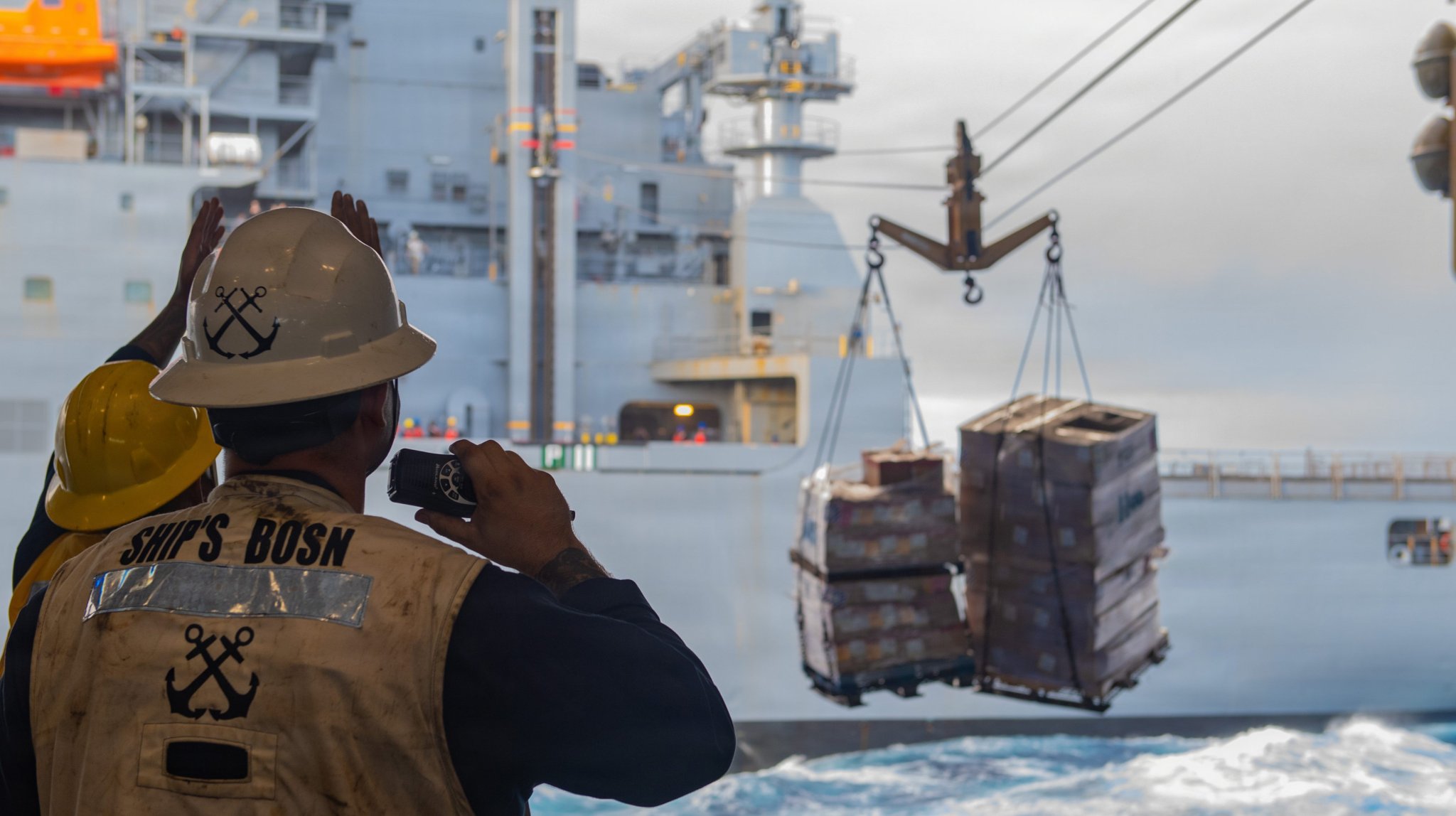
Running out of fresh food, deodorant and other basic supplies is unpleasant for anyone. They’re particularly difficult to go without while spending months aboard an aircraft carrier at sea.
As the USS Theodore Roosevelt makes its way toward the Middle East this week as the latest aircraft carrier to deploy to the Iran war, the Navy says it has applied lessons from previous carriers in the region that struggled with supplies during extended combat operations. The Roosevelt left San Diego last month carrying significantly more food, retail goods and other supplies than previous carriers, according to the U.S. Pacific Fleet.
“Theodore Roosevelt is loaded with significantly more food stores and on-hand retail ship store inventory than previous aircraft carriers,” a Pacific Fleet spokesperson told Task & Purpose. “This sustainment depth is further backed by pre-staged retail and personal hygiene orders to be delivered to the carrier as it conducts operations.”
The Navy’s decision to load up the Roosevelt comes after numerous reports of sailors aboard the USS Abraham Lincoln reporting that ship ran out of a wide range of supplies, from food to hygiene and cleaning products, in both dining facilities and at the ship’s stores during a 286-day deployment this year
The Navy described the preparations as part of an effort to apply “lessons from recent high-tempo operations” as Roosevelt prepares for what sailors and their families have been told could be at least an eight-month deployment.
Retired Rear Adm. Michael Baker, a former Navy medical officer with experience in strategic planning in the Middle East, told Task & Purpose that keeping a carrier and its air wing supplied is an enormous logistical undertaking.
“There are approximately 6,000 staff on board… That’s a lot of groceries,” Baker said.
Several logistics ports lost to war
The fuller stores on the Roosevelt follow disruptions to the Navy’s traditional logistics network in the Middle East after Iranian attacks damaged U.S. facilities in Bahrain.
Baker compared Bahrain’s shore-based resupply network to a “Costco” for ships at sea. After Iranian attacks badly damaged Naval Support Activity Bahrain early in the war, he said shifting key supply operations roughly 2,200 miles away to Diego Garcia in the Indian Ocean complicated the Navy’s resupply chain.
The longer supply chain particularly affects fresh fruits or vegetables and refrigerated or frozen foods, Baker said. Food aboard a carrier is more than a logistical requirement, he added, because its quantity and quality are important to maintaining morale of the deployed sailors.
Long stretches at sea without shore leave, particularly during combat operations, can wear sailors down physically and psychologically, Baker said.
“Being on a ship 24/7, at sea, always on alert, it is tiring and wears you out both mentally and physically,” Baker said.
Mental health resources will be ‘comparable’ to other strike groups
The mental health of sailors on extended deployments has also come under increasing scrutiny. Eight service members across the USS Abraham Lincoln Carrier Strike Group attempted suicide during its nearly 10-month deployment, acting Navy Secretary Hung Cao confirmed last week.
Pacific Fleet said mental health care resources for sailors on the deployment will be “comparable” to those that sail with other strike groups.
“The Theodore Roosevelt Carrier Strike Group is staffed with robust mental health capabilities encompassing a full spectrum of care, ranging from preventative workshops and pastoral counseling to individual psychotherapy, substance abuse rehabilitation, and psychiatric support,” a U.S. Pacific Fleet spokesperson told Task & Purpose. “This level of care is comparable to that found on other U.S. Navy aircraft carriers.”
Those capabilities are taking on added significance as the Navy confronts the mental health consequences of prolonged deployments across the fleet. This week, the death by suicide of a 21-year-old sailor after nearly 11 months deployed in the Caribbean brought renewed attention to gaps in mental health care aboard ships.
NPR reported this week that Mass Communication Specialist Seaman Jaimie Bethea, 21, died by suicide in June, a month before USS Fort Lauderdale returned from an 11-month deployment to the Caribbean. Her family has questioned whether the Navy did enough to address her deteriorating mental health during the deployment.
Long deployments are unlikely to disappear soon. Before USS Stout departed Norfolk this week, sailors were told to prepare for the possibility of deployments lasting as long as a year, according to NPR.
Pacific Fleet declined to discuss where the carrier will operate next, citing operational security.
The post Navy says next aircraft carrier headed to Middle East is carrying more food and supplies appeared first on Task & Purpose.
USS Theodore Roosevelt is deploying to the Middle East this week, carrying significantly more food and supplies than previous aircraft carriers. This deployment follows lessons learned from earlier operations, where sailors faced shortages. The carrier's logistical preparations are crucial due to disruptions in the Navy's supply chain caused by Iranian attacks on U.S. facilities in Bahrain. The deployment is expected to last at least eight months, with a focus on maintaining the mental health of the crew.
- USS Theodore Roosevelt is deploying to the Middle East this week.
- The carrier is carrying significantly more food and supplies than previous deployments.
- The deployment is expected to last at least eight months.
- Logistical challenges have arisen due to Iranian attacks on U.S. facilities in Bahrain.
- Mental health resources for sailors will be comparable to other strike groups.