
North Korea planted mines that hit South Korean troops
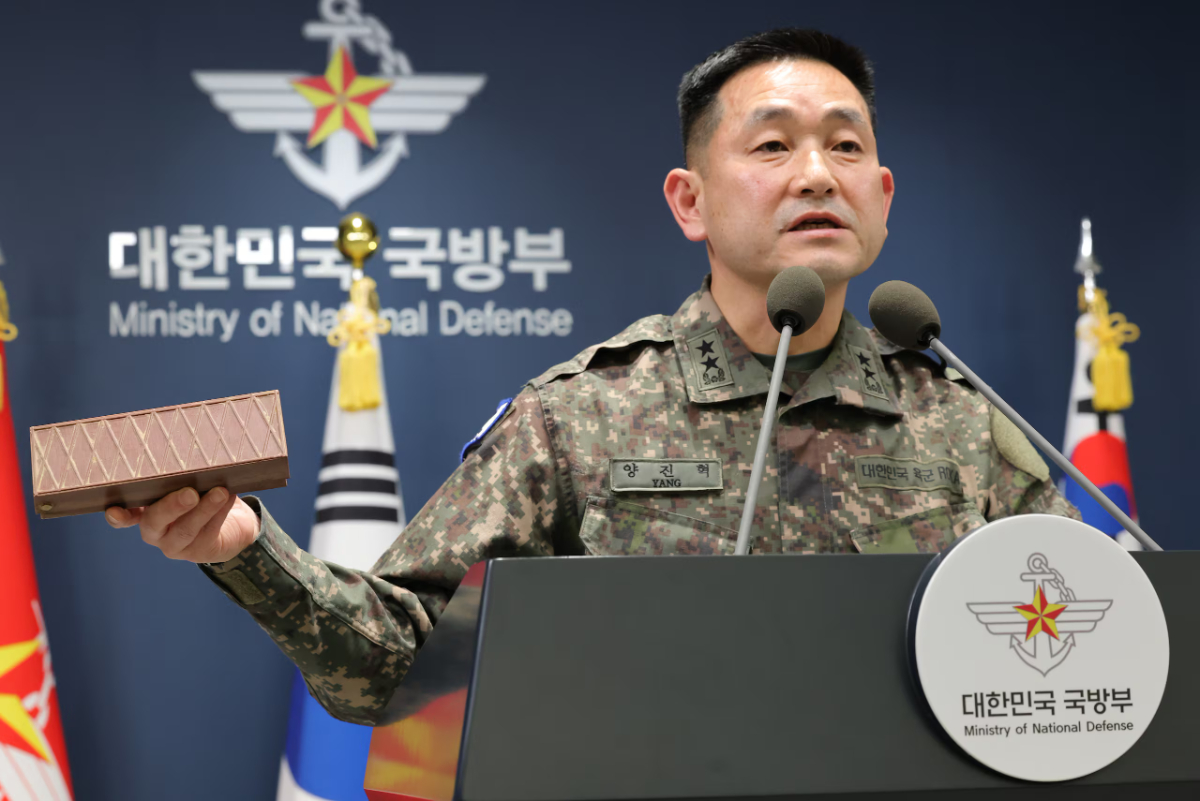
South Korea’s military has concluded that North Korean troops deliberately planted the land mines that wounded three South Korean soldiers inside the Demilitarized Zone last month, and it has removed the remaining mines, but President Lee Jae Myung’s description of the blast as an “unfortunate accident” has drawn sharp criticism at home.
The explosion happened on Sept. 21 in the western sector of the DMZ, in an area patrolled by the South Korean Army’s 25th Infantry Division. Two of the three soldiers were seriously injured. On Oct. 5, after a joint investigation with the U.S.-led United Nations Command, the Joint Chiefs of Staff said the blast was caused by North Korean resin anti-personnel mines planted south of the Military Demarcation Line, the actual border inside the DMZ. The UN Command recognized the mines as a violation of the 1953 Korean Armistice Agreement.
Investigators matched fragments taken from the wounded soldiers with a North Korean resin mine previously recovered from the Imjin River, and they found one more North Korean mine about 1 meter (3 feet) from the second blast site. The resin mines are made of plastic, which makes them harder to find with metal detectors. The JCS said two mines exploded and that soldiers saw a third, unexploded mine as they withdrew.
South Korean troops entered the area with specialized equipment on Oct. 5 and destroyed the North Korean mines at about 12:51 p.m., the JCS said. Defense Minister Kang Shin-chul called the operation effectively unprecedented in the history of the DMZ and a resolute response. On Oct. 8, JCS Chairman Gen. Jin Yong-sung told lawmakers he regarded the blast as a North Korean provocation and said the military would review further response measures.
Lee, who visited the wounded soldiers at the Armed Forces Capital Hospital, did not directly name North Korea in his Oct. 1 Armed Forces Day speech. He referred to the soldiers injured in an “unfortunate accident” and said he would keep working to reduce military tensions and restore dialogue with Pyongyang. His spokesperson later said the remark was meant to comfort the injured troops.
The opposition People Power Party seized on the wording. Party leader Jang Dong-hyeok faulted Lee for not assigning blame to the North, and lawmaker Lim Jong-deuk called the president’s stance submissive. Members of Lee’s Democratic Party noted that the mine removal was the first operation to clear North Korean mines planted south of the demarcation line and that the previous government of Yoon Suk Yeol took no major action after North Korea began fortifying the border in April 2024.
Criticism has also come from columnists. In an Oct. 7 column in the Chosun Ilbo, Yang Sang-hoon argued that Lee’s approach has gone further than earlier Democratic Party governments in accommodating North Korea, and he suggested that Pyongyang could try to use the case in which Lee is accused of involvement in illegal payments to North Korea as leverage. Yang said he did not wish to speculate that the case was driving Lee’s policy. Lee was indicted in 2024 over Ssangbangwool Group’s alleged transfer of $8 million to North Korea and has denied wrongdoing. His trials were suspended after he took office.
Content preview only. Full article available at source. View Full Article
North Korean troops planted land mines in the Demilitarized Zone on September 21, injuring three South Korean soldiers, two of whom were seriously hurt. The South Korean military confirmed the mines were a violation of the 1953 Korean Armistice Agreement. Following a joint investigation, South Korean forces removed the remaining mines on October 5, marking a significant military operation in response to the incident.
- North Korean troops planted land mines in the DMZ.
- Three South Korean soldiers were wounded, two seriously.
- The incident occurred on September 21, 2024.
- The UN Command recognized the mines as a violation of the 1953 Korean Armistice Agreement.
- South Korean troops successfully removed the mines on October 5, 2024.