
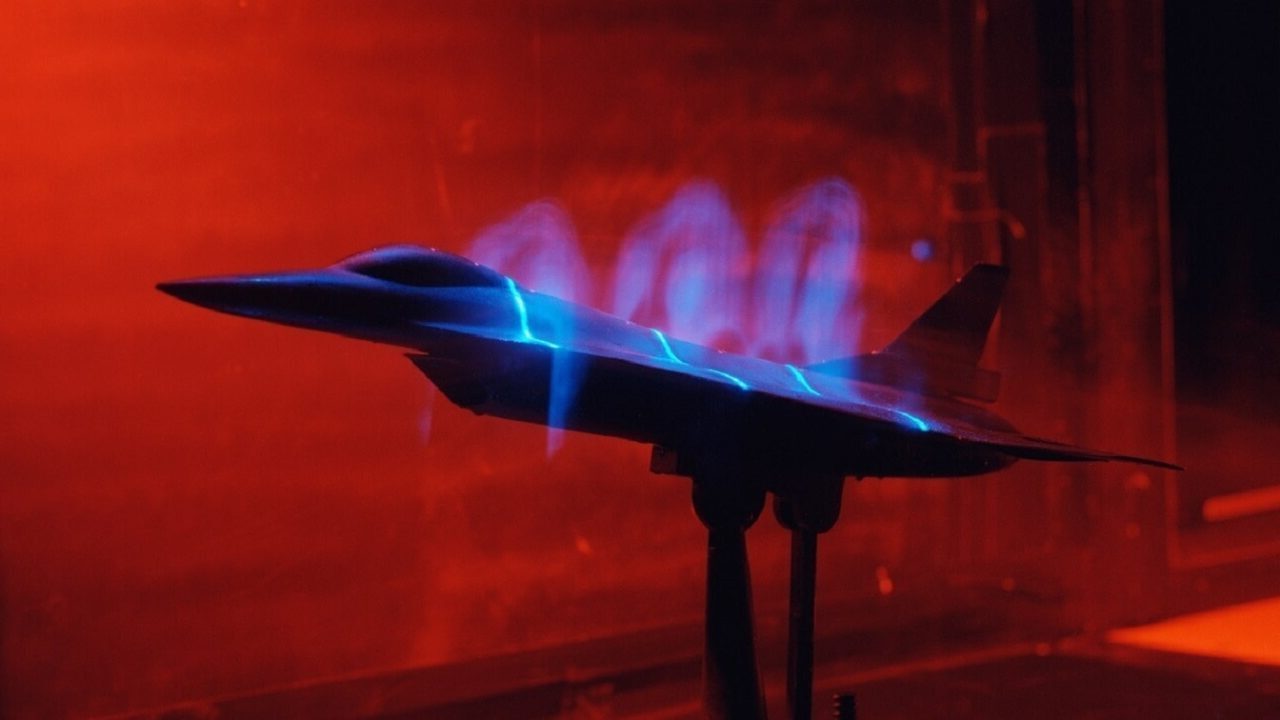
 F-16XL fighter. Image Credit: Creative Commons.
Summary and Key Points: Expert Sean Spoonts revisits the F-16XL, General Dynamics’ cranked-arrow Fighting Falcon with a 56-inch fuselage stretch, a graphite-composite wing 600 pounds lighter, 27 hardpoints, twice the F-16’s bombload, Mach 1.2 supercruise, Mach 2.05 top speed, and a 50,000-foot ceiling, which lost the 1981 Enhanced Tactical Fighter competition to the two-engine F-15E Strike Eagle on payload.
The F-16XL Is Aviation History
Although it’s called the F-16XL, the “XL” doesn’t officially mean “Extra Large.”
It meant extra range, incredible lift, and a huge payload.
The F-16A Fighting Falcon was not a large aircraft to begin with. Among US fighter aircraft, it runs on the small side compared with the F-18 Hornet, the F-15 Eagle, and the F-14 Tomcat, its contemporaries when it first took to the skies as a prototype in 1974.
Out With The F-111 Aardvark
In 1981, the Air Force looked for a new aircraft capable of deep-strike missions to replace the F-111 Aardvark.
They wanted long range, high speed, a large bomb payload, and the ability to reach its target without fighter escort or electronic warfare aircraft to fly ahead and suppress SAM sites along the way.
The Enhanced Tactical Fighter Program (ETF) would run for two years, and the competition would boil down to two aircraft: General Dynamics’ F-16XL and McDonnell Douglas’s F-15E Strike Eagle.
The F-16XL Was A Radically Different Kind of Falcon
While bearing a passing resemblance to the F-16A Fighting Falcon it was derived from, the F-16XL was a radically different kind of bird.
General Dynamics had replaced the F-16A’s cropped wing and horizontal stabilizers with a “Cranked-arrow Delta” wing configuration, which increased lift by 120% over the Fighting Falcon. Because the trailing edge of this cranked-arrow wing could drag on the runway at high angles of attack during takeoff and landing, the F-16A removed its lower ventral fin and canted the tail nozzle up 3.16 degrees to improve clearance.
The new wing was made from graphite-bismaleimide carbon composites, which weighed 600 lbs. less than the standard F-16A wing. The fuselage was extended by 56 inches with two plugs: one up front and one at the rear.
The Performance Of The F-16XL Was Stunning
These modifications produced an aircraft with stunning performance during evaluation and testing. Under the new cranked-arrow wing, the F-16XL could carry twice the bombload of an F-16 with 27 hardpoints for just about any mix of bombs, missiles, or rockets the Air Force could dream up. Because this ordnance was tucked under the wing in an aerodynamic, semi-conformal way, drag was 60% lower than on the F-16A. This allowed the F-16XL to fly faster with a full bomb load without risking drag tearing off the hardpoints.
The F-16XL Could Reach Supercruise Without Its Afterburner
Pilots flying the F-16XL during testing reported that the plane could reach and hold Mach 1.2 without engaging its fuel-hungry afterburner.
The pilots reported a top speed of Mach 2.05 and a service ceiling of 50,000 feet; both were below those of the F-111 Aardvark it would replace, but the F-111 was conceived as a high-speed, low-altitude nuclear strike aircraft. That wasn’t a primary requirement of the F-16XL in the ETF program, or, as it later came to be called, the Dual Role Fighter Program.
The Air Force Took The Lower-Cost Risk In Choosing The F-15E
With the F-15E Strike Eagle, the Air Force found a much safer, more comfortable choice. The F-15E was a two-seat version of the F-15 used to train new pilots. McDonnell Douglas was already building them; they just needed a few simple modifications to turn them into a heavy strike fighter.
Against the F-16XL, it could fly 10,000 feet higher and 345 mph faster. It also had two engines versus the F-16XL’s single engine. This was judged very important for long-range missions over contested airspace, where losing “an engine” was preferable to losing “the engine” in terms of pilot survivability.
The F-15E’s two engines also allowed it to carry a 23,000 lb. payload with fewer hardpoints (15 vs. 27). The F-16XL was limited to 15,000 lbs. of ordnance.
Another factor in the F-15E’s favor was program cost. The F-16XL would require General Dynamics to retool significantly to put it into production, at a cost of $470 million. The tweaks needed for the F-15E would cost $270 million. Contrary to the common perception that the US military always opts for the more expensive program by default, the US Air Force chose the F-15E over the F-16XL.
F-16XL: Where Are They Now?
NASA built and flew only two F-16XL prototypes. NASA took an interest in them and flew them into the late 1990s, drilling millions of tiny holes in one wing to study drag-reduction methods at supersonic speeds.
If you’d like to see the F-16XL today, both are at the Flight Test Museum at Edwards AFB in California.
The single-seat version is on display.
About the Author: Sean Spoonts
Sean Spoonts is the former Editor-In-Chief of SOFREP.com. He is a military analyst, writer, and commentator whose work has appeared in Newsweek, CNS News, Ukrinform, and various 30military/veteran media networks and professional publications, including the Military Intelligence Professional Bulletin. He is a U.S. Navy veteran, having served as an Aviation Anti-Submarine Warfare Operator and Search and Rescue Helicopter Aircrewman.