
PLA Type 076 Amphibious Assault Ship Enters Systematic Preparation, Key Link in the Back Sea Landing Chain to be Completed Before 2030
 Li Minghui
PLA Type 076 Amphibious Assault Ship Enters Systematic Preparation, Key Link in the Taiwan Landing Chain to be Completed Before 2030
The recent 2026 annual military power report submitted by Taiwan's defense department states the focus of the PLA in the coming years more explicitly than in previous years: it is not merely about increasing the number of ships and aircraft, but about integrating air and sea dominance, cross-sea delivery, information support, and sustained supply into a joint landing system. Taiwanese military expert Zhuang Zhong assesses that related projects may be completed in phases between 2030 and 2035. This timeline is noteworthy, but should not be misinterpreted as the PLA having already developed mature cross-sea landing capabilities.
The 076 is Not Just a Standalone Large Ship
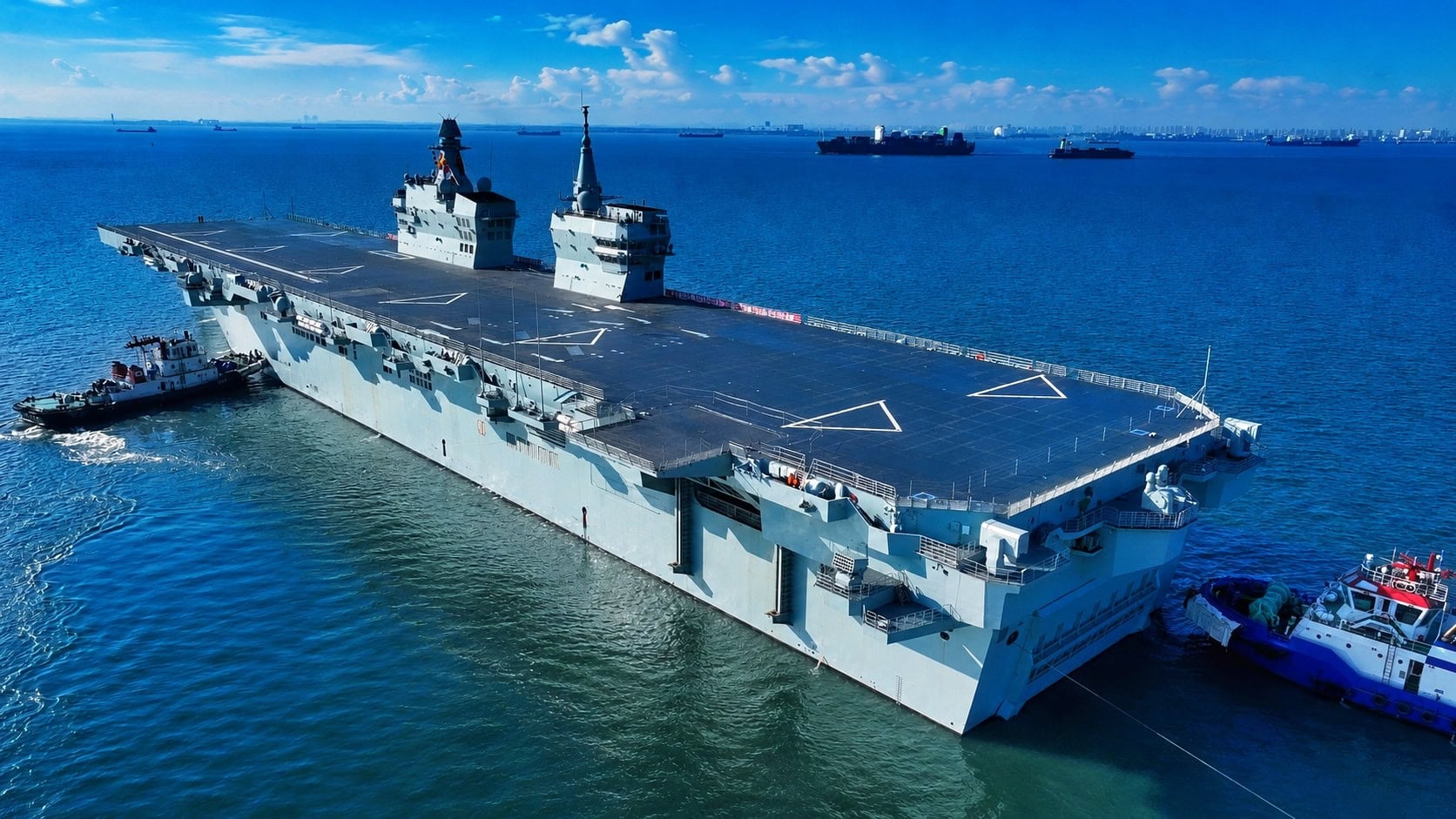
Public reports indicate that the PLA Navy plans to build the Type 076 amphibious assault ship while also developing self-elevating amphibious landing barges and "water bridge" landing equipment. The value of the Type 076 lies not only in its tonnage or deck area, but in its potential to integrate helicopters, drones, unmanned reconnaissance, and maritime command nodes onto the same platform. When combined with airborne assault troops, it can extend the first wave of forces from traditional beachheads to airports, ports, and deep inland nodes.
However, this does not mean that a new ship can solve the landing problem. The narrowest part of the Taiwan Strait is about 130 kilometers, and factors such as sea conditions, beach terrain, port damage, and anti-ship missiles can turn large landing ships into high-value targets. The real challenge is how to continuously deliver fuel, ammunition, maintenance equipment, and casualties ashore after losing the dock.
Supply Barges Illustrate the Problem Better than Carrier-Based Aircraft
According to Taiwan, the PLA is researching self-elevating amphibious barges and "water bridge" landing vessels, aiming to address the shortcomings of existing equipment that struggles to cross the strait and adapt to Taiwan's maritime conditions. These types of equipment may not seem as impressive as the Type 076, but they are closer to the engineering fundamentals of landing operations: once a port is damaged, subsequent waves must rely on temporary floating channels, shallow water transport, and dispersed unloading.
The same report also mentions that the Army Aviation Corps is conducting fuel and ammunition resupply training on near-sea platforms, the Air Force is updating airborne infantry fighting vehicles, transport vehicles, and mortar carriers, while the Army is improving the Z-20 and exploring unmanned transport helicopters. In short, the PLA is breaking down the question of "can we land" into many smaller issues to be resolved one by one.
Information Links and Casualty Evacuation are the Hidden Bottlenecks
The report mentions the "National Grid," "Thousand Sails" low-orbit communication constellation, fourth-generation Beidou satellites, mobile electronic warfare reconnaissance vehicles, and the artificial intelligence deep forgery capabilities of cyber forces. These details indicate that the PLA envisions landing operations that will compete for communication, navigation, and cognitive space from the very first minute. Without a stable data link, even the most advanced Type 076 is just an isolated platform at sea.
However, the Taiwanese military report also acknowledges that the PLA's current joint landing capabilities are still insufficient. I believe that the most easily overestimated aspect by outsiders is the number of platforms, while the most easily overlooked is the reliability of joint operations. China's military industry can quickly build ships and barges, but integrating the Navy, Air Force, Army Aviation Corps, Rocket Force, Strategic Support Force, and joint logistics system into a single high-intensity command chain still requires repeated drills.
The Real Test is Whether They Can Sustain for Seven Days
Strategically, the Type 076 and new landing barges primarily enhance options for blockade and coercion, not necessarily indicating that Beijing has decided to launch a full-scale landing. They can be used to demonstrate presence in distant seas, cut off external aid channels, and create greater military uncertainty during a crisis. For Taiwan, the defense focus cannot only be on the first wave of landing ships but must also target maritime supply, temporary docks, communication nodes, and casualty evacuation networks.
Sources include reports from Taiwan's Central News Agency on the 2026 annual military power report, Taiwan News's compilation of joint blockade exercises, and Singapore's CNA analysis of Chinese naval and air force activities. The real question worth asking is not when the Type 076 will be launched, but whether the PLA can sustain landing forces for more than seven days under conditions of port damage, satellite interference, and increasing losses.
The People's Liberation Army Navy is preparing the Type 076 amphibious assault ship as part of a joint landing system aimed at enhancing cross-sea operational capabilities by 2030. This includes developing logistics support and communication systems to ensure sustained operations. The report emphasizes the importance of overcoming logistical challenges and maintaining operational readiness in the Taiwan Strait.
- The PLA is developing the Type 076 amphibious assault ship and related landing equipment.
- The focus is on creating a joint landing system for cross-sea operations by 2030.
- Logistics and supply chain capabilities are critical for successful amphibious operations.
- The report highlights the importance of communication and coordination among military branches for effective operations.
- Taiwan's military acknowledges that the PLA's current joint landing capabilities are still insufficient.