
Poland's 8 Billion Zloty Lightning Deal Reveals Europe's Unresolved Air Defense Gap in 2026
 Dr. Klaus Weber
Poland's 8 Billion Zloty Piorun Deal Highlights Europe's Unresolved Air Defense Gap in 2026
8 billion zloty for several thousand missiles and several hundred launchers sounds like a breakthrough in European defense cooperation. Politically, this is exactly what the new framework agreement on the Polish air defense system Piorun between Poland, Norway, Lithuania, and Latvia represents. However, militarily, it reveals something less reassuring: Europe is finally learning to buy ammunition and launchers together, but it is still not building a truly common air defense architecture. Therefore, the contract is important, but it is not the solution to the problem it is symbolically meant to address.
The deal is facilitated through the EU's SAFE facility, that new credit instrument designed to mobilize up to 150 billion euros for accelerated procurement. Poland is not only the largest recipient of SAFE funds but also acts as the consortium leader. More than 80 percent of the procured systems will go to the Polish armed forces, with the remainder going to three partner states. This reveals the first truth of this deal: it is not a European air defense in the strict sense, but rather a Polish-dominated national procurement with a multinational label.
A joint purchase is not yet a joint air defense
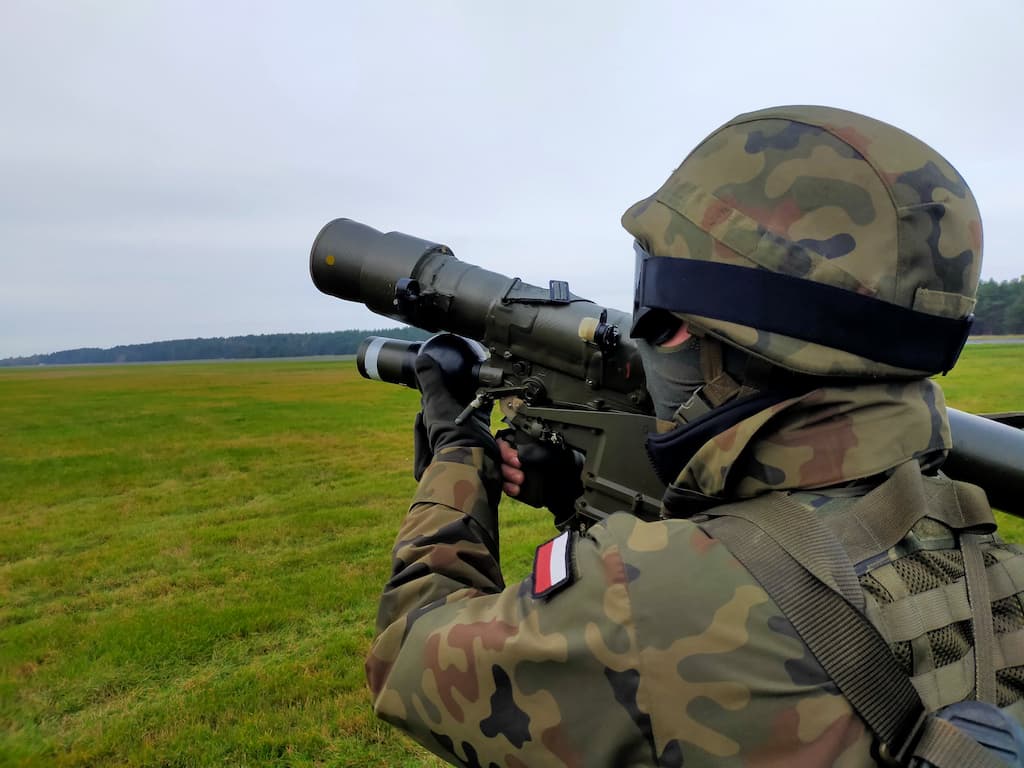
That Lithuania, Latvia, and Norway are participating in a Polish procurement is politically noteworthy. SAFE fundamentally requires joint procurement, and the Piorun contract shows for the first time what this principle can look like in a real Eastern European threat corridor. Especially because Norway, as a non-EU member, is involved, this process demonstrates that Europe's security cooperation has become institutionally more flexible. For Brussels, this is a success. For Warsaw, it is an industrial policy triumph. For the Baltic states, it is a quick response to the daily threat of drones and helicopters on NATO's eastern flank.
But is that enough? Only partially. The Piorun is a very useful system for the lowest layer of air defense. It is suitable against low-flying aircraft, helicopters, and especially against slower aerial targets in close range. According to the manufacturer, its range is up to 6.5 kilometers, with an engagement altitude of up to 4 kilometers. This is valuable for frontline troops, critical infrastructure, and mobile units. However, it is not a substitute for an integrated system of radar, command networks, medium-range capabilities, and cost-effective ammunition logic against mass drones. Europe is therefore procuring more tubes and more missiles, but still lacks a fully networked air defense from the foxhole to operational depth.
Why the Piorun is Politically Attractive
The success of the Piorun has a very concrete reason: it has been legitimized in Ukraine not theoretically, but practically. Polish MANPADS were among the visibly successful systems in the first phase of the war, transforming from a national niche product to a European reference item. This is ideal for governments. The system is combat-proven, relatively quick to produce, cheaper compared to Patriot or SAMP/T, and politically easy to communicate. Those who want to demonstrate capability today prefer to buy a proven short-range missile from Skarżysko-Kamienna rather than negotiate for years over a new pan-European program.
- Range: up to 6.5 kilometers
- Engagement altitude: up to 4 kilometers
- Operational profile: aircraft, helicopters, drones, low-flying targets
- Delivery horizon of the new contract: completion by 2030
However, this very attractiveness contains the second strategic irony. Europe is turning to the Piorun because the system appears to be immediately available compared to more complex solutions. Yet, as the threat from cruise missiles, glide bombs, ballistic systems, and drone swarms increases, merely expanding the MANPADS stockpiles will not suffice. One can close a gap with a Piorun; one cannot build an air defense pyramid with it.
SAFE Rewards Procurement, Not Automatically Integration
On paper, SAFE is a step in the right direction. The European Commission explicitly describes the instrument as a means for joint investments, joint procurement, and closing critical capability gaps. Up to 150 billion euros in long-term, favorably priced loans are intended to reduce the fragmentation of the European market. However, from Weber's perspective, caution is needed here. SAFE primarily addresses a financing problem. Europe's air defense is also an integration problem. Who orders which sensors, which ammunition, which data links, which training standards, and which maintenance capacities when?
The Piorun contract illustrates both aspects: Yes, Brussels can bundle demand. No, demand bundling does not yet create a common operational logic. If four states buy the same system, they still do not have a unified doctrine, a common spare parts planning, or a coordinated prioritization between frontline troops, territorial defense, and critical infrastructure. Joint procurement reduces prices and creates political visibility. Joint defense only emerges when procurement, training, logistics, and C2 architecture are integrated. This is precisely where Europe remains structurally slow.
The Industrial Lesson from Poland is Tougher than Brussels' Success Report
Perhaps the most revealing aspect is not the contract itself, but what it says about the Polish industry. PGZ and MESKO have increased the production capacity for Piorun missiles from around 300 to 1,500 units per year in just a few years and aim to exceed 2,000. At the same time, personnel has been expanded. This is not a detail. It shows that real European defense capability grows where a single state brings together political priority, funding, and industrial concentration. The European level only came into play once the national production model was already functioning.
This is the uncomfortable lesson for Berlin, Paris, and Brussels. European cooperation in this case does not begin with a supranational factory, but with scaling a national champion. The internal market only helps when someone is producing beforehand. In other words: SAFE distributes loans, but Poland delivers the factory discipline. This may seem unromantic from the perspective of European integration. Militarily, it is plausible.
Therefore, the Strategic Gain Remains Real but Limited
For NATO's eastern flank, the deal is still sensible. Poland, Lithuania, and Latvia live with the real prospect that the next crisis will not begin with a tank assault, but with drones, helicopters, sabotage, and limited air violations. In such an environment, every additional close-range intercept increases responsiveness. Norway is also strengthening a layer that is becoming more relevant in the far north against helicopters, drones, and low-flying targets. Thus, the contract is not mere symbolic politics. It creates real quantities.
However, the strategic limitation remains. Europe's air defense will not fail in 2026 due to the question of whether enough Piorun launchers have been ordered. It will be measured by whether a truly integrated, multi-layered, and industry-based resilient network emerges from many national protection islands. The new framework agreement is a useful building block for that. Nothing more. Europe's paradox remains: only when the danger becomes acute does the continent learn to buy together. But as long as it only buys together and does not integrate together, air defense remains an addition of national reflexes rather than a European capability.
Poland signed an 8 billion Zloty deal for the Piorun air defense system, involving Norway, Lithuania, and Latvia in a joint procurement effort. Over 80% of the systems will be allocated to the Polish Armed Forces, with the contract expected to be finalized by 2030. The Piorun system is designed to counter low-flying aircraft and drones, addressing immediate threats in the region.
- Poland signed an 8 billion Zloty deal for the Piorun air defense system.
- The deal involves several thousand missiles and hundreds of launchers.
- Over 80% of the procured systems will go to the Polish Armed Forces.
- The Piorun system is effective against low-flying aircraft and drones.
- The contract is expected to be completed by 2030.