
RAND 2026 Finds U.S. Navy Cannot Repair Arleigh Burke Destroyers Fast Enough for China War
 Marcus Chen
RAND 2026 Finds U.S. Navy Cannot Repair Arleigh Burke Destroyers Fast Enough for China War
Four repair scenarios were enough to expose the problem. In RAND's August 2025 tabletop exercise, Arleigh Burke-class destroyers took damage in the Strait of Malacca, the South China Sea, the Philippine defense fight, and a Taiwan invasion scenario. The common result was not dramatic. It was worse. The ships survived long enough to need help, and the U.S. Navy did not have a clean way to get them fixed quickly in theater.
That matters more than another debate over whether the fleet has 291 ships, 300 ships, or some future 355-ship target. In a Western Pacific fight, the count that matters is how many hulls can keep generating missile cells after the first week. A DDG-51 that limps to San Diego for repairs is not a combatant. It is a very expensive absence.
The Repair Fight Starts Before the First Missile Lands
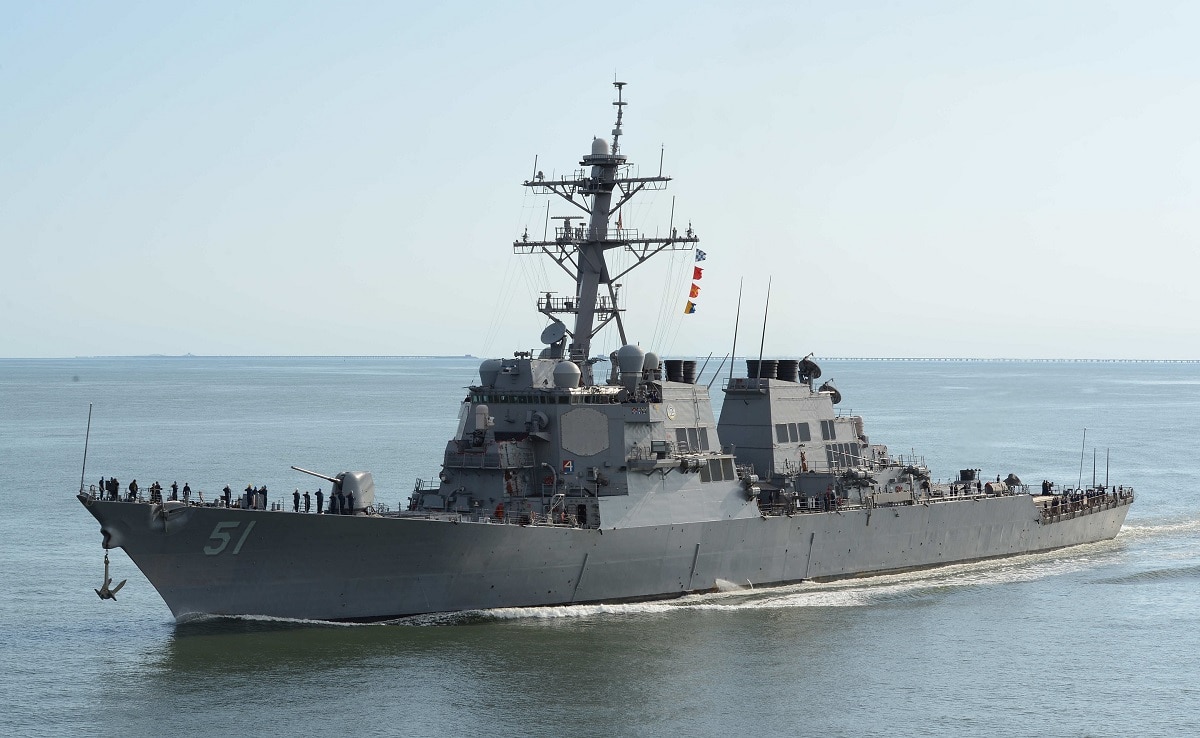
The RAND report, Battle Damage Repair for Arleigh Burke-Class Destroyers, is useful because it does not pretend warship repair is a generic logistics issue. It focuses on the Navy's workhorse: the DDG-51. Burkes carry Aegis combat systems, Standard Missiles, Tomahawks, vertical launch cells, helicopters, sensors, and the air-defense burden that keeps carriers, amphibious ships, and logistics vessels alive.
The class is large by U.S. standards but not replaceable in wartime. The Navy has more than 70 Arleigh Burke destroyers in service, yet only a fraction would be in the Western Pacific at the opening of a crisis. Some would be in maintenance. Some would be training. Some would be tied to carrier strike groups elsewhere. Anyone who has served on a destroyer knows availability is not the same as inventory.
RAND's core warning is blunt: the Navy has not faced damage at the level likely in a major war since World War II. A China scenario is not one ship taking a mine strike and waiting for a carefully staged salvage operation. It is multiple ships hit by anti-ship ballistic missiles, cruise missiles, rockets, gunfire, drones, torpedoes, or collision damage while the fight continues around them.
China Gets the Geography Bonus
Defense News summarized the problem well this week: battle-damaged U.S. warships could not be quickly repaired and returned to combat during a war with China. RAND analyst Bradley Martin added the line that should make planners uncomfortable: China is not only closer, it has significantly better industrial repair capability.
That is the geography tax the U.S. Navy keeps trying to outrun. A damaged Chinese destroyer or frigate operating near the Taiwan Strait can fall back toward a dense coastal industrial base. A damaged U.S. destroyer near Luzon or east of Taiwan faces a different map. Guam has military value but limited heavy repair depth. Japan, South Korea, and Australia have capable yards, but access is not automatic, and each yard sits inside a political decision cycle.
The distance math is ugly. From Taiwan to Guam is roughly 1,700 nautical miles. From Taiwan to Pearl Harbor is more than 4,500 nautical miles. From Taiwan to San Diego is more than 6,000 nautical miles. If a ship can make 15 knots after damage, Guam is nearly five days away in ideal conditions. Pearl Harbor is closer to two weeks. San Diego is a campaign-level disappearance.
That assumes the ship can safely transit, the route is open, the crew can keep the plant running, and the Navy is willing to pull escorts away from the fight to protect a wounded hull. Those assumptions are doing too much work.
Allied Shipyards Are Not Magic
Japan, South Korea, and Australia matter enormously, but RAND is right to challenge the lazy assumption that allied capacity can simply be penciled into a U.S. operational plan. Shipyards are physical assets inside sovereign countries. They have labor limits, commercial obligations, legal restrictions, ammunition-handling rules, security requirements, and vulnerability to Chinese missile pressure.
The tabletop exercise found that U.S. participants had knowledge gaps about host-nation ports, capabilities, and access requirements. That is not a minor staff failure. In war, repair decisions are time decisions. If the theater commander spends two days learning what a Japanese or Australian yard can legally do with a damaged American destroyer carrying ordnance, the ship is not regenerating combat power. It is waiting.
There is also an escalation problem. Repairing a U.S. warship that suffered battle damage near Taiwan is not the same political act as hosting a port visit. Beijing would understand the difference. Allied governments might still say yes, but the U.S. Navy cannot build its repair model around the hope that every capital will approve every request at every threat level.
The Parts Problem Is the Fleet Problem
The least glamorous part of RAND's report may be the most important. Poor availability of necessary parts can delay repair even after a host nation agrees to help. Burkes share a class name, but ships built across decades are not identical. Combat systems, radars, launchers, power systems, and control equipment vary by flight, modernization history, and local configuration.
That means the Navy cannot solve battle damage repair with a generic container marked “DDG parts.” It needs pre-positioned packages tied to actual hulls, repair teams trained to use them, and authority to move those packages without peacetime paperwork. RAND recommends deployable repair teams, flyaway assessment units, scalable expeditionary mobile repair facilities, and multinational pre-positioning. None of that is exotic. It is basic force regeneration.
The uncomfortable part is that peacetime efficiency pushed the Navy in the opposite direction. Lean inventories, just-in-time supply habits, and optimized shipyard schedules work until missiles start removing ships from the order of battle. A fleet designed to be efficient in port can be brittle at sea.
Exercises Need Broken Ships
The U.S. kicked off Valiant Shield 2026 and Resolute Dragon 26 in the Western Pacific this week, according to USNI News. Those exercises matter because they test deployment, joint fires, and allied coordination. But the repair problem needs to be exercised with the same seriousness as missile shoots and amphibious landings.
A realistic Pacific exercise should force commanders to answer several ugly questions. Which port takes the damaged DDG if Guam is saturated? Who authorizes ordnance handling in an allied yard? How many welders and electronics technicians can be flown forward in 24 hours? Which spare arrays, pumps, cables, and launch-system components are already west of Hawaii? What happens if Japan says yes to voyage repairs but no to a long repair period?
Those questions are not administrative. They determine whether the fleet can absorb hits and keep fighting. Sea control is not held by pristine ships on PowerPoint slides. It is held by damaged ships that still have radar, power, weapons, and a crew that knows the Navy can get them back into the line.
The Navy's China Problem Is Regeneration
Washington likes to talk about deterrence in terms of platforms: more submarines, more missiles, more unmanned systems, more bases. Platforms matter. But deterrence also depends on whether China believes the U.S. fleet can take punishment and regenerate combat power faster than the People's Liberation Army can impose losses.
Right now, RAND's answer is not reassuring. The Navy has organic repair capacity for limited fixes and for getting ships home. It does not yet have a wartime repair architecture built for multiple damaged destroyers across the first island chain.
The conclusion is simple enough to test. In the next major Pacific exercise, break three destroyers on paper and make the staff repair them under Chinese missile pressure, allied political constraints, and parts shortages. If the ships cannot return to the fight inside the operational timeline, then the fleet is smaller than Washington thinks.
The U.S. Navy struggles to repair Arleigh Burke-class destroyers quickly enough for potential conflicts with China, as highlighted in a RAND report from August 2025. The Navy's repair capabilities are inadequate for the level of damage expected in a major war, with logistical challenges exacerbated by geographical disadvantages and reliance on allied shipyards. RAND emphasizes the need for improved wartime repair architecture to ensure combat readiness.
- U.S. Navy cannot repair Arleigh Burke destroyers quickly enough for a potential conflict with China.
- RAND's tabletop exercise highlighted the Navy's inability to handle damage at the level expected in a major war.
- China has better industrial repair capabilities and geographical advantages for quick repairs.
- The Navy's current repair architecture is inadequate for multiple damaged destroyers in wartime.
- Logistical issues, including parts availability and allied shipyard capacity, complicate repair efforts.