
Rappel demonstrations are risky, but common among elite units

Source: Task & Purpose
Loading...Strong SignalCredibility: 81%
Report Content
The details behind the death of an Air Force special operations instructor killed during a rappelling demonstration Saturday will likely not be known for weeks or even months.
But rappelling demonstrations by military members at large public events, particularly involving highly trained special ops units, are not new.
Air Force Tech. Sgt. Ian Patterson, a Tactical Air Control Party instructor assigned to a training unit at Joint Base San Antonio, Texas, was killed when he fell from the rafters of that city’s Alamodome football stadium prior to a college football game. Patterson was participating in a rappelling demonstration before the game when he fell from the rafters, which are at least 160 feet above the playing field, according to the stadium’s technical manual.
Video of the accident appears to show Patterson holding or attached to rappelling lines but falling unchecked.
Though the Air Force has made no statement on the cause of the accident, some media commentary has suggested that Patterson’s death traces to recent recruiting and marketing blitzes under Secretary of Defense Pete Hegseth, who has pushed the military to project an action- and combat-oriented public persona.
The Daily Beast referred to the accident as “Hegseth’s stunt.” Another story by the publication echoed that framing, and then there were the round-ups of reactions from Newsweek and others that repeated much of the same.
The Air Force did not immediately respond to questions on what chain of command may have ordered or approved the demonstration, but military members rappelling into football games has been a common event across the country for at least a decade.
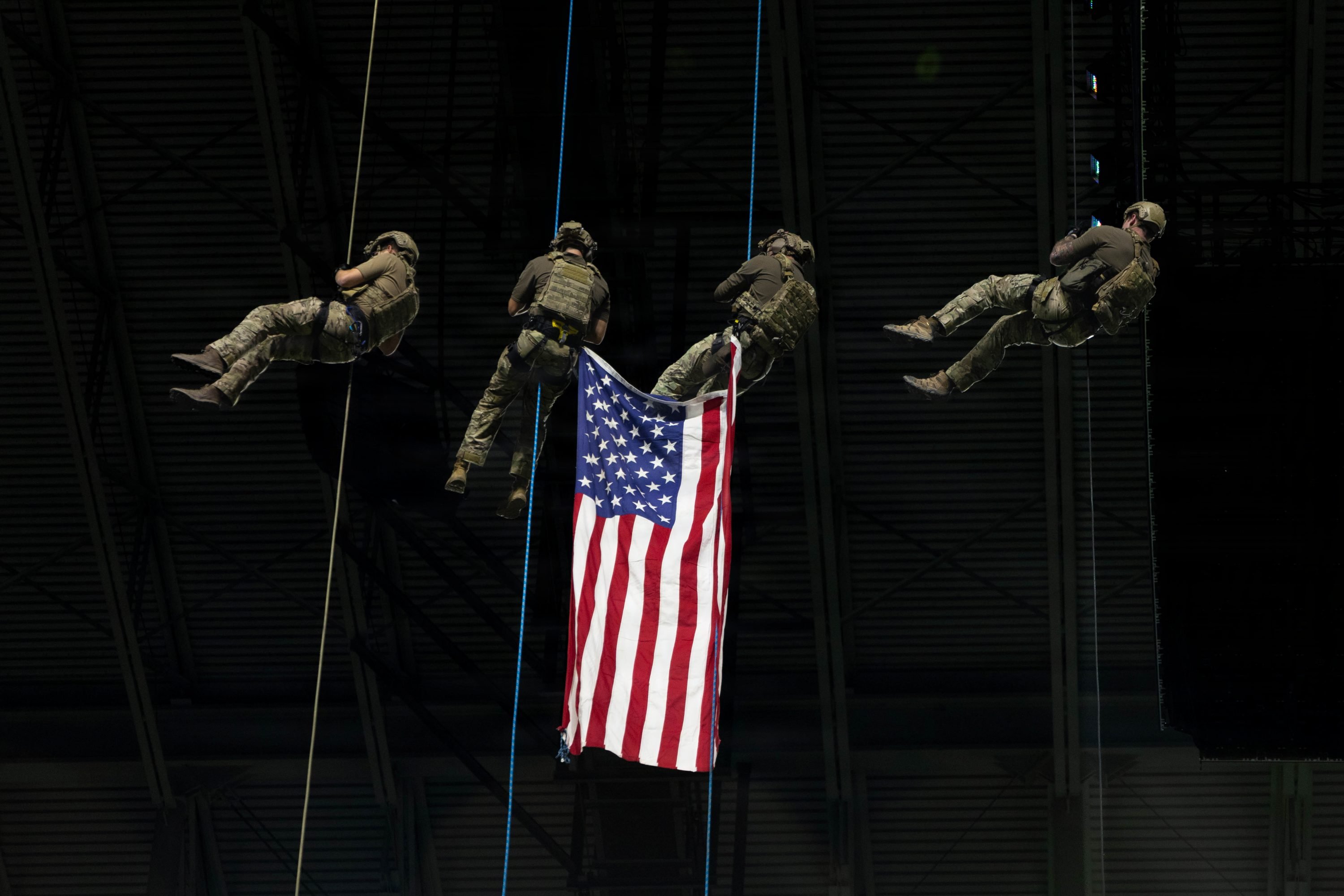 A group of soldiers rappel with an American flag for the National Anthem during an American Conference football game between the Army West Point Black Knights and University of Texas San Antonio, in Texas, Nov. 29, 2025. Army photo by Spc. David Dumas.
Just in San Antonio, groups of Air Force special warfare instructors stationed at Lackland, as Patterson was, along with groups of Army soldiers, have performed similar demonstrations at the Alamodome and the city’s AT&T Center at least four other times in recent years. Along with football games, military members have rappelled into San Antonio Spurs basketball games and the city’s annual stock show and rodeo, the latter in both 2023 and 2024, prior to Hegseth’s arrival at the Pentagon.
Dating back to at least 2018, military photographers have covered rappelling demonstrations in sports stadiums in Arizona, New York, Idaho, South Dakota, and California, and recorded rappel demonstrations from helicopters at several NASCAR race tracks.
Demonstrators are usually highly trained units
Many military members are exposed to rappelling during basic training or other early stages of their career. But the skill is an integral part of the job for most ground combat units that work in steep terrain or who deploy from helicopters. For helicopter operations, rappelling is considered an “alternate insertion” method, along with fast roping, for missions that lack a safe landing zone.
Many special operations units train specifically to rappel or fast rope in rescues and direct raids. Rappelling is fairly safe and can be done from nearly any height with a long enough rope, but only one team member can use a rope at a time. Fast roping allows several team members to slide down a thicker rope at once, but usually requires a lower hover and can lead to falls.
Rappelling derives from the mountain climbing world, where climbers slide down a rope to safely descend terrain too steep to climb or walk down. Using a mechanical brake or, less commonly, a simple knot, rappelling allows a single individual to slide down a rope very quickly while controlling their speed. A skilled rappeller can rapidly zip down a rope to a specific spot, stop quickly and “tie off” on the rope, keeping them suspended in one spot, such as when a rescuer needs to render aid to an injured patient on a cliff face.
Top Stories This Week
As a TACP instructor, Patterson would almost certainly have been an expert in the skill. TACP is one of four Air Force Special Warfare roles for which rappelling is a core job skill for both steep terrain and helicopter operations.
In August, the Air Force published a 19-photo gallery of Patterson’s unit, Detachment 2 of the 6th Combat Training Squadron, training in rappel techniques. The photos do not identify any airmen by name, but show both TACP instructors and students rappelling from a training tower and from inside a hovering helicopter at Camp Bullis, a training range outside of San Antonio.
Air Force rappel training for all of its Special Warfare roles follows Air Force training rules for rappelling, which are based on the Army’s rappelling manual, TC-21-24. That manual requires that rappel training be overseen by three separate roles for training on fixed structures like a tower. Each rappeller must be overseen by a Rappel Master, who is in charge of all aspects of the training; a Safety Officer, who ensures equipment and personnel are properly prepared; and a rappel lane non-commissioned officer who directly oversees each rappeller on one rope. Training can also include a specific belayer on the ground.
An Air Force investigation into Patterson’s death will review what procedures were in place during the accident.
The post Rappel demonstrations are risky, but common among elite units appeared first on Task & Purpose.
Classification
Region
North America
Analytical Domain
Operational
Primary Category / Secondary Categories
Casualties & Losses / Military Operations
SALUTE Report
Size
1 Air Force Tech. Sgt.
Activity
died during a rappelling demonstration
Location
San Antonio · Texas
Unit
Air Force Special Warfare
Time
Saturday
Equipment
rappelling lines
Summary
Air Force Tech. Sgt. Ian Patterson died during a rappelling demonstration at the Alamodome in San Antonio, Texas, on Saturday. He fell from a height of at least 160 feet while participating in the event. Patterson was a Tactical Air Control Party instructor, and his death is under investigation as military rappelling demonstrations have been common at public events for years.
Key Facts
- Air Force Tech. Sgt. Ian Patterson died during a rappelling demonstration at Alamodome in San Antonio, Texas.
- The fall occurred from a height of at least 160 feet.
- Patterson was a Tactical Air Control Party instructor.
- Rappelling demonstrations by military units have been common at public events for over a decade.
- An investigation into the circumstances of the accident is underway.