
RIMPAC 2026 Cannot Print Its Way Across the Pacific
 Marcus Chen
RIMPAC 2026 Cannot Print Its Way Across the Pacific
One autonomous boat drove parts to USS Essex during RIMPAC 2026. Another 14-foot unmanned surface vessel on display in Hawaii was printed for the exercise. A rugged micro-factory, according to Defense One's reporting from Schofield Barracks, can be parachuted from an aircraft and set up in minutes.
That is the right experiment. It is not yet the right answer.
The U.S. military is using the Rim of the Pacific exercise to test a problem that every Pacific commander can describe in his sleep: ships and aircraft break, spare parts move slowly, and a war inside the first island chain would punish any force that has to send damaged equipment back across the ocean. RIMPAC's advanced manufacturing demonstration is useful because it attacks the sustainment problem at the point of failure. But it also risks creating a comforting story that software, 3D printers, and autonomous skiffs can compensate for a logistics network still too thin for a prolonged fight.
What RIMPAC Actually Tested
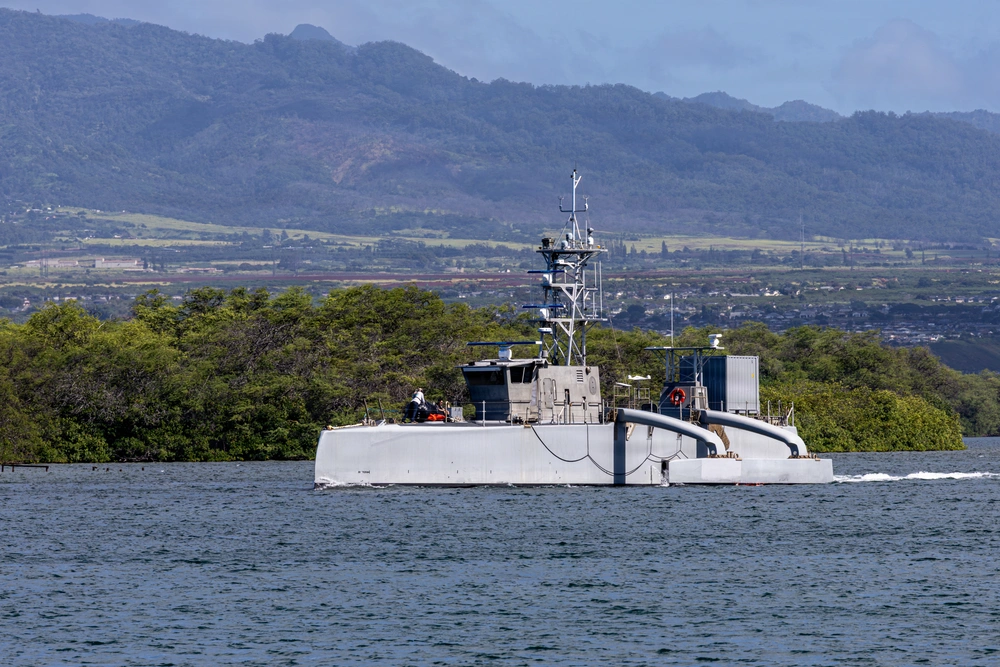
Rear Adm. Michael Mattis described this year's RIMPAC as involving 38 countries, 31 surface vessels, five submarines, more than 30,000 personnel, almost 180 aircraft, and more than 1,100 personnel conducting landings. That scale matters. A logistics technology that only works in a lab is a briefing slide. A technology that works when dozens of navies, ships, aircraft, pier schedules, spectrum conflicts, and command relationships are already in motion is at least worth serious attention.
The demonstration brought together three ideas: expeditionary advanced manufacturing, autonomous delivery, and artificial intelligence for matching demand to production. Firestorm showed a two-container manufacturing cell that can be set up by two people in a few hours. Norway's Fieldmade displayed a deployable additive manufacturing micro-factory. Snowbird Technologies showed a ship-capable containerized printer. Havoc presented a 14-foot autonomous boat. Splash Industries said its 10-foot Typhoon unmanned surface vessel conducted an autonomous resupply of USS Essex by entering the amphibious assault ship's well deck, then ran through rough water toward an aircraft carrier 100 miles from shore.
For anyone who has stood engineering watches on a deployed ship, the value is obvious. A $40 fitting, a cracked bracket, or a missing specialty part can immobilize a system whose replacement assembly is sitting in a warehouse thousands of miles away. The Navy does not lose combat power only when a missile hits steel. It loses combat power every time a broken part turns into days of waiting.
The Distance Math Still Wins
The hard numbers are ugly. In May, Defense One quoted U.S. Indo-Pacific Command's logistics and engineering strategy director describing Hawaii as 3,000 miles from the U.S. West Coast, Guam as 5,000 miles from Hawaii, and the first island chain as another 1,500 miles from Guam. That is not a route map. It is a warning label.
Gen. Xavier Brunson, the U.S. Forces Korea commander, put it more bluntly: the United States cannot win if its supply lines are 5,000 miles long. Maj. Gen. Gavin Gardner of the 8th Theater Sustainment Command said broken Army watercraft once had to be sent back to the U.S. West Coast, a process that could involve a 30-day sail from Australia. Korean dry docks have since overhauled U.S. ships, and the Army has expanded repair options in South Korea, Japan, the Philippines, Australia, and Singapore. That is the real model: distributed repair first, advanced manufacturing as an accelerator.
A printer can make selected parts. It cannot create trained machinists, certified materials, electrical components, bearings, pumps, ammunition stocks, fuel, dry docks, protected warehouses, or air and missile defense for the node that hosts it. An autonomous boat can move a Pelican case. It cannot replace a Military Sealift Command tanker, a roll-on/roll-off ship, or a pier that survives Chinese missile attack.
That distinction matters because Washington loves small systems that appear to solve large political problems. Cheap drones, autonomous boats, and printed parts are attractive because they suggest the United States can distribute risk without paying the full bill for bases, sealift, repair capacity, munitions stockpiles, and allied access agreements. The Pacific will not be fooled.
Autonomous Resupply Has a Survivability Problem
The Typhoon run to Essex is operationally interesting because it connects a small unmanned vessel to an amphibious ship at sea. In a crisis, that could reduce the number of crewed connectors exposed to surveillance and missile threat. It could also let widely distributed Marine or Navy units exchange small payloads without lighting up larger logistics movements.
But the payload scale is modest. A 10-foot drone boat can move urgent parts, batteries, medical supplies, sensors, or classified components. It does not move containerized reloads. It does not refuel a destroyer. It does not rearm a Marine Littoral Regiment. If the U.S. Navy treats these craft as a niche sustainment tool, they make sense. If it treats them as evidence that the logistics problem is being solved, it is kidding itself.
There is also the targeting problem. Unmanned vessels need communications, navigation, and recovery plans. In a contested environment, Chinese electronic warfare, cyber operations, maritime militia reporting, satellites, aircraft, and long-range fires would all compress the operating space. A small USV may be harder to justify shooting at with an expensive missile, but it is not invisible. The more valuable its cargo, the more it becomes part of the kill chain.
What Would Make This Real
RIMPAC should be treated as the beginning of a logistics standard, not a technology showcase. The useful questions are not whether a printer works in Hawaii or whether a drone boat can reach a ship 100 miles offshore. The useful questions are whether the same system can produce certified parts after two weeks of disrupted power, contaminated fuel, intermittent satellite links, cyber pressure, and a maintenance crew that has already been awake too long.
The Navy and Marine Corps need three metrics. First, how many mission-degrading failures can forward manufacturing actually fix without reach-back to the continental United States? Second, how fast can those parts be certified for flight, shipboard, or weapons-system use? Third, how many distributed nodes can be kept alive under missile threat without consuming more protection than the combat force can spare?
If RIMPAC 2026 produces honest answers to those questions, it will be more than another autonomy demonstration. It will show where the Pacific sustainment architecture is still brittle.
The lesson is not that 3D printers and autonomous boats are gimmicks. They are not. The lesson is that they are tactical tools inside a theater-wide logistics fight. The United States can print some parts forward. It still has to build the ports, contracts, repair authorities, stockpiles, ships, and allied access that make those parts matter.
Distance is not defeated by clever delivery. It is defeated by mass, redundancy, and repair capacity already forward when the first shot is fired. RIMPAC is testing the right tools. The danger is pretending the tools are the architecture.
RIMPAC 2026 involved 38 countries and over 30,000 personnel testing logistics and advanced manufacturing capabilities in Hawaii. The U.S. Navy demonstrated the use of autonomous boats and 3D printers to address supply chain challenges. The exercise highlighted the importance of maintaining operational readiness despite long supply lines and equipment failures. Key technologies included deployable manufacturing cells and unmanned surface vessels for resupply operations.
- RIMPAC 2026 involved 38 countries and over 30,000 personnel.
- The U.S. Navy tested advanced manufacturing and autonomous delivery systems.
- Logistics challenges highlighted include long supply lines and equipment failures.
- Autonomous vessels were used for resupply operations during the exercise.
- The report emphasizes the need for distributed repair and advanced manufacturing capabilities.