
Royal Navy seeks drones to clear maritime test ranges
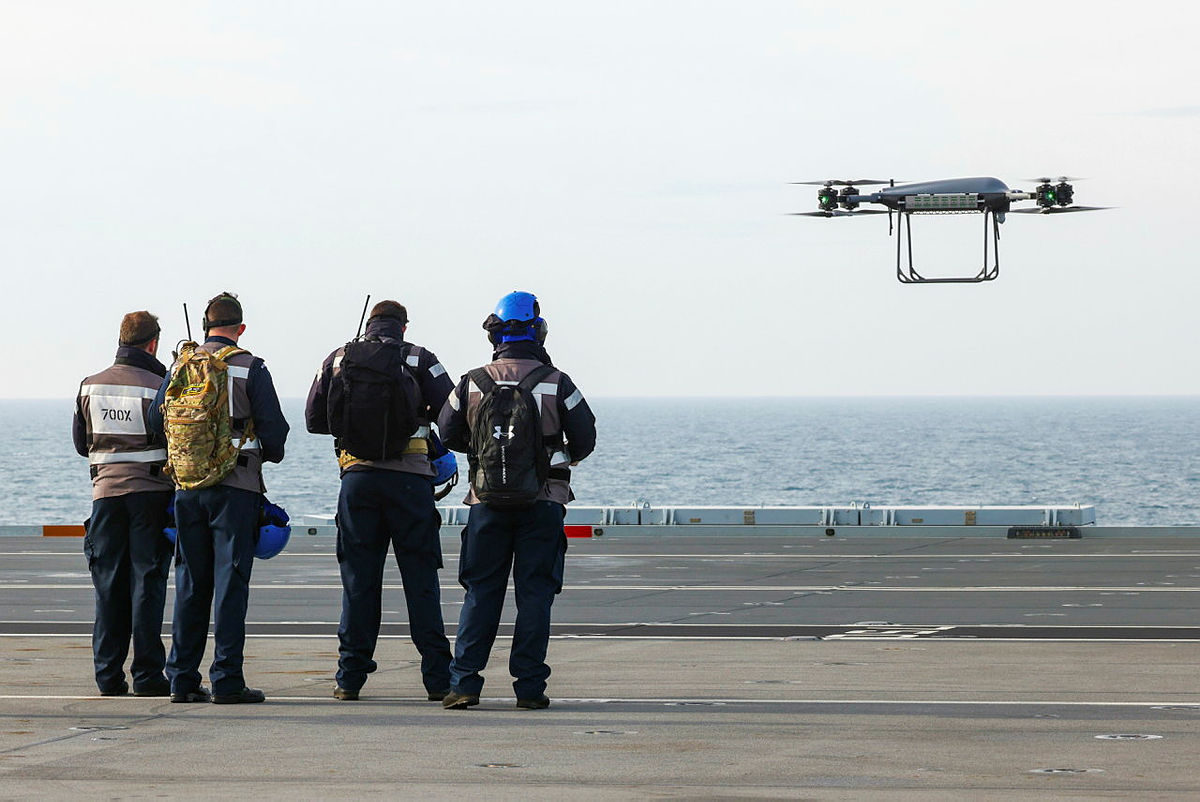
The Royal Navy has launched a formal Request for Information (RFI) seeking unmanned aerial systems capable of clearing and monitoring maritime weapons test ranges, Navy Command Headquarters announced on April 14, 2026.
The technical scope disclosed in the RFI published on the United Kingdom’s Defence Sourcing Portal and Contracts Finder is expansive. The Royal Navy has indicated that cleared ranges could span up to 500 kilometers by 800 kilometers at their widest points — roughly 350,000 square kilometers — though more typical operational clearance requirements would cover approximately 300 kilometers by 400 kilometers, or around 110,000 square kilometers. That is an area larger than Iceland and considerably larger than a typical commercial unmanned aerial vehicle is designed to monitor without advanced endurance and communication architectures.
To assess what the market can offer, the Navy is asking potential suppliers to detail a range of platform specifications, including dimensions, weight, cruising and maximum speed, operating altitude, and both laden and unladen endurance and range. The service is also seeking information on available sensor payloads — electro-optical cameras, radar, and similar systems — maximum payload capacity, command and control methods such as Iridium or Starlink satellite links, ADS-B transponder compatibility, and lost-link protocols. Civil Aviation Authority approval for UK flight operations is also a listed evaluation criterion, underscoring that these platforms would need to operate within controlled and uncontrolled airspace above active maritime zones.
The operational problem the Royal Navy is trying to solve is straightforward: before the service can fire a weapon or test sensitive equipment at sea, it must first confirm that no military or civilian vessels or aircraft are present within the required safety corridors around the range. Currently, that clearance function falls to crewed aerial platforms, typically fixed-wing aircraft or helicopters tasked to fly designated patterns and report the area clear. The system works, but it has a significant vulnerability. If those crewed assets are redirected to support urgent operational requirements — a realistic scenario for a navy managing persistent global commitments — planned trials must be postponed or scaled back entirely.
That dependency has operational and budgetary consequences. Defense equipment trials underpin fleet readiness, with delays cascading into certification timelines, crew training schedules, and capability delivery milestones. An uncrewed solution capable of performing the same clearance and assurance function independently would insulate the testing program from the unpredictable demands of maritime operations, allowing the Royal Navy to maintain its trials schedule regardless of where its crewed aviation assets are committed on any given day.
The Royal Navy’s decision to engage industry formally on the question suggests the service has already assessed that the market may have credible answers.
Companies wishing to respond must submit their answers by the April 28 deadline.
Content preview only. Full article available at source. View Full Article
The Royal Navy has issued a Request for Information (RFI) for unmanned aerial systems to clear and monitor maritime weapons test ranges, announced on April 14, 2026. The operational area for these systems could reach up to 500 km by 800 km. This initiative aims to reduce reliance on crewed aircraft for range clearance, allowing for more efficient testing schedules. Suppliers must submit their proposals by April 28, 2026.
- The Royal Navy is seeking unmanned aerial systems for maritime weapons test range clearance.
- The RFI was announced on April 14, 2026.
- The operational area for clearance could be up to 500 km by 800 km.
- The Royal Navy aims to reduce dependency on crewed aerial platforms for range clearance.
- Responses to the RFI are due by April 28, 2026.