
Russia allocated 44 percent of its budget to war and is testing the limits of its military economy in 2026.
 S.W
S.WRussia Allocated 44 Percent of Its Budget to War and Is Testing the Limits of Military Economy in 2026
A figure that Moscow prefers not to explain
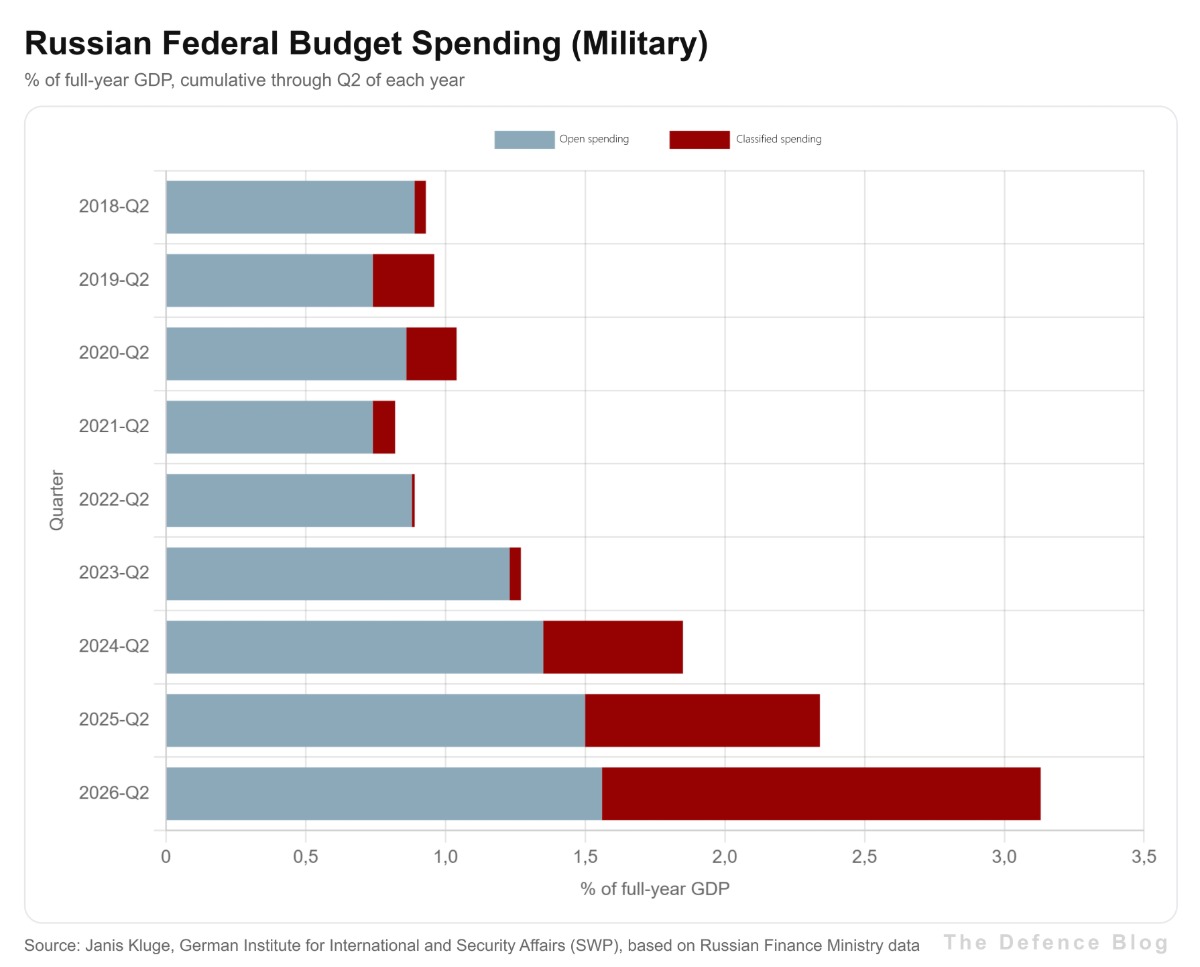
In the first half of 2026, military needs accounted for 43.8 percent of federal expenditures in Russia. This is not a forecast or an estimate from Western intelligence, but a calculation by German economist Janis Kluge based on data from the Russian Ministry of Finance, published on September 4. In absolute terms, this amounts to 10.7 trillion rubles, approximately 125 billion dollars at the current exchange rate, which is 30 percent more than the same period in 2025. For a state that continues to speak of a normally functioning economy, this figure appears almost indecently high.
However, the share alone does not describe the problem. Military spending reached 10.5 percent of GDP in the first half of the year and 57.3 percent of federal budget revenues. In other words, more than half of the taxes and other revenues collected by Moscow were directed towards the war, maintaining the army, and related procurements. This is where the convenient rhetoric about the temporary mobilization of resources ends, and the institutional restructuring of the state begins.
The secret line has become the main channel of funding
The main increase came not from open funding for the Ministry of Defense, but from classified items. The budget law for 2026 provided for 11.6 trillion rubles in such expenditures for the entire year, but already after six months, the execution exceeded 8.4 trillion. The Russian budget documents analyzed by Kluge suggest that about 85 percent of this category in previous quarters was related to military needs. Therefore, the formal distinction between "defense," "security," and classified expenditures increasingly reflects less the actual purpose of the money.
The dynamics are particularly indicative in historical comparison. In the first half of 2018, the army accounted for 24.5 percent of federal expenditures; in 2020-2021, the figure was around 20 percent. It then rose to 29.6 percent in 2023, 36.6 percent in 2024, and 39.3 percent in 2025. In just one year, Russia added about 4.5 percentage points. This is no longer just a "military budget," but a budgetary model in which civilian priorities are forced to compete with the front under inherently unequal conditions.
Why the increase in spending does not equal an increase in capabilities
The Kremlin is indeed capable of buying ammunition, drones, missiles, and regional loyalty with high payments for some time. However, a ruble directed towards war does not automatically convert into a ruble of military effectiveness. The price of armaments is influenced by imported components, parallel imports, a shortage of skilled workers, and rising credit costs. At the same time, secrecy complicates external oversight and internal assessment of results. The system may demonstrate record utilization of funds while simultaneously producing more simple strike drones and fewer complex platforms that require microelectronics, optics, and precision machine tools.
In this sense, the current situation resembles not the Soviet mobilization economy of the 1940s, but rather the late Soviet habit of concealing structural imbalances behind gross indicators. The Soviet Union could increase the production of tanks and missiles for years, but it could not endlessly compensate for technological lag with sheer mass. Today's Russia has a more flexible private sector and supply channels through third countries, but sanctions increase costs, and dependence on external components becomes less transparent, not less real.
Oil rent no longer covers military appetite
Financial pressure is exacerbated by declining energy revenues. According to data presented in Kluge's analysis and reported by Defence Blog, oil and gas revenues in the first quarter of 2026 fell by about 45 percent year-on-year. They are affected by sanctions against exports and a stronger ruble, which reduces the ruble value of dollar revenues. Non-oil and gas revenues increased by approximately 7 percent, but this was not enough. Bloomberg, for its part, reported that Russian financial officials warned Vladimir Putin about the difficult compatibility of the current level of military spending with budgetary sustainability.
There is also an important caveat. A straightforward extrapolation of the first half of the year overestimates the expected share of military spending in annual GDP: budget execution typically slows down in the second and third quarters. Additionally, unusually low classified expenditures at the end of 2025 may have indicated a deferral of payments to 2026 to meet last year's deficit plan. This does not negate the trend but merely makes its measurement more precise. The record may be partially calendar-related, but 57.1 trillion rubles in direct military expenditures since February 2022 cannot be explained by the calendar alone.
Strategic conclusions for war and the post-war period
For the front, such a budget means Moscow's ability to continue the war even without major operational successes. Russia can compensate for losses with personnel and ammunition, maintain pressure with drones, and simultaneously wait for the opponent to tire first. But this strategy buys time at the cost of future maneuverability. The more money goes into classified military contours, the harder it becomes to finance the infrastructure, healthcare, and civilian technologies necessary for restoring productivity.
Therefore, declaring the Russian economy as "collapsed" would be as lazy as taking its record expenditures as a sign of strength. It is more accurate to speak of a state that still retains the ability to wage war but pays increasingly dearly for each subsequent year. The Russian military-industrial complex will survive and will likely continue to produce mass systems. The condition is simple: war must remain a priority with virtually no limits. If oil revenues do not recover and front-line needs grow, Moscow will face not an immediate bankruptcy but a slow displacement of the civilian economy by military expenditures—a process whose consequences will become apparent only after years.
Sources
- Janis Kluge, analysis of data from the Russian Ministry of Finance, September 4, 2026.
- Defence Blog, "Russia’s military spending hits a record 44% of its budget," September 9, 2026.
- Ministry of Finance of the Russian Federation, published data on federal budget execution and OFZ documents, September 2026.
- Bloomberg, reports on warnings from Russian financial officials regarding the availability of military expenditures, cited by Defence Blog.
Russia allocated 44% of its federal budget to military needs in the first half of 2026, reflecting a significant increase in military spending. This allocation represents 10.5% of GDP and 57.3% of federal revenues, indicating a shift in economic priorities towards defense. The report highlights concerns over the sustainability of such spending amid declining energy revenues and the implications for the civilian economy.
- Russia allocated 44% of its budget to military needs in the first half of 2026.
- Military spending reached 10.5% of GDP and 57.3% of federal budget revenues.
- The increase in military spending is 30% higher than the same period in 2025.
- Secrecy around military expenditures complicates external oversight.
- Energy revenue has decreased by approximately 45% year-on-year, impacting budget sustainability.