
Russia reveals how its new automated drone defense system works

Russia has publicly released footage of its Zubr automated counter-drone system operating for the first time, showing the weapon detecting, tracking, and engaging aerial targets with minimal human involvement.
The release came alongside confirmation from Rostec, Russia’s state-owned defense conglomerate, that the first batch of Zubr systems has already entered active duty protecting critical infrastructure across the country. It is the first time Moscow has shown the system not as an exhibition model but as a functioning weapon doing the job it was built to do.
Russia first unveiled the system publicly at the Army-2024 defense exhibition in August 2024, where it drew attention as a concept. What the new release shows is the system in operation: the radar picking up an incoming target, the automated tracking locking on without operator input, and the gun modules responding. According to the developers, the Zubr system independently detects drones and automatically tracks them, with the operator required only to make a decision and give the command to engage. That division of labor, machine handles detection and tracking, human handles the shoot decision, is the core design philosophy behind the system and the feature Russia most wanted to demonstrate publicly.
Each Zubr system consists of four towed firing units, a centralized control center, and its own dedicated radar station. Each firing unit carries its own electro-optical targeting system and is armed with four PKT or PKTM 7.62 mm machine guns, the same caliber used in Soviet and Russian tank-mounted weapons for decades, now arrayed four barrels per module across a system designed to fill the airspace around an incoming drone with enough fire to guarantee a kill. With four modules per system and four guns per module, a single Zubr complex brings sixteen machine gun barrels to bear simultaneously on any aerial threat entering its engagement zone.
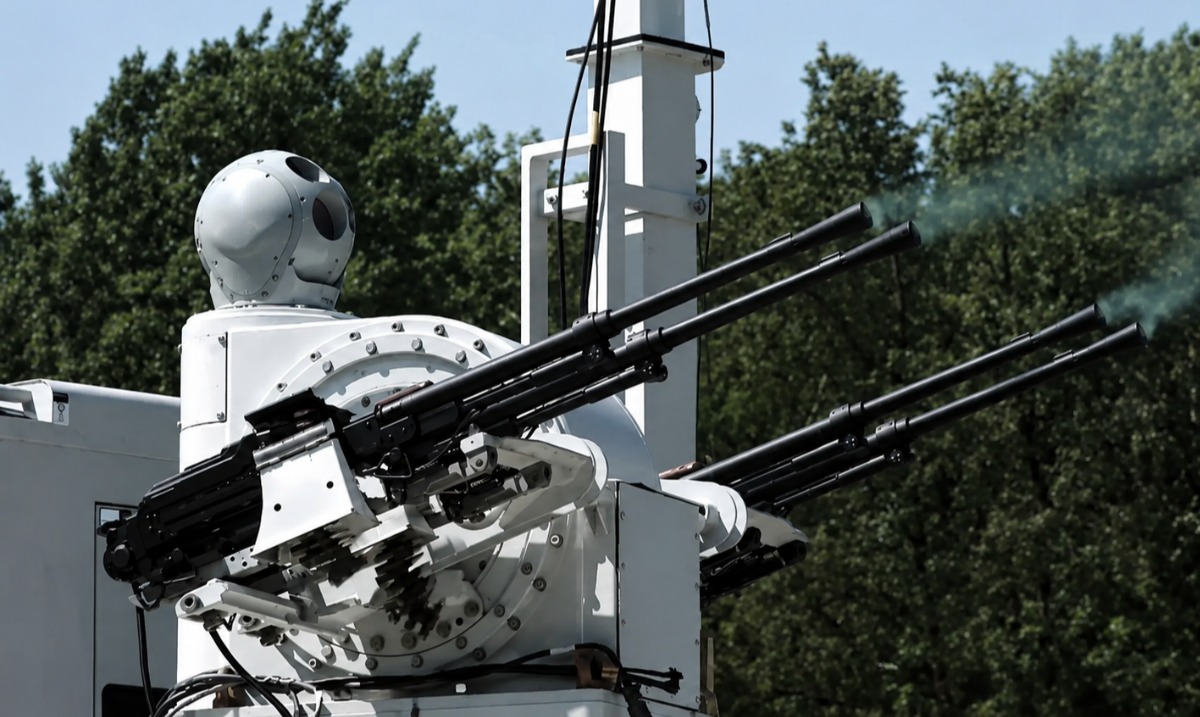 Screengrab from video posted to social media
The radar station built into the Zubr can detect both large and small aerial targets at ranges of up to 1.5 km (0.93 miles), providing enough warning distance to complete a targeting solution and open fire before a fast-moving drone closes to impact range. The system operates around the clock, which matters because Ukrainian drone strikes on Russian territory have increasingly shifted to nighttime windows when visual detection by cameras or guards becomes unreliable. Radar-based detection removes that vulnerability by making darkness irrelevant to the acquisition process.
“During testing, the complex demonstrated high effectiveness against small-sized and high-speed targets,” said Bekhan Ozdoev, industrial director of Rostec’s weapons cluster and a member of the bureau of the Russian Union of Machine Builders. Those claims carry the standard caveats that apply to any state defense contractor’s self-assessment of its own product, and independent verification of the Zubr’s real-world intercept record is not available. What the footage does confirm is that the system functions as a coherent integrated unit, with radar, tracking, and fire control working together rather than as separate manually operated components.
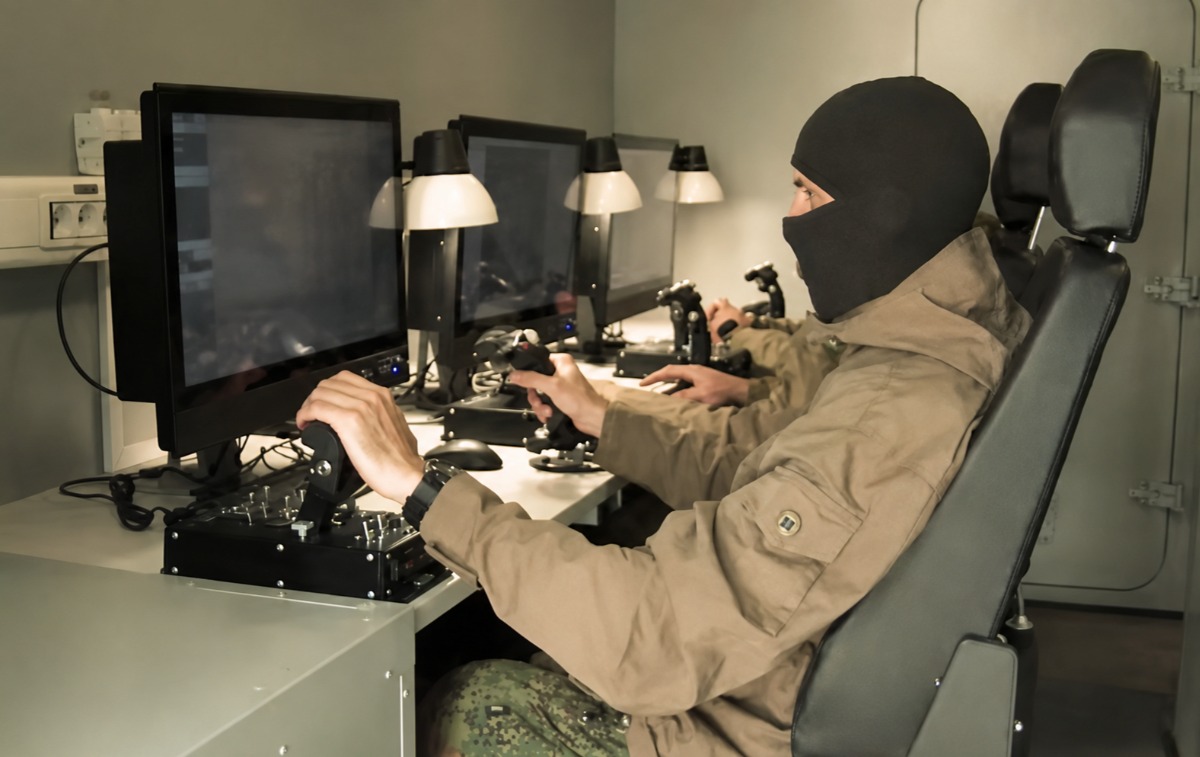 Screengrab from video posted to social media
Analysts estimated the effective engagement range against small FPV drones at roughly 370 to 450 meters (1,215 to 1,475 feet), placing the Zubr firmly in the terminal defense category. Terminal defense means the system is not designed to intercept threats at distance; it is the last line of firepower between an incoming drone and the facility it was sent to destroy, engaging targets in the final seconds of their flight when every other layer of air defense has already been bypassed or exhausted. Russia has framed that positioning honestly, describing the Zubr as coverage for the “close-range zone” around sensitive sites rather than a wide-area solution.
The context for the Zubr’s deployment is the sustained and escalating Ukrainian drone campaign against Russian territory. Ukraine’s Security Service stated that its Alpha Unit alone destroyed Russian air defense systems worth approximately $4 billion in 2025, a figure that illustrates the scale of attrition Moscow has absorbed across its defensive network and explains the urgency behind fielding automated close-in systems that don’t depend on expensive interceptor missiles. Cheap gun-based terminal defense, automated enough to react faster than a human operator, is a logical answer to cheap attack drones arriving in numbers too large for missile-based systems to handle cost-effectively.
Content preview only. Full article available at source. View Full Article
Russia demonstrated its Zubr automated counter-drone system, which detects, tracks, and engages aerial threats with minimal human input. The system, now active in protecting critical infrastructure, consists of four towed firing units armed with machine guns and operates continuously, effectively countering drone threats, especially at night. This marks the first operational display of the Zubr since its unveiling at the Army-2024 exhibition in August 2024.
- The Zubr system can detect and engage aerial targets with minimal human involvement.
- Each Zubr system consists of four towed firing units and a centralized control center.
- The system operates around the clock, effectively countering nighttime drone strikes.
- The effective engagement range against small drones is estimated at 370 to 450 meters.
- The Zubr is designed as a terminal defense system for critical infrastructure.