
Russian "Geraniums" receive Chinese cameras and change the war for Ukraine's rear in 2026
 Dmitri Volkov
Russian "Geraniums" Receive Chinese Cameras and Change the War Behind Ukraine's Lines in 2026
The most important figure in the new phase of the air war is not the number of drones launched, but the distance at which they begin to see their target. According to field data, Russian "Geraniums" equipped with Chinese cameras and radio modems can maintain practical effectiveness at a range of approximately 200 kilometers. This does not yet turn the Shahed-136 into a "flying Lancet," but it does change the risk calculation for Ukrainian railways, rear hubs, and supply columns.
From a Disposable Device to a Guided Munition
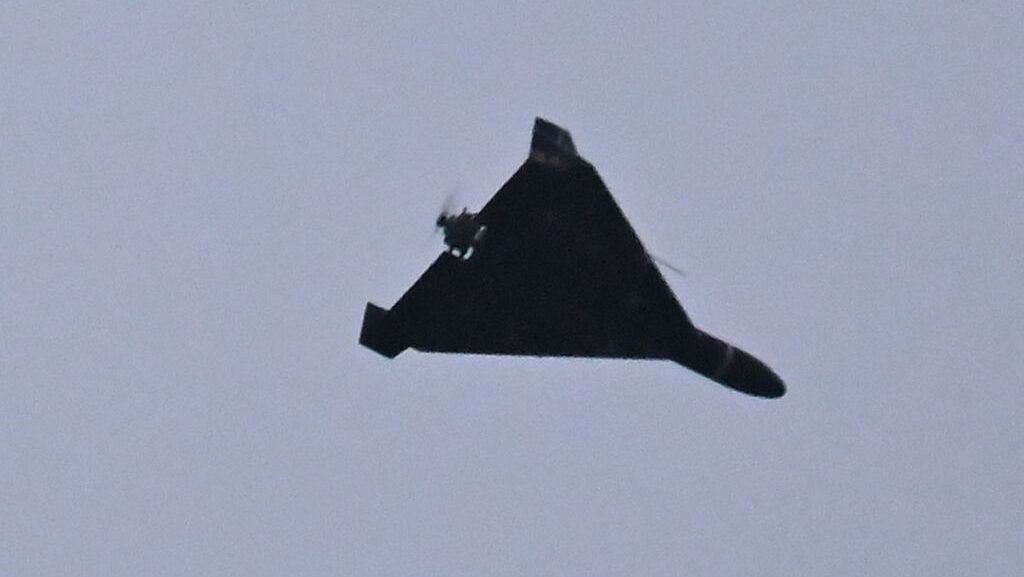
The classic "Geranium-2" was a relatively simple loitering munition: the route was predetermined, navigation relied on an inertial system and satellite signals, and the operator did not participate in the final selection of the target point. In the discovered wreckage of new variants, according to Ukrainian specialist Serhii Flash and analysis by Defence Express, there are Chinese cameras and radio modems. This combination provides the operator with a video channel and the ability to adjust the course in the final segment.
A technical detail here is more important than a marketing label. The "Geranium" retains the limitations of a large, relatively slow device with a warhead of about 50 kilograms. It lacks the maneuverability of a compact FPV drone and cannot reliably pursue a single fast-moving vehicle. However, against a train, a convoy, a transshipment point, or large equipment located in a predictable place, even limited correction significantly increases the probability of a hit. The estimated operational range of about 200 kilometers should still be considered indicative rather than a passport characteristic.
Why the Target is Not the City, but the Logistics System
The Ukrainian report for October 29 mentioned 189 combat engagements, 257 guided bombs, and over 9,000 kamikaze drones used in the previous day. These figures reflect the position of the Ukrainian side and require independent verification; however, they demonstrate the scale of saturation of the front with cheap means of destruction. Against this backdrop, the camera transforms some "Geraniums" from a tool of area pressure into a means of hunting for nodes through which the war passes.
The railway network is particularly vulnerable for structural reasons: its movement is predictable, and mass cargo cannot be instantly dispersed. If the operator receives a stable image at least in the final stage of flight, they do not need to hit the entire object. It is sufficient to disrupt one bridge, locomotive, ammunition car, or transshipment point for the delay to propagate through the chain. For the Russian army, this is more advantageous than spending an expensive cruise missile on every rear target.
Chinese Components and the Limits of Russian Adaptation
The emergence of Chinese cameras and modems has a dual significance. On one hand, it demonstrates the ability of the Russian military-industrial complex to quickly assemble a new configuration from available components without waiting for the full development of a domestic system. This is typical logic of military economics in a protracted war: not an ideal platform, but a sufficiently good serial unit that can be mounted on thousands of airframes.
On the other hand, dependence on imported electronics indicates the technological limit of this adaptation. A camera alone does not create an intelligence-strike loop. A secure communication channel, ground operators, repeaters, software, and stable navigation in conditions of Ukrainian electronic warfare are needed. The more actively the Russian side uses online correction, the more emissions and vulnerable links appear in the control chain. The adversary gains new opportunities to suppress the channel, detect operators, and introduce false coordinates.
Ground Robots as Part of the Same Logic
Simultaneously, another direction of Russian adaptation is being noted: ground robotic platforms with electronic warfare systems designed to intercept aerial drones. The Hudson Institute describes them as "soft kill" systems that are supposed to protect positions without expending expensive missiles. This is not a coincidence. Russia is simultaneously improving its own strike UAVs while trying to reduce the cost of intercepting them.
This creates a closed cycle: the "Geranium" threatens rear logistics, the ground robot covers the front line from Ukrainian drones, and electronic warfare becomes not an auxiliary means but a basic infrastructure of combat. However, serial production does not equal quality. If the remotely controlled "Geranium" operates effectively only in favorable communication conditions, its mass application will depend on the weather, terrain, density of Ukrainian EW assets, and Russia's ability to replenish Chinese components.
Forecast Without Technological Optimism
The new "Geraniums" are not a revolution and do not negate Ukrainian air defense. Their significance is more modest and dangerous: they gradually blur the line between a strategic strike drone and a tactical munition, forcing the defense of not only cities but also every major movement deep within the country. The Ukrainian side will have to combine camouflage and dispersion with layered suppression of control channels, rather than relying solely on shooting down airframes.
The Russian military system once again demonstrates a strong side that is often underestimated: the ability to transform commercial electronics and frontline observations into serial design changes. But this is a strength of improvisation, not a sign of technological independence. In the coming months, the crucial factor will not be the presence of a camera, but whether Russia can ensure secure communication and mass production of the entire system. If it cannot, the "smart" "Geranium" will remain an expensive exception among cheap disposable devices.
Sources: Defence Express, "Field Reports Suggest Camera-Linked Shahed UAVs Can Operate Effectively up to About 200 km" (October 29, 2026); Hudson Institute, "Ukraine Military Situation Report" (October 29, 2026); EMPR, combat operations report for October 29, 2026.
Russian 'Geran' drones have been upgraded with Chinese cameras and radio modems, allowing them to effectively target Ukrainian logistics from a distance of up to 200 kilometers. This shift in focus from urban areas to supply lines enhances the threat to Ukraine's railway and supply networks. The integration of foreign technology highlights Russia's adaptability in warfare, although operational success depends on secure communication and environmental factors.
- Russian 'Geran' drones can operate effectively up to 200 kilometers with new Chinese cameras and radio modems.
- The drones are shifting focus from urban targets to logistical systems in Ukraine.
- The integration of Chinese technology demonstrates Russia's ability to adapt quickly to battlefield needs.
- The operational effectiveness of these drones is contingent on secure communication and environmental conditions.