
Russia's 2026 Admiral Nakhimov Return Creates One Giant Liability
 Alexandra Reeves
Russia's 2026 Admiral Nakhimov Return Creates One Giant Liability
Russia has finally pushed Admiral Nakhimov back toward service, and Moscow would like the world to see a resurrected giant. The more useful reading is less flattering. A 28,000-ton nuclear battlecruiser entering final trials in 2026 is not just a symbol of Russian naval ambition. It is a very expensive bet that the age of the irreplaceable surface combatant is not over.
That is a bold bet to make after the Black Sea.
According to 19FortyFive, the modernized Kirov-class battlecruiser has moved through final sea trials after a refit that began with the ship's long lay-up at Sevmash and consumed more than a decade of active modernization work. Defence UA, citing Russian and open-source reporting, puts the broader saga even more starkly: Admiral Nakhimov has been waiting, rebuilding, or testing since the late 1990s. A ship commissioned in 1988 has spent much of its adult life as a project rather than as a fleet asset.
The Firepower Is Real
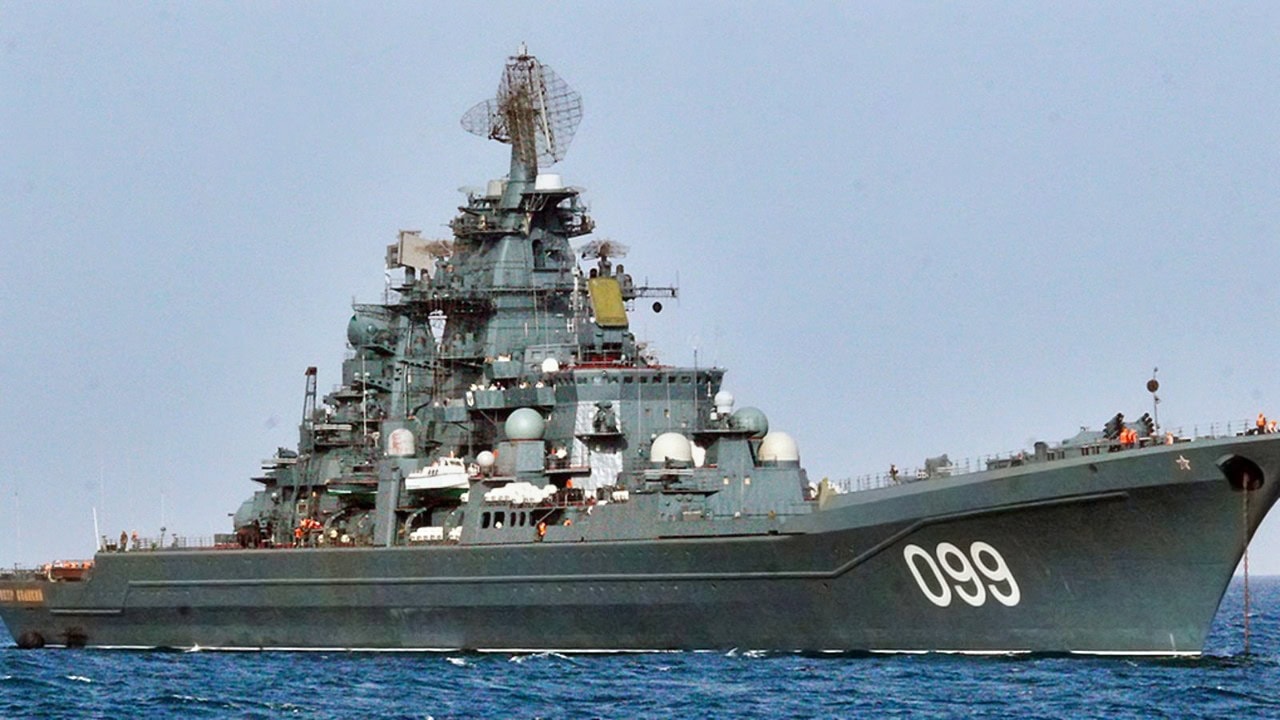
Let's not pretend the ship is harmless. Naval News describes the Kirov class as the largest and most heavily armed surface combatant in the world, below aircraft carriers in displacement but above ordinary cruisers in sheer mass and magazine depth. Admiral Nakhimov reportedly replaces its old P-700 Granit anti-ship missiles with roughly 80 UKSK 3S14 vertical launch cells. Those cells can carry Kalibr cruise missiles, P-800 Oniks, and potentially the 3M22 Zircon hypersonic missile.
When air defence cells are included, open-source reporting cited by 19FortyFive and Army Recognition places the total vertical-launch fit as high as about 176 cells. That number matters. An Arleigh Burke destroyer carries up to 96 cells total. China's Type 055 carries around 112. Admiral Nakhimov, if the reported fit is accurate, is in a different category for surface missile capacity.
The ship also retains the great Cold War advantage of nuclear propulsion. Its two reactors give it endurance and speed that make sense in the Northern Fleet's operating area. In the Barents Sea and around Russia's Arctic bastion, distance is not a detail. It is the theatre.
The Cost Is the Point
The awkward question is not whether Admiral Nakhimov is powerful. It is whether Russia bought the right kind of power.
Naval News notes estimates as high as $5 billion for the modernization. 19FortyFive cites unofficial estimates around 200 billion rubles, roughly $2.67 billion, compared with a 2013 contract near 50 billion rubles. Even allowing for currency swings, sanctions, secrecy, and Russia's messy defence accounting, the direction is obvious. This was not a clean refit. It was an industrial marathon for one hull.
That is where Moscow's prestige story starts to look thin. Five smaller frigates with 16 UKSK cells each would spread a similar strike load across multiple platforms. They would not have Nakhimov's theatre air-defence battery or nuclear endurance, but they would create a fleet problem rather than a single target problem. Modern naval war rewards distribution. Russia has rebuilt concentration.
Everyone loves magazine depth until the magazine is sitting in one place.
The Moskva Lesson Still Applies
The Russian Navy already received the unpleasant briefing. In April 2022, Ukraine struck and sank Moskva, the Black Sea Fleet flagship, with Neptune anti-ship missiles. Since then, Ukrainian uncrewed surface vessels have repeatedly forced Russian ships to adapt, withdraw, disperse, or hide. The point is not that a Ukrainian drone boat is about to appear in the Barents Sea tomorrow morning. It is that cheap weapons have changed the risk calculation for expensive ships.
Naval News makes this argument directly, noting that uncrewed surface, subsurface, and aerial systems create defensive problems that are not solved by looking impressive in port. A large ship can carry more sensors, missiles, jammers, guns, and command systems. It also presents a larger political prize. If Admiral Nakhimov is damaged, Moscow loses more than steel. It loses the story it spent decades rebuilding.
This is where some Western commentary can get lazy. The Arctic is not the Black Sea, and Russia is not sending Nakhimov to duel Ukrainian sea drones off Sevastopol. The ship's most plausible mission is Northern Fleet bastion defence, helping protect the approaches to Russia's ballistic missile submarines. In that role, long endurance, heavy air defence, and command capacity are not vanity features. They are useful.
But useful is not the same as wise. A single overbuilt escort for a nuclear bastion is still a single overbuilt escort. It must be protected, maintained, crewed, modernized, and politically shielded. It cannot be in two places at once. If it is kept near the bastion, it is less useful as a global power-projection asset. If it is sent abroad to wave the flag, it is not doing bastion defence.
NATO Should Watch the Arctic, Not the Parade
For NATO, the right reaction is neither panic nor mockery. Panic would overstate what one ship can do. Mockery would miss why Moscow wants it.
Admiral Nakhimov tells us Russia still cares deeply about the Northern Fleet and the nuclear submarine bastion behind it. That is the strategic signal. The ship is not mainly about chasing carrier groups across the Atlantic. It is about hardening the maritime layer around Russia's survivable nuclear force, while also giving the Kremlin a prestige platform at a time when Admiral Kuznetsov remains a running embarrassment.
NATO planners should therefore watch three things. First, whether Nakhimov actually deploys with the reported weapons fit or continues to slip through testing. Second, whether Pyotr Velikiy is retired, leaving Russia with one usable nuclear battlecruiser rather than two. Third, whether the Northern Fleet builds a real protective network around the ship, including submarines, maritime patrol aircraft, coastal sensors, and drone defences.
The short answer is this: Admiral Nakhimov is a threat, but not the threat Moscow wants it to be. It is less a reborn Soviet dreadnought than a floating audit of Russian naval priorities. Russia has built an enormous missile magazine for the Arctic. Now it has to prove that one giant ship is a strategy, not just a very expensive object that everyone knows where to find.
Admiral Nakhimov is returning to service in 2026 after extensive modernization, undergoing final trials in the Barents Sea. The Russian Navy's nuclear battlecruiser features advanced missile capabilities, including 176 vertical launch cells for various missile types. This modernization, costing between $2.67 billion and $5 billion, aims to enhance Russia's naval power in the Arctic region, particularly for bastion defense.
- Admiral Nakhimov is undergoing final trials in 2026 after modernization.
- The ship has been in a long-term refit since the late 1990s.
- It features approximately 176 vertical launch cells for various missiles.
- The modernization cost is estimated between $2.67 billion and $5 billion.
- The ship's primary role is expected to be Northern Fleet bastion defense.