
Russia's 611 Drones and 70 Missiles Highlight Europe's Patriot Gap Before Ankara 2026
 Dr. Klaus Weber
Russia's 611 Drones and 70 Missiles Expose Europe's Patriot Gap Before Ankara 2026
611 drones and 70 missiles in one night are not a propaganda number, but an industrial balance sheet. On the night of June 15, a Russian Geran-2, the Russian variant of the Iranian Shahed type, struck the area of the Kyiv Caves Lavra, according to the Ukrainian Security Service. At 01:50, the drone body hit the chapel area of the Dormition Cathedral; roof structures, domes, walls, and glass surfaces were damaged. Nationwide, eleven people died in the attack according to Ukrainian reports, and dozens were injured in Kyiv and other cities. Europe responded the same day with new sanctions. But is that enough when the actual operational question is not sanctions, but interceptors?
The political response came quickly, the military response did not
The Council of the European Union decided on June 15 to impose another sanctions package against 34 individuals and 47 entities. Among them are seven individuals and 21 entities that, according to the EU, support Russia's military-industrial complex, as well as 24 actors in the shadow fleet. Institutionally, this is coherent: Russia finances its war through energy revenues, procures drone components through circumvention networks, and simultaneously engages in disinformation. Politically, it is necessary. Militarily, however, it is not air defense.
The problem is particularly uncomfortable because Europe's instruments operate on different time horizons. Sanctions exert pressure over months or years. Ukraine needs interceptors at night. SAFE loans, European procurement frameworks, and industrial programs create demand, but do not automatically produce PAC-3 MSE, Aster 30, or IRIS-T SLM missiles in a bunker near Kyiv. The Russian attack on the Lavra makes this time gap visible: Europe can respond legally in the morning, but it cannot deploy an additional Patriot battery the same night.
Germany's Patriot Dilemma is Europe's Dilemma
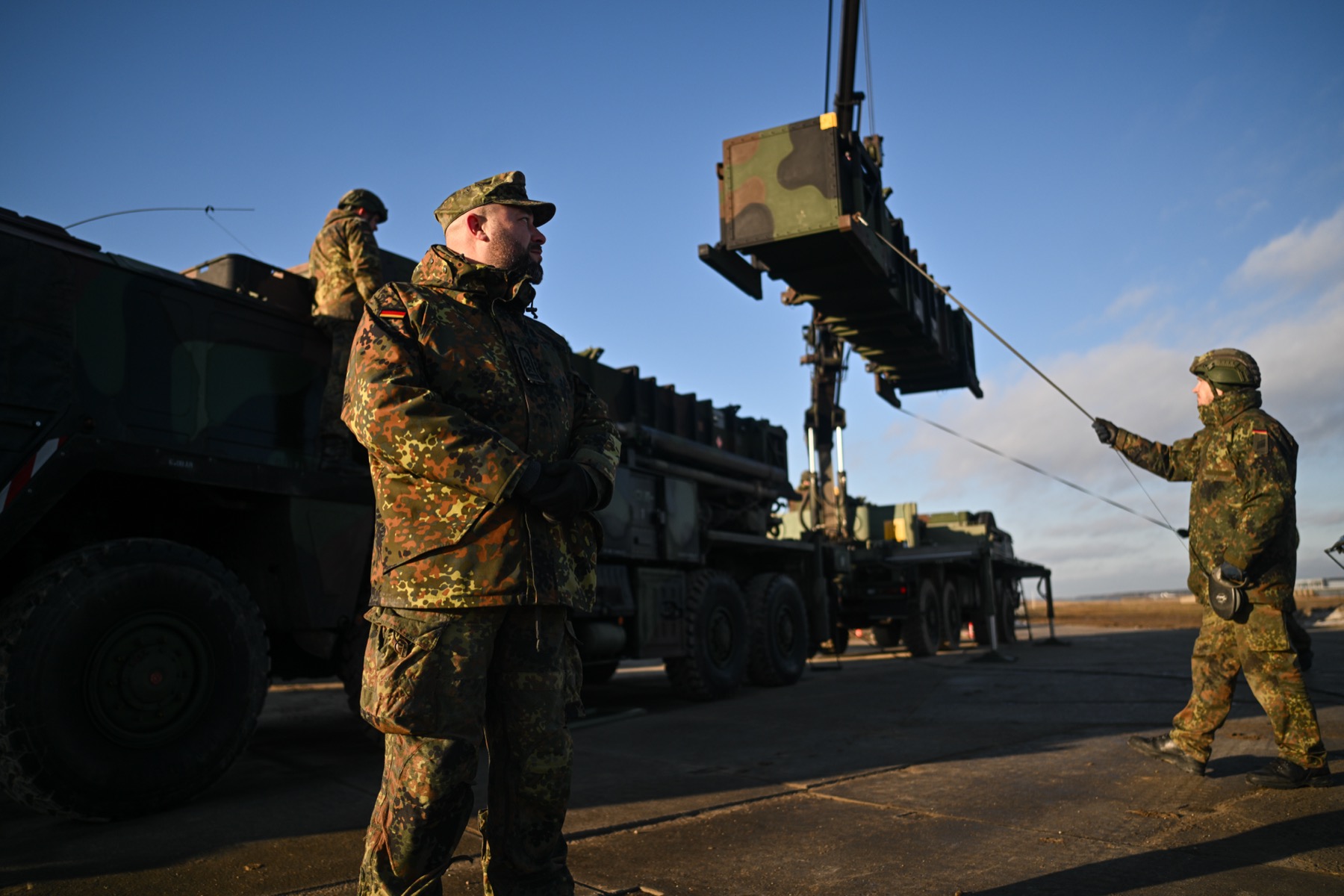
On June 4, Ukraine had already asked Germany for dozens of additional Patriot interceptors from German stocks. Berlin has not publicly made a final decision on this. This reluctance is not a lack of solidarity, but the result of a structural inventory problem. Germany has transferred Patriot systems to Ukraine, is participating in PURL procurements, and is jointly establishing production lines with partners. Nevertheless, the central truth remains uncomfortable: those who give away Patriot today reduce their own NATO air defense tomorrow.
The Patriot complex is hardly replaceable for ballistic missiles and high-quality cruise missiles. IRIS-T SLM, produced by Diehl Defence, is extremely useful against drones, aircraft, and many cruise missiles, but is not a full substitute against ballistic threats. SAMP/T with Aster 30 is Europe's most relevant long-range alternative, but has never been scaled politically and industrially in breadth. This is where Europe's failure lies: states have purchased systems in recent years, but have not created a common European interceptor economy.
CSIS summarized the production situation soberly in March. In 2025, only about 620 of the most modern PAC-3 MSE interceptors were delivered; Kyiv received approximately 600 Patriot interceptors over four years of war. Lockheed Martin currently produces around 600 PAC-3s per year and plans to increase to 2,000 over seven years. This number sounds large until compared to a single Russian night of attack. Not every Geran-2 requires a Patriot shot; on the contrary: it would be financially and tactically unwise to expend million-dollar interceptors against cheap drones. But the mix of drones, cruise missiles, and ballistic weapons forces Ukraine to strain all levels of air defense simultaneously.
More money is not an automatic shield
The European debate before the NATO summit in Ankara on July 7 and 8 will revolve around the 5 percent target. Since the Hague summit in 2025, allies have committed to invest 5 percent of GDP annually in core defense and security-related expenditures by 2035: at least 3.5 percent for conventional defense, up to 1.5 percent for resilience, infrastructure, cyber, innovation, and industrial base. Additionally, annual plans are to show a credible path. This is an improvement over the old 2 percent debate, but it is not a capability demonstration.
The numbers already show the paradox. According to SIPRI, the 29 European NATO states spent a total of $559 billion in 2025. Germany became the largest European NATO military spender with $114 billion, exceeding the old threshold of 2.3 percent of GDP for the first time since 1990. At the same time, Ukraine is asking Berlin for dozens of Patriot missiles. The connection is brutally simple: a budget can grow while a specific ammunition shelf remains empty. Defense spending is input. Air defense in Kyiv is output.
EU support is also significant on paper. The Council estimates military aid for the Ukrainian armed forces at €75.2 billion. SAFE provides up to €150 billion in loans for joint procurement, and the Ukraine loan approved in April for €90 billion is expected to flow about €60 billion into defense industry and procurement. Of 19 national SAFE plans, 15 include projects with Ukraine. This is institutionally noteworthy. But the crucial question is not whether a loan framework exists, but whether it addresses the right bottlenecks: missile engines, seekers, explosives, chips, test stands, qualified labor, and export approvals.
The wrong lesson from the Lavra
Russia claimed that the Lavra was hit not by Russian weapons, but by a Patriot missile. The Ukrainian Security Service, on the other hand, published debris from a Geran-2 drone body and referred to components from the special economic zone of Alabuga. The technical debate is important, but the strategic lesson runs deeper. Moscow relies on mass, ambiguity, and exhaustion: hundreds of drones force Ukraine to sort, while a few ballistic missiles compel the use of the most expensive interceptors, and propaganda then attempts to politically reinterpret every debris situation.
Europe should not only respond with moral outrage. A credible approach must connect three levels. First, Patriot stocks must be prioritized in the short term through PURL and bilateral transfers so that Ukrainian major cities do not have to choose between cultural heritage and power plants. Second, SAFE needs a dedicated air defense component that scales IRIS-T, Aster 30, SAMP/T, CAMM, and NASAMS munitions with multi-year purchase guarantees. Third, Germany must accept that the European Sky Shield Initiative, without French-Italian and British-Norwegian production logic, remains merely an aggregator of national demand, not a European air defense system.
The bitter point is: Europe now has enough money to make its deficits visible. Previously, there was a lack of political will; today, there is a lack of production lines, prioritization rights, and common stockpiles. The attack on Kyiv on June 15 was therefore not only a Russian war crime against Ukrainian civilians and cultural heritage. It was a test of the European security architecture. Sanctions can slow down Russia's war economy. But as long as Europe treats interceptors as exceptional goods and not as strategic infrastructure, every 5 percent commitment remains a number before the next air alarm.
Sources
- Ukrainska Pravda, June 15, 2026, SSU information on Geran-2 debris at the Kyiv Caves Lavra.
- Council of the EU, June 15, 2026, new sanctions package against Russia's military-industrial complex and shadow fleet.
- European Pravda, June 4, 2026, Ukrainian request to Germany for additional Patriot interceptors.
- NATO, 2026, 5 percent defense investment commitment and annual implementation plans.
- SIPRI, 2026, European NATO military spending in 2025 and Germany's $114 billion spending.
- CSIS, March 2026, analysis of European air defense production and dependence on US interceptors.
On June 15, 2026, Russian Armed Forces conducted a significant attack using 611 drones and 70 missiles, targeting Kyiv and resulting in 11 civilian deaths. The Ukrainian Security Service reported damage to the Kyiv Pechersk Lavra, prompting the EU to impose new sanctions. Germany is under pressure to provide additional Patriot missiles to Ukraine, revealing a critical gap in European air defense capabilities.
- Russia launched 611 drones and 70 missiles in a single night attack on Ukraine.
- The attack on Kyiv resulted in 11 civilian deaths and numerous injuries.
- The European Union imposed new sanctions in response to the attack.
- Germany has been asked for additional Patriot missiles to defend against such attacks.
- The report highlights a gap in Europe's air defense capabilities.