
Saronic puts first Marauder autonomous warship in water
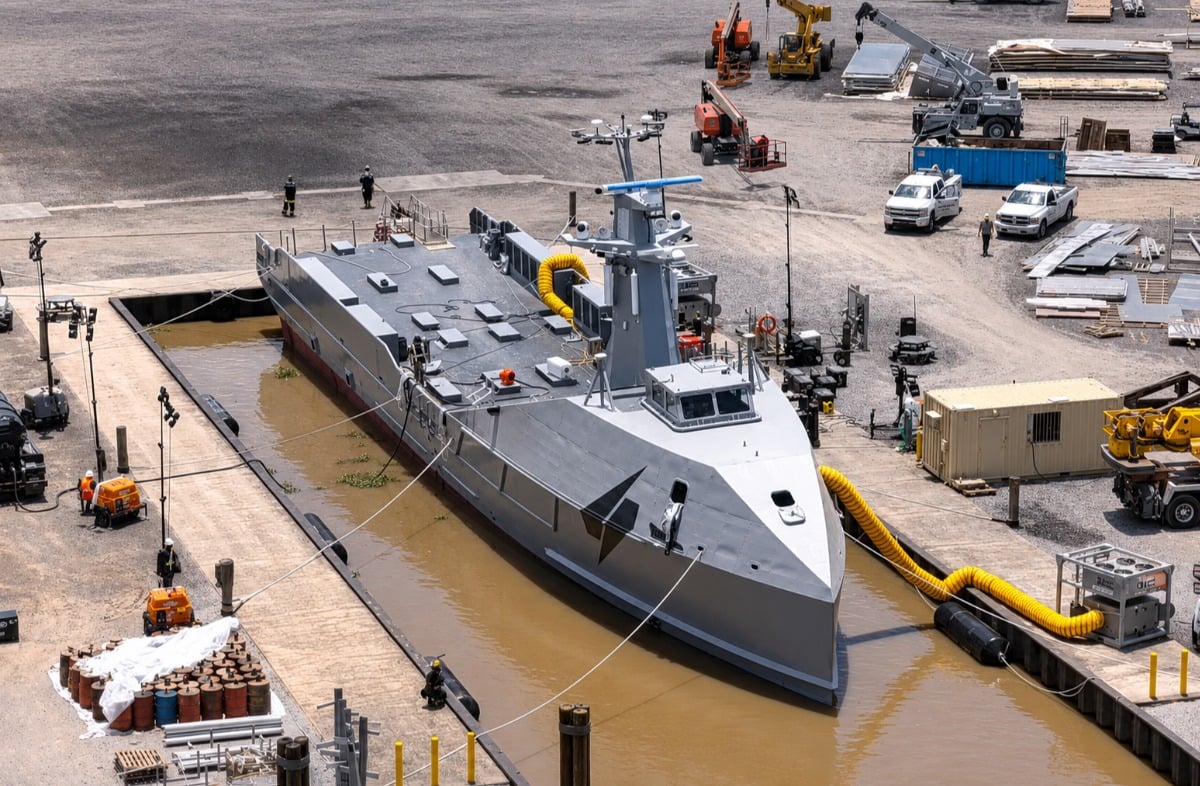
An Austin-based firm put an autonomous warship in the water last week, and it took less than a year to build — a pace American shipbuilding hasn’t matched since the Liberty ships of World War II.
Saronic Technologies announced Wednesday that the first hull of its Marauder medium unmanned surface vessel had completed its launch and moved to on-water trials. The company went from initial design to a vessel afloat in under twelve months, a timeline that stands in sharp contrast to the years-long schedules that have defined U.S. naval shipbuilding for decades. Three additional hulls are already under construction at Saronic’s Franklin, Louisiana shipyard, with the second hull already 25 percent further along in production than the first was at the same stage.
To understand why that pace matters, some context helps. The U.S. Navy has struggled for years with shipbuilding delays and cost overruns across multiple major programs. The Gerald R. Ford-class aircraft carrier program ran years behind schedule and billions over budget. Virginia-class submarine deliveries have consistently fallen short of contracted rates, prompting congressional criticism and Department of War concern about industrial base capacity. Against that backdrop, a company that goes from blank page to water in under a year with a production model explicitly designed to scale is making a pointed argument about how American shipbuilding could work differently.
Marauder is classified as a medium unmanned surface vessel, a category the Navy defines roughly as displacing between 500 and 2,000 metric tons, designed for operations that are too distant, too dangerous, or too sustained to justify putting a crew aboard. The vessel can operate fully autonomously or under remote human supervision from ashore, covering up to 5,400 nautical miles (10,000 km) at a top speed of more than 25 knots (46 km/h). That range puts it in the same operational league as many crewed surface combatants: 5,400 nautical miles is roughly the distance from the U.S. East Coast to the United Kingdom, or from Hawaii to Japan, without refueling. Its 150-metric-ton (330,000 lb) payload capacity arrives in a configurable hold that can accommodate up to four 40-foot or eight 20-foot ISO shipping containers, the standard intermodal boxes found on commercial cargo vessels worldwide. That containerized approach means Marauder can be reconfigured for different mission sets — logistics resupply, persistent surveillance, electronic warfare, or strike — without modifying the hull itself, simply by swapping the payload modules before deployment.
The production model behind Marauder is as significant as the vessel itself. Most major defense programs separate design, manufacturing, and software development across different organizations and timelines, a structure that generates coordination overhead, delays, and cost growth at every interface. Saronic operates all three functions under one roof at the Franklin shipyard, using modern aluminum construction techniques, subassemblies designed for manufacturing speed, optimized production sequencing, and modular construction methods. The company says the second hull is progressing 25 percent faster than the first, and expects further efficiency gains as production scales. With shipyard expansion on track for completion by the end of 2026, Saronic says the Franklin facility will be capable of producing up to 20 Marauders per year, a rate that would represent meaningful fleet numbers within a few years rather than the decades that conventional naval procurement timelines imply.
“Designing, building, and launching an entire new class of ships in under a year is a feat the American shipbuilding industry hasn’t seen in generations,” said Dino Mavrookas, co-founder and CEO of Saronic. “It’s what happens when design, production, and manufacturing are fully integrated under one roof. With multiple hulls already underway and our shipyard continuing to grow, this is what revitalizing American shipbuilding actually looks like — autonomous ships delivered at speed and scale, with the production capacity to back it up.”
Alongside the physical vessel, Saronic has built a software fleet intelligence platform that gives remote operators continuous visibility into every onboard system. Every hardware component on Marauder carries a software interface for monitoring and control, surfacing telemetry, vessel state, and subsystem status in real time. Operators can intervene remotely in autonomous processes from any location, and the platform logs all activity for diagnostics and historical replay. That level of transparency matters operationally: as autonomous vessels operate further from shore in higher-stakes environments, the ability to audit decisions, diagnose anomalies, and override onboard systems without physical access becomes a prerequisite for military acceptance. Saronic frames the platform as one that will scale with the fleet, keeping an expanding number of hulls auditable and under human-on-the-loop control as autonomy capabilities mature.
Content preview only. Full article available at source. View Full Article
Saronic Technologies launched the first Marauder autonomous warship in Franklin, Louisiana, last week, completing the build in under a year. The company is constructing three additional hulls, with the second hull progressing 25% faster than the first. The Marauder can operate autonomously or under remote supervision, covering up to 5,400 nautical miles, and is designed for various mission sets without modifying the hull.
- Saronic Technologies launched the first Marauder autonomous warship last week.
- The vessel was built in under a year, a significant improvement over traditional U.S. shipbuilding timelines.
- Three additional hulls are under construction, with the second hull progressing 25% faster than the first.
- Marauder can operate autonomously or under remote supervision, covering up to 5,400 nautical miles.
- The production model integrates design, manufacturing, and software development under one roof.