
Saudi Arabia Requests 20,000 APKWS II Missiles Worth $1.96 Billion to Transform Air Defense Economy
 Ahmed Al-Rashid
Saudi Arabia Requests 20,000 APKWS II Missiles Worth $1.96 Billion to Transform Air Defense Economy
On July 16, 2026, the news was not just that Washington approved the sale of new munitions to Riyadh, but that the number itself reveals the nature of the war Saudi Arabia is preparing for. The package announced by the U.S. State Department, which was reported by Breaking Defense, TWZ, and several defense sites, has an estimated value of $1.96 billion and includes up to 20,000 guidance sections from the Advanced Precision Kill Weapon System II, nearly half of which is for air use against drones and cheap aerial threats, while the other half is for air-to-ground use.
Practically speaking, this is not an ordinary missile deal. Saudi Arabia is not buying more shine for its air force, but is trying to fill a painful gap that emerged in Yemen, which became more apparent with the Iran-U.S. conflict over the Gulf and the Strait of Hormuz. The real military question is not whether Riyadh can shoot down a single drone, but how much it will cost to shoot down a hundred drones in one week, and where the munitions will come from afterward.
What the U.S. Deal Includes
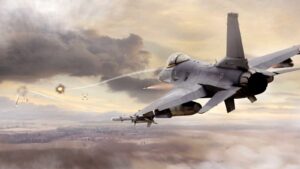
According to the available texts regarding the U.S. notification, Saudi Arabia requested up to 10,000 APKWS II guidance sections in an air-to-air version for countering drones and aerial threats, and up to 10,000 guidance sections in an air-to-ground version. The package also includes LAU-131/A launchers in 70mm caliber, Mk66 motors, Mk-152 high-explosive warheads, proximity fuses, and support, training, and logistics services.
The prime contractor is BAE Systems, while the $1.96 billion figure is an estimated ceiling for a foreign military sale and is not necessarily a final bill. However, the political number is clear enough: Washington is willing to provide Riyadh with a weapon that addresses the problem of defense against drones, not a weapon that changes the conventional balance of power with Iran.
APKWS II is not a completely new missile at its core. It is a laser guidance section added to the unguided Hydra 70 rocket to turn it into precision munitions. The air-to-air version for countering drones, known in some literature as FALCO or AGR-20F, uses a proximity fuse and algorithm modifications to target a relatively slow small target like a suicide drone. Here lies the appeal of the weapon: it is much cheaper than the AIM-120 or AIM-9X and can be carried in larger numbers on existing aircraft.
Economics of Interception Before Politics
Any military personnel who has served in the region knows that air defense does not collapse only when radar fails, but when the cost of interception becomes dozens of times higher than the cost of attack. The Houthis, Iranians, and their allies understood this equation early on. A simple drone or cruise missile forces the defending party to operate radars, launch fighters, and expend an expensive missile. If this happens every night, the problem becomes financial and industrial before it is tactical.
In recent years, Saudi Arabia has relied on heavy layers of Patriot systems, F-15SA fighters, Eurofighter Typhoons, and U.S.-backed early warning radars. This has given it a real capability for protection, but it has not provided a comfortable economy for interception. Launching an air-to-air missile costing hundreds of thousands of dollars or more against a cheap drone is exactly what the adversary wants. Purchasing 20,000 APKWS guidance sections is a Saudi acknowledgment that the era of luxurious air defense is over.
TWZ estimates that the guidance section in APKWS typically costs tens of thousands of dollars, while modern AIM-120 missiles approach nearly a million dollars in many contracts, and the AIM-9X nears hundreds of thousands of dollars. Even if the Saudi price is higher due to support, training, and inventory, the logic remains the same: Riyadh wants munitions that can be expended in large quantities without depleting conventional air missile stocks.
Why Saudi Arabia Now
The timing is inseparable from the Gulf context. In recent weeks, Iranian attacks and U.S. responses have escalated around Hormuz, with attacks or interceptions occurring in Bahrain, Kuwait, Qatar, and the waters near Oman, while the Houthi issue has resurfaced after an exchange of fire with Saudi Arabia that ended a relatively long ceasefire. Even if the details of each incident differ, the overall picture is clear: the low sky over the Gulf has filled with cheap and disruptive munitions.
Saudi Arabia has suitable aircraft for this mission. The F-15SA can carry multiple pods, and the Eurofighter Typhoon has received integrations in recent years that facilitate the use of APKWS in certain roles. However, having the aircraft and munitions is not enough. Intercepting small drones with a fighter jet requires an accurate early warning network, clear rules of engagement, training pilots to launch laser-guided munitions against aerial targets, and strict monitoring to avoid friendly fire or hitting civilian targets.
Here I return to the capability triangle that I always use: equipment, training, institution. Riyadh is now buying the equipment side in large quantities. The training side can be partially purchased from the Americans. However, the institutional side, which is the hardest, means that the Royal Air Defense, the Air Force, the Joint Operations Command, and the Border Guard must operate as a single entity. Without that, APKWS will become just another munition in a large warehouse.
What APKWS Does Not Do
It is a mistake to portray the deal as a comprehensive solution. APKWS does not intercept high-speed ballistic missiles, nor does it replace Patriot or THAAD or naval defense around ports and oil facilities. Additionally, using it from fighters means costs for flight hours, maintenance, engines, and pilots, which are not cheap. The weapon reduces the cost of munitions, but it does not eliminate the cost of the platform.
There is also the question of industrial capacity. Ukraine, U.S. Central Command, and other Gulf states view APKWS as an ideal tool against drones. If Saudi Arabia buys 20,000 units, this puts pressure on BAE Systems' production line and on 70mm munitions stocks. In modern warfare, the question is no longer just who has the money, but who can secure a place in the production schedule.
Politically, the deal gives Washington a double card. It reassures Saudi Arabia that the U.S. will not leave it facing Iranian and Houthi drones, but at the same time keeps Riyadh within the American arms, training, and software system. This is not defensive independence, but better management of dependence. The difference is significant, even if deal data does not like to acknowledge it.
Military Summary
I read this deal as a shift from symbolic air defense to calculative air defense. Saudi Arabia is not saying it has found a magic weapon, but it is saying that the next war may be a war of thousands of small targets, and shooting them down with million-dollar missiles is not a sustainable defense policy. In my view, this is correct thinking, but it came late after years of massive spending on platforms that do not alone address the low sky problem.
The old rule in artillery says that munitions that do not arrive on time are worth nothing. In Gulf defense today, it can be slightly modified: a missile that hits the target but bankrupts the stock serves the adversary a second time.
APKWS will enhance Saudi Arabia's ability to counter drones and slow missiles, and will reduce the gap between the cost of attack and the cost of defense. However, it will also reveal the contradiction that accompanies every Gulf military upgrade: the desire for operational independence and the ongoing need for the American designer, trainer, and supplier. This is not a deal to end dependence, but a deal that makes it a little cheaper and more manageable.
Saudi Arabia requested 20,000 APKWS II missiles worth $1.96 billion to enhance its air defense capabilities against drones and low-cost aerial threats. The deal, announced on July 16, 2026, includes both air-to-air and air-to-ground variants, with BAE Systems as the primary contractor. This procurement indicates a strategic shift in Saudi defense policy towards more economical solutions for air defense.
- Saudi Arabia has requested 20,000 APKWS II missiles valued at $1.96 billion.
- The deal includes both air-to-air and air-to-ground variants of the APKWS II.
- The primary contractor for the deal is BAE Systems.
- The procurement aims to address vulnerabilities in air defense against drones and low-cost aerial threats.
- The deal reflects a shift towards more cost-effective air defense solutions.