
Self-driving Razorback UGV carries drone-killing turret
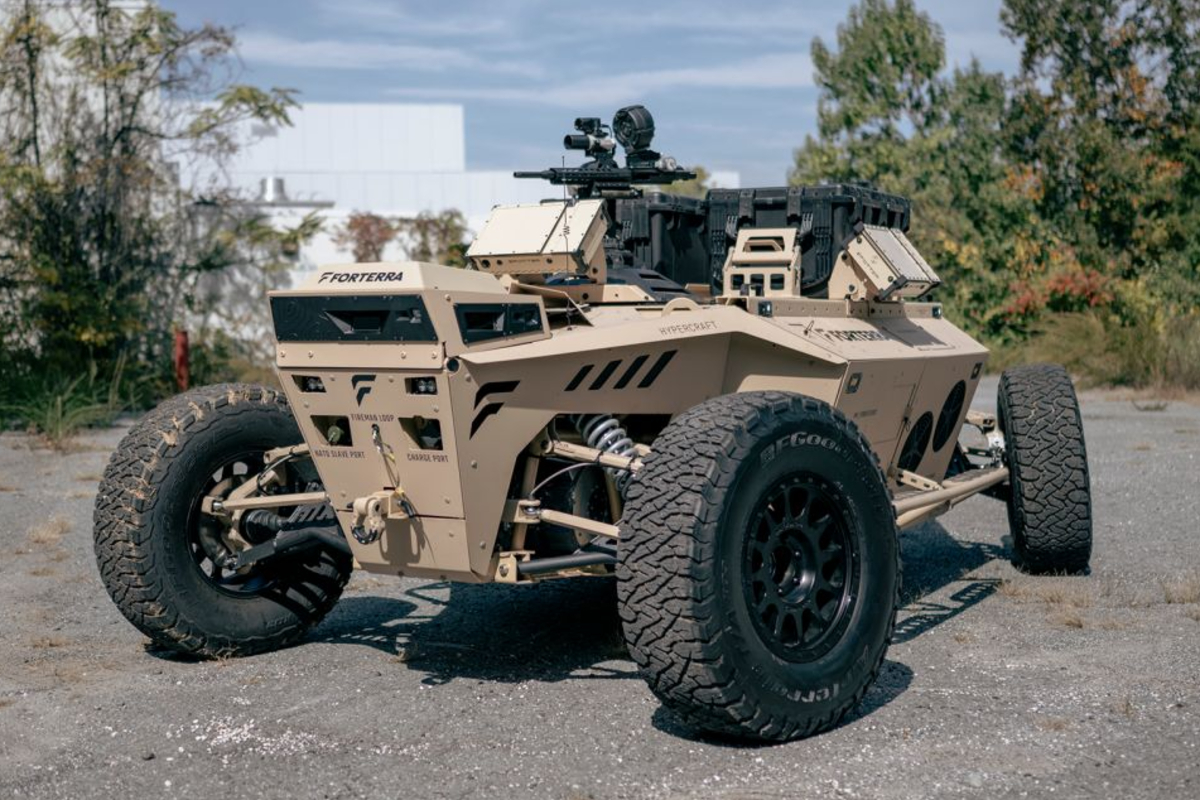
Forterra and Hypercraft are showing a driverless off-road vehicle built for military resupply at the Association of the U.S. Army’s annual meeting in Washington, pairing Hypercraft’s Razorback unmanned ground vehicle with Forterra’s AutoDrive self-driving system and a counter-drone turret from 9 Mothers.
The companies say the vehicle is aimed at contested logistics, moving supplies through areas where a human driver would be under fire. Neither company has announced a military customer, contract or price for the combination.
“We’re going after contested logistics and other missions where a driver is the most exposed person on the battlefield,” Forterra Chief Growth Officer Scott Sanders told Tectonic. “Razorback and AutoDrive combine to deliver a platform that can go further, over more complicated terrain, and power platforms in ways that traditional UGVs cannot.”
Razorback is the first complete vehicle from Hypercraft, a company in Provo, Utah, that started out building electric powertrains for commercial vehicles before moving into defense. Hypercraft unveiled the vehicle earlier this year. It is more than 4 meters (13 feet) long and, according to the company, can carry up to 1,814 kg (4,000 pounds), drive about 800 km (500 miles) and supply up to 38 kilowatts of electricity to other equipment. Hypercraft designed it to take third-party sensors, radios, weapons and mission payloads, and it has already shown the vehicle with Fortem Technologies’ counter-drone radar.
Sanders said Razorback was designed for autonomy from the start, which made it an easy fit, since many unmanned ground vehicles are crewed trucks with self-driving kits added after production.
Forterra, formerly Robotic Research, does not build vehicles. Its AutoDrive package combines software, sensors and computers that can turn an existing vehicle into a driverless one. The company says AutoDrive has been integrated into more than 50 vehicle types, used on more than 1,100 missions and put under contract for more than 258 systems. Those include Polaris Ranger 1500 utility vehicles used in Ukraine, Oshkosh Joint Light Tactical Vehicles for the U.S. Marine Corps’ ROGUE-Fires anti-ship missile launcher and Ford F-250 pickups for the U.S. Army.
The vehicle at AUSA carries 9 Mothers’ Edda turret, a roughly 23 kg (50-pound) counter-drone system from Austin, Texas. Edda listens for the sound of small drone rotors, tracks the target with cameras and fires a shotgun at drones about 18 cm (7 inches) across at ranges of 10 to 100 meters (33 to 328 feet). In August, the U.S. Army tested the same turret on a Forterra-equipped, self-driving Ford F-250 during a live-fire exercise at Fort Bragg, North Carolina.
Forterra said it chooses partners that solve real operational problems, can scale to production and understand that autonomy reaches beyond software into the vehicle, sensors, computers, communications and operator.
“Get any of those wrong, and the system doesn’t get fielded,” Sanders said.
Forterra is also one of six companies the U.S. Army selected in August for its Infantry Last Tactical Mile prototype effort, which is testing robotic vehicles for front-line resupply and casualty evacuation, using its MESA vehicle built on a Polaris Ranger.
Content preview only. Full article available at source. View Full Article
Forterra and Hypercraft showcased the Razorback unmanned ground vehicle at the AUSA meeting in Washington, designed for military resupply and counter-drone operations. The vehicle, equipped with a counter-drone turret from 9 Mothers, aims to enhance logistics in contested environments. It can carry significant payloads and has been tested by the U.S. Army, indicating its potential military applications.
- Forterra and Hypercraft unveiled a driverless off-road vehicle at the AUSA meeting.
- The Razorback UGV is designed for contested logistics and can carry up to 1,814 kg.
- The vehicle features a counter-drone turret from 9 Mothers that can engage drones at various ranges.
- Forterra's AutoDrive system has been integrated into over 50 vehicle types for military use.
- The U.S. Army tested the Edda turret on a self-driving Ford F-250 during a live-fire exercise.