
Similar Performance Demands, Doubts About Technology Sharing: Can India's Involvement "Save" France's Sixth-Generation Fighter?
[Global Times Special Correspondent Chen Yang] In the absence of success in seeking a fifth-generation fighter jet, the Indian Ministry of Defense recently confirmed that it has sought to join the sixth-generation fighter jet project "Future Combat Air System" (FCAS) led by France. Some foreign media believe that this not only marks a further advancement in defense cooperation between France and India but also largely saves the FCAS project, which was on the verge of collapse. However, whether the joint development of the sixth-generation fighter jet by India and France is truly reliable has sparked widespread discussion.
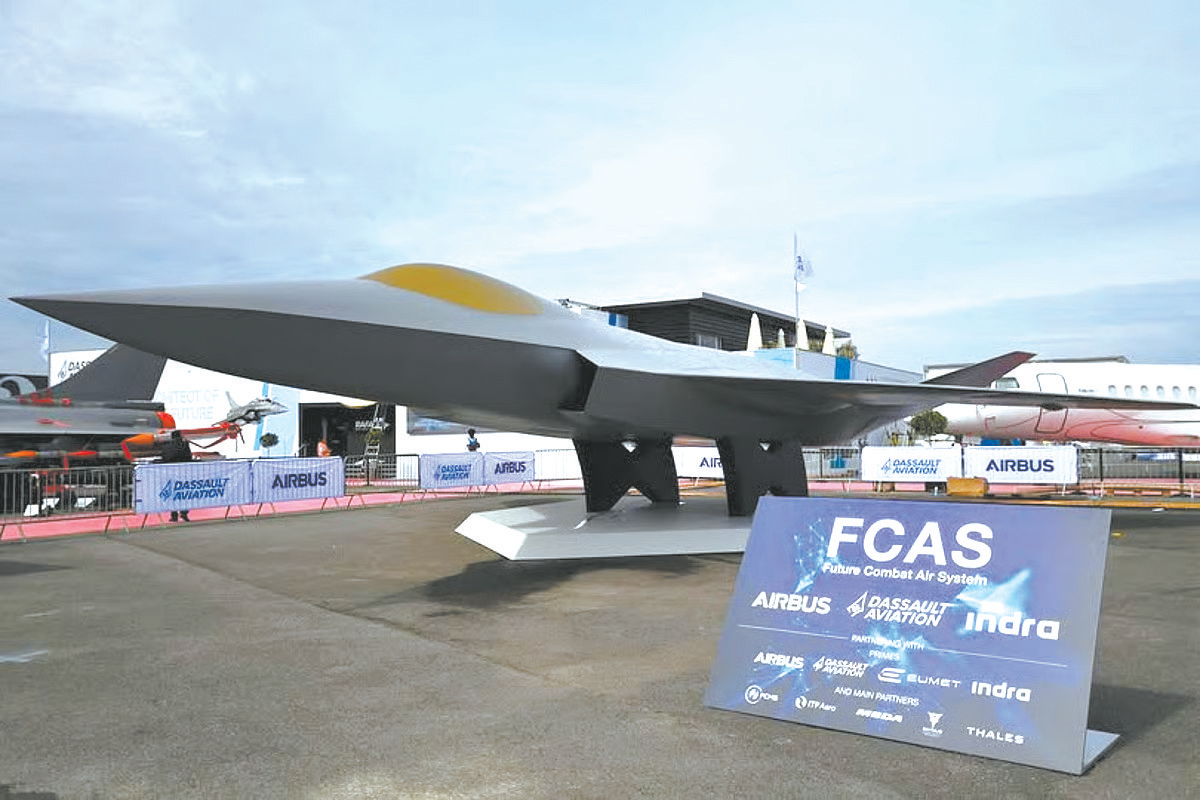
Germany exits, India joins
According to a report from Malaysia's "Asian Defense Security" website on the 11th, a report submitted by the Indian Ministry of Defense to the Parliamentary Standing Committee on Defense disclosed that India has "initiated relevant work in a coordinated manner" in an effort to join the FCAS sixth-generation fighter jet project led by France. The Indian Parliament subsequently requested the Ministry of Defense to submit a detailed roadmap and timeline for acquiring the sixth-generation fighter jet. At the same time, the committee also expressed a desire to understand the progress of India's indigenous Advanced Medium Combat Aircraft (AMCA), which, according to the Indian Air Force's report, is a key node in strengthening the Air Force's autonomous capabilities.
The professional international aviation website "Aviation Week" reported on the 11th that the Indian Air Force revealed in a report submitted as early as March this year that India is striving to collaborate with Europe on the development of a sixth-generation fighter jet. The report stated that Europe is advancing two sixth-generation fighter projects: one is the "Global Combat Air Program" (GCAP) composed of the UK, Italy, and Japan, and the other is the FCAS project promoted by France and Germany. The report explicitly stated that the Indian Air Force would attempt to participate in one of them and immediately begin considering the development of a sixth-generation fighter jet to "avoid falling behind other countries."
Reports indicate that the FCAS project originally envisioned a very promising future: the next-generation stealth fighter at the core of the project would replace the French "Rafale" and the European "Typhoon" fighters, working alongside a fleet of long-range drones with high autonomous combat capabilities, interconnected through a "combat cloud" on the battlefield. However, since the FCAS project was launched in 2017, it has been fraught with disputes: the related disagreements are not significantly technical but mainly focus on political aspects. Dassault Aviation, representing France, and Airbus, representing Germany, have been embroiled in disputes over project leadership, work sharing, intellectual property rights, and fundamental design concepts. Ultimately, Germany and France announced in June this year that they would terminate the joint fighter development work under the FCAS project framework, with France independently developing a technology demonstrator scheduled for test flight in 2031. Eric Trappier, Chairman and CEO of Dassault Aviation, stated to the relevant committee of the French Senate on July 1 that the company is willing to cooperate as long as consensus rules can be established in advance, "not ruling out the possibility of collaborating with non-European partners."
Surprisingly, just as the FCAS project faced disintegration due to Germany's exit, India stepped in to fill the gap.
India and France hit it off
The U.S. magazine "Military Observer" analyzed that the disagreements between Germany and France on the FCAS project are precisely the opportunity for India and France to join forces. Dassault Aviation seeks to dominate the project on the grounds of mastering the core technology of the next-generation fighter, while Germany demands equal industrial shares and ownership of intellectual property. A more irreconcilable contradiction between the two countries is that France explicitly requires the next-generation fighter to have the capability to take off and land from aircraft carriers and to carry nuclear weapons, which are core pillars of France's "nuclear deterrence + carrier strike" defense strategy. However, meeting these requirements means that the new fighter would need to significantly increase costs, while Germany, lacking both aircraft carriers and nuclear weapon needs, has no interest in this.
In contrast, the needs of India and France are more aligned. Compared to Germany and France, India's aviation industry is relatively weak and cannot directly compete with France for leadership in the FCAS project; instead, it hopes to familiarize itself with the core technologies of the next-generation fighter through participation in the project. At the same time, India's requirements for the next-generation fighter are quite similar to those of France. The Indian Navy has two active aircraft carriers and is planning to build a third, with the carrier-based fighter currently being the problem-prone Russian MiG-29K, which is set to be replaced by the French "Rafale." Additionally, the Indian Air Force's "Tigers" and "Mirage 2000" fighters, which perform nuclear missions, are nearing the end of their service life and urgently need replacement. Therefore, India and France are indeed a perfect match in the development of the next-generation fighter jet.
Furthermore, India had previously publicly expressed its consideration of participating in the GCAP project, which is progressing more smoothly overall and is close to the test flight of its technology demonstrator. However, the Indian Ministry of Defense admitted in its report that the GCAP project has already allocated shares among the UK, Italy, and Japan, and as a "latecomer," India's voice and industrial share in it may be very limited. In contrast, the FCAS project, after the split between France and Germany, is in a "rebuilding" phase, providing India with an opportunity to participate in rule-making as a more equal partner.
Of course, India's final decision to participate in the FCAS project is also related to the close military technology cooperation relationship established between India and France in recent years. The Indian Air Force is equipped with two types of French-made fighter jets, the "Mirage 2000" and the "Rafale," and France has a mature defense cooperation foundation in India. More importantly, the two countries have already begun joint development of a 120-kilonewton class fighter engine for India's indigenous fifth-generation fighter AMCA project. From the procurement of the "Rafale" to engine cooperation, the defense industrial chain between France and India has deeply intertwined, making it only natural for the two countries to continue advancing the FCAS project.
"Military Observer" mentioned that for France, bringing India into the FCAS project not only secures more financial support and generates economies of scale but also applies pressure on Russia. Given that the progress of India's indigenous fifth-generation fighter AMCA project is severely lagging, the Indian Air Force has previously been negotiating with Russia for licensed production cooperation on the Su-57E fifth-generation fighter jet. If India decides to join the FCAS project, it will significantly squeeze the procurement budget for the Indian Air Force's new generation of fighter jets, directly impacting plans to import advanced fighters from Russia. Recently, India's announcement to temporarily abandon the introduction of the Su-57E may also be related to this.
The future outlook is not all smooth sailing
However, the prospects for cooperation between France and India on the sixth-generation fighter jet are not all smooth sailing. The Indian Air Force currently faces a severe shortage of fighter jets, with the number of existing fighter squadrons falling short of the authorized strength by 13 squadrons. Both the indigenous "Tejas" fighter and the "Rafale" fighter imported from France are unlikely to supplement the force in the short term. In this context, if the FCAS project encounters delays, it will exacerbate the Indian Air Force's predicament.
"Military Observer" stated that European fighter jet projects have long faced the issue of high labor costs, and France is more eager to collaborate with India, where labor costs are much lower. However, India's industry itself has many inefficiencies and delays; for instance, the procurement cost of the Russian Su-30MKI fighter produced in India is almost twice that of similar aircraft produced in Russia. Therefore, it is still difficult to determine to what extent the cooperation between France and India through the FCAS project can enhance their respective aviation capabilities.
At the same time, one of the main purposes of India's participation in the FCAS project is to acquire the "combat cloud" network, unmanned swarm systems, and the engine and sensor technologies for the next-generation fighter jet, which India currently does not have the capability to develop independently. However, France has always been conservative in terms of technology transfer. Although India has already procured and equipped the "Rafale" fighter jet in bulk, France has so far refused to provide India with the source code for the avionics system of that fighter. Considering that the sixth-generation fighter involves cutting-edge technologies such as artificial intelligence, unmanned drone collaboration, and directed energy weapons, the extent to which France is willing to open up the relevant "technology black box" to India will be an extremely sensitive issue. Some European defense analysts have sarcastically remarked, "Those who think that cooperation with Germany is already difficult will have a new understanding of the term 'difficulty' when cooperating with France."
India confirmed its intention to join the French-led sixth-generation fighter jet project (FCAS) following Germany's exit. This move aims to enhance defense cooperation with France and secure access to advanced military technology. The FCAS project seeks to develop a next-generation fighter jet to replace current aircraft, aligning with India's defense needs and strategic interests.
- India officially confirmed its intention to join the FCAS project led by France.
- Germany's exit from the FCAS project created an opportunity for India to fill the gap.
- India's defense cooperation with France has deepened in recent years, including joint development of fighter jet engines.
- The FCAS project aims to develop a next-generation fighter jet to replace existing aircraft.
- India's participation in FCAS may impact its procurement plans for Russian fighter jets.