
Small Texas firm shows Congress its drone fuze production line
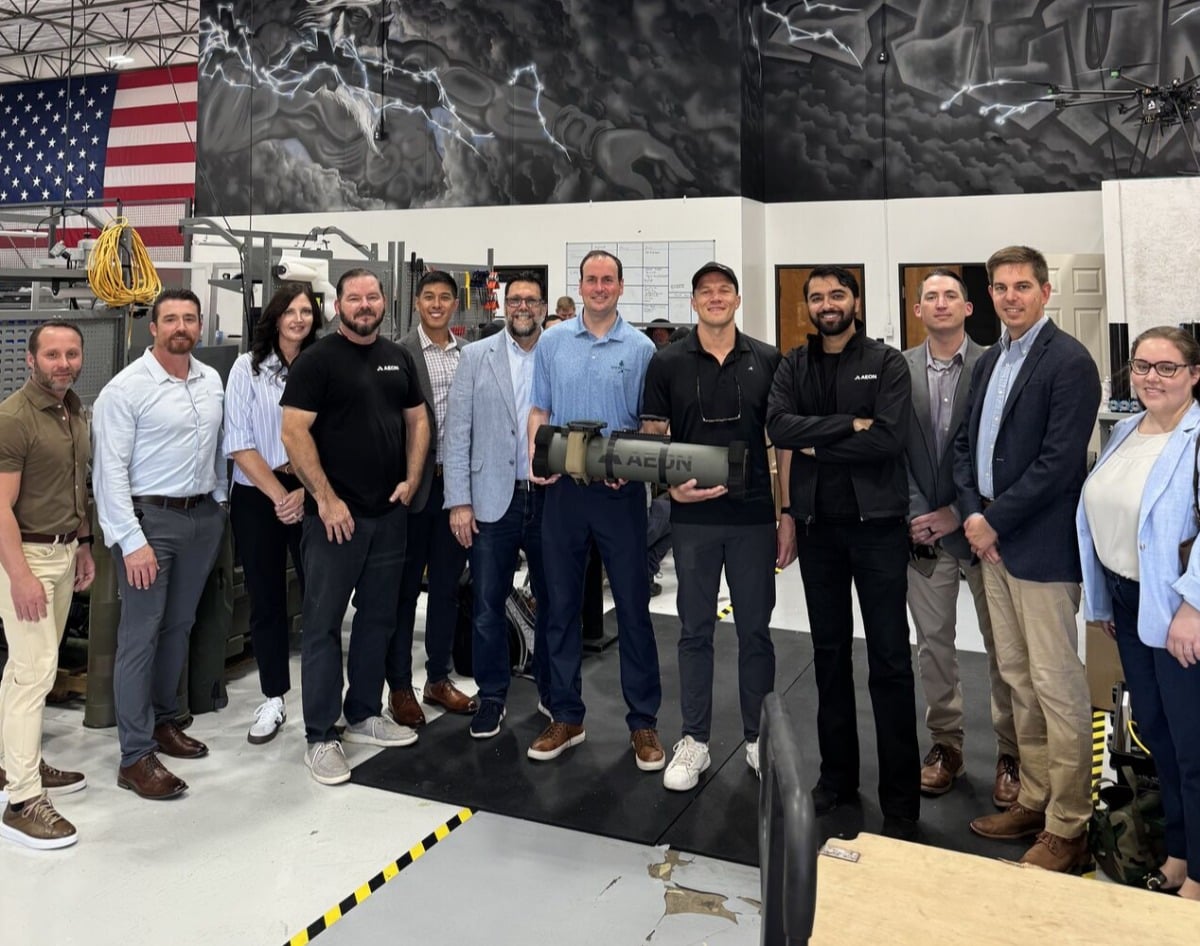
A small Texas company has shown a group of congressional staffers exactly how it plans to help the Pentagon arm 200,000 drones, and the answer sitting on its factory floor was something as unglamorous as it is essential: the tiny electronic trigger that actually makes a warhead go off.
Naweed Tahmas, founder and CEO of Aeon, a Texas-based defense manufacturer, said the company hosted congressional appropriations staffers Mike Velasquez, Emily Taylor, Will McPherson, and Daniel Hartl for a tour of its new fuze production line, which Tahmas said is set to deliver nearly 1,000 fuzes the following week for Drone Dominance, the Pentagon’s aggressive push to rapidly buy large quantities of low-cost, lethal drones.
A fuze is the electronic or mechanical component inside a warhead that actually triggers detonation, sensing the right conditions, whether that means impact, proximity to a target, or a timed delay, and firing the explosive charge at precisely the intended moment. Without a working fuze, even the most sophisticated missile or drone warhead is functionally inert, making the component one of the least visible but most operationally critical parts of any weapon system.
Aeon’s statement described the fuze line as high-voltage and low-cost, built to serve drones, interceptors, and missiles broadly rather than a single weapon platform, and framed the company as already producing and delivering fuzes to customers rather than merely developing the capability.
“Need high-voltage, low-cost drone, interceptor, and missile fuzes gone before the fuze board? Reach out. We’re producing and delivering to customers right now,” Aeon said.
Aeon’s framing suggests the company is positioning its fuze production specifically to help customers move faster through or around that traditional bottleneck, an appealing pitch at a moment when the Pentagon has made speed the central organizing principle of its entire drone acquisition strategy.
Drone Dominance itself represents one of the most ambitious procurement pushes the Department of War has launched in recent memory. Announced by Secretary of War Pete Hegseth, the program aims to purchase more than 200,000 small, lethal drones by 2027 through an iterative, roughly $1 billion plan explicitly designed around rapid, phased competitions rather than the military’s traditionally slow, multiyear acquisition cycle. The program runs through a series of live evaluation events called Gauntlets, where vendor systems get tested by actual military operators under realistic conditions, with the Pentagon issuing prototype delivery orders to the companies that perform best. The Department of War expanded the initiative further in July 2026, adding a new category focused on reusable drones capable of dropping bombs on enemy targets, a category defense officials have taken to calling bombers, on top of the program’s original focus on one-way attack drones that destroy themselves along with their target.
Every one of those hundreds of thousands of drones eventually needs a working fuze if it is expected to actually destroy anything rather than simply fly into a target and bounce off harmlessly, which is precisely the market opportunity Aeon appears to be positioning itself around. The company built its broader reputation on a vertically integrated approach to weapons manufacturing, meaning it produces critical internal components, including solid rocket motors and fuzes, in-house rather than sourcing them from external suppliers, a strategy Tahmas has said gives Aeon direct control over cost and insulates its programs from the kind of supply chain fragility that has disrupted larger, more traditionally structured defense programs. That same vertical integration underpins Aeon’s flagship weapon system, Zeus, a modular, software-defined guided missile the company introduced in April 2026 priced at roughly $50,000 per unit and designed for production rates exceeding 10,000 units annually, a scale target Tahmas has said was built into the weapon’s design from day one rather than retrofitted later.
Founded in 2023, Aeon has grown quickly by defense industry standards, securing $18.6 million in venture capital funding from investors including Quiet Capital, Silent Ventures, and 1789 Capital, and the company recently announced it is relocating its headquarters and manufacturing operations from Austin to nearby Cedar Park, Texas, where the city council approved a $1.5 million economic development agreement in May 2026 tied to Aeon creating 135 jobs with a combined annual payroll of roughly $16.5 million by the end of 2029. Tahmas confirmed the fuze production line tour took place at the company’s current facility, describing it as one of the last looks at that site before Aeon moves into its new, larger production plant in Cedar Park.
Content preview only. Full article available at source. View Full Article
Aeon showcased its drone fuze production line in Cedar Park, Texas, to congressional staffers, detailing plans to deliver nearly 1,000 fuzes for the Pentagon's Drone Dominance program. The initiative aims to procure over 200,000 drones by 2027, emphasizing rapid acquisition and production. Aeon, founded in 2023, is positioned to meet this demand with its vertically integrated manufacturing approach, ensuring control over costs and supply chain stability.
- Aeon plans to produce 200,000 drones for the Pentagon's Drone Dominance program by 2027.
- The company is delivering nearly 1,000 fuzes next week.
- Aeon has secured $18.6 million in venture capital funding.
- The company is relocating its headquarters to Cedar Park, Texas, creating 135 jobs.
- The fuze production line is designed for drones, interceptors, and missiles.