
Smaller, easier, smarter: what special operators want from AI
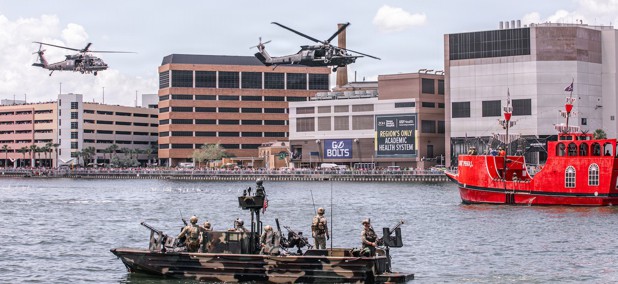
TAMPA, Florida—U.S. special operators want AI tools that offer the power of giant data centers out on the disconnected front lines.
SOF units already use generative AI “heavily” for things like resource allocation and force deployment, and are “delving” into its use for tactical operations, said Rob McClintock, the program manager for intelligence for the program executive office for digital applications.
But today’s tools typically run in the cloud, connected to massive data centers. Operators need them to work in remote locations beyond reach of networks. Physical proximity to the “tactical edge” enables faster use of mission-critical data and faster decision-making, officials at the Global SOF Foundation’s SOF Week event here said this week.
So Special Operations Command is looking for frameworks that extend the power of cloud computing much closer to where data is collected and used—a concept sometimes called “fog computing.”
They’re also looking for versions of large language models that require less computing power while still understanding human intent with less instruction.
“In that conversation about managing the cognitive load on operators, voice command is a logical step,” said Col. Robert “Ramsey” Oliver, PEO of SOCOM’s SOF Warrior.
Today’s biggest consumer-facing tech and AI companies don’t build products for niche tactical needs. Melissa Johnson, SOCOM’s acquisition executive, said the solution will likely emerge from smaller startups.
“From an acquisition perspective, we're not just limited to the bigger companies with their own mindset, because AI is very dynamic,” Johnson said. “Sometimes the smaller organizations, smaller businesses bring those solution sets.”
The most desirable feature of any AI tool for SOCOM is simply making it easier for operators to do what they already do. For example, getting different types of drones to work together, or planning and carrying out missions with just a few spoken or even gestured commands, said Lt. Col. Aaron Davidson, the program manager for the unmanned systems autonomy and Interoperability portfolio.
McClintock said they’re also looking into AI “agents” that can plan, revise and execute strategies.
U.S. Special Operations Command (SOCOM) is actively seeking AI tools to enhance tactical operations and resource allocation in remote locations. The focus is on developing AI solutions that can operate independently of cloud computing, utilizing 'fog computing' concepts. SOCOM is also exploring partnerships with smaller startups to meet its unique operational needs.
- U.S. special operators are using generative AI for resource allocation and force deployment.
- SOCOM is looking for AI tools that can operate in remote locations.
- The concept of 'fog computing' is being explored to enhance data accessibility at the tactical edge.
- Smaller startups are expected to provide solutions for SOCOM's needs.
- AI agents are being considered for planning and executing strategies.