
South Korea tests a robot sailor as recruits run short
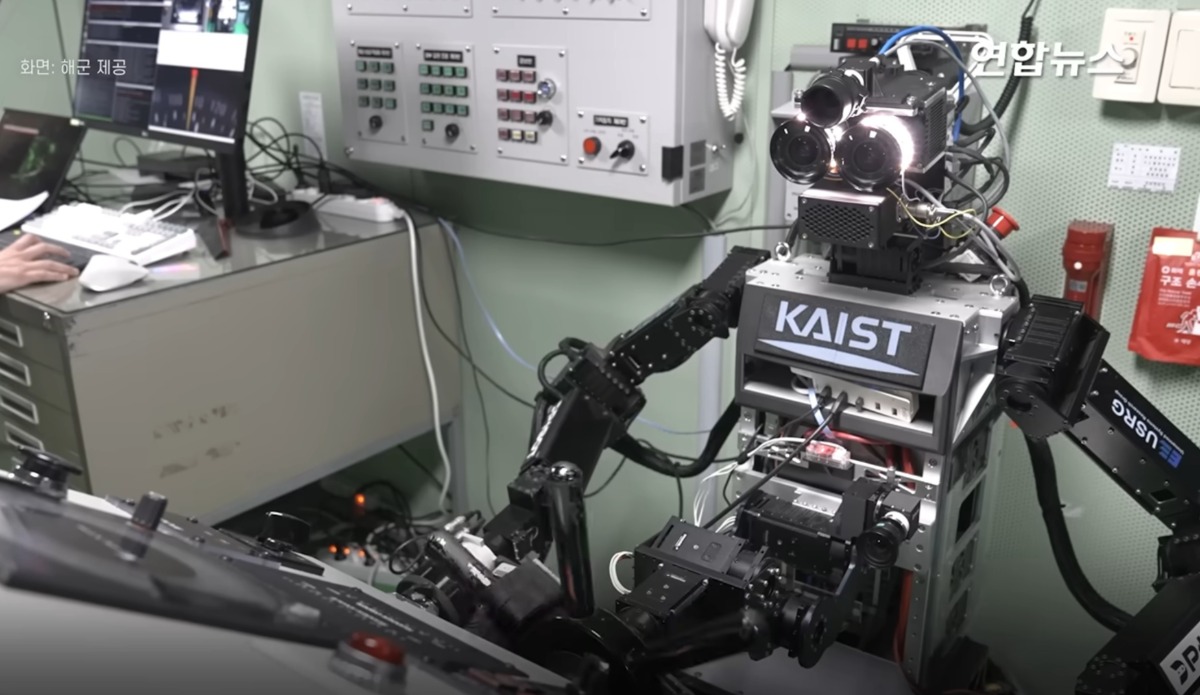
South Korea’s Navy released footage this week of a combat experiment where a humanoid robot called PIBOT took the helm of a naval vessel, gripping the ship’s rudder controls and holding its heading, the same way a human sailor would.
The test ran August 23 at a ship-handling simulator operated by the Navy Education and Training Command in Jinhae, and it marks the first time the service has shown the robot performing a role outside a cockpit.
PIBOT wasn’t designed with ships in mind. The Korea Advanced Institute of Science and Technology, or KAIST, built it as a life-sized humanoid pilot, roughly 160 centimeters (5 feet 3 inches) tall and 65 kilograms (143 pounds), able to climb into an ordinary aircraft cockpit and fly it using the exact same switches, yokes and throttles a human pilot would use, with zero modification to the plane itself. That’s the entire point of the design, according to the KAIST team led by professor David Shim: rather than building a new autopilot system for every aircraft type, you build a robot that can operate whatever cockpit is already sitting in front of it.
The robot uses multiple cameras to read instruments and watch its surroundings, and its developers have loaded it with large language model technology so it can absorb technical manuals and aeronautical charts the same way a person studies for a checkride, just at a scale no human pilot could match. KAIST has said PIBOT can hold the entire worldwide set of Jeppesen navigation charts in memory, something genuinely impossible for a person.
The project has been funded by South Korea’s Agency for Defense Development, and Shim has said for years that the same underlying hardware and software could, in theory, extend well past aviation: he’s mentioned testing PIBOT driving a car at low speed, and floated tanks and armored vehicles as future targets, on the logic that a humanoid body means you never have to redesign the machine for the robot. This week’s ship-steering test is the first public demonstration that the Navy is taking that logic seriously.
South Korea’s active-duty military has shrunk by roughly 20% over the past six years, down to about 450,000 troops, and the reason has nothing to do with policy and everything to do with demographics. The country has the world’s lowest birthrate, and the pool of 20-year-old men, the age when most Koreans enlist for mandatory service, fell 30% between 2019 and 2025 alone. The military is currently about 50,000 troops short of what it says it needs, including a 21,000-person gap in non-commissioned officers, the sergeants and petty officers who do much of the actual hands-on work of running a ship or a unit. Some defense researchers project the total force could fall as low as 270,000 by 2040 if nothing changes, against a North Korean military still estimated at over a million.
That’s the backdrop against which a robotic helmsman stops sounding like a novelty and starts sounding like a contingency plan. A ship still needs someone, or something, physically holding a heading hour after hour, and that’s exactly the kind of repetitive, always-on task a humanoid robot doesn’t get tired doing.
The Navy hasn’t said how PIBOT performed against the benchmarks it was tested on, whether the robot will get more roles in future simulator runs, or whether there’s any plan to put it, or a system like it, aboard an actual ship at sea rather than a simulator in Jinhae.
Content preview only. Full article available at source. View Full Article
The South Korean Navy tested a humanoid robot named PIBOT as a helmsman in a ship-handling simulator in Jinhae on August 23. This marks the first public demonstration of the robot's capabilities outside of aviation. The military is facing a personnel shortage, prompting interest in robotic solutions for operational roles.
- PIBOT is a humanoid robot designed to operate various cockpits without modification.
- The South Korean military is facing a significant personnel shortage due to demographic changes.
- The robot was tested in a ship-handling simulator operated by the Navy Education and Training Command.
- The project is funded by South Korea's Agency for Defense Development.
- The Navy has not disclosed PIBOT's performance metrics from the test.