
Spain's H135, Flexrotor, and A900 showcase Europe's maritime drone problem in 2026
 Dr. Klaus Weber
Spain's H135, Flexrotor, and A900 Highlight Europe's Maritime Drone Problem in 2026
An H135 helicopter, two unmanned systems, and an offshore patrol vessel off Rota: That was all that was needed on May 20, 2026, to make an old European defense problem visible. Airbus Helicopters and the Spanish Navy demonstrated maritime Crewed-Uncrewed Teaming with the Rayo, an H135, the Airbus Flexrotor, and the Alpha Unmanned Systems A900. Technically, this is remarkable. Institutionally, it is sobering. Europe can increasingly network individual sensors, but it has yet to build a reliable multinational naval capability from them.
The attempt was concrete enough not to be dismissed as mere trade show rhetoric. According to Defence Industry Europe, both unmanned platforms were launched and landed from a moving ship. A pilot in the H135 controlled the drones via Airbus' HTeaming tablet. The live images were transmitted to the helicopter crew and the ship, relayed through Airbus' Helicopter Integrated Tactical System, and integrated into Navantia's NAIAD and the Spanish command system SCOMBA. The scenario was a simulated pursuit of a fast boat during a maritime ISTAR operation.
The Technology is Smaller than the Promise
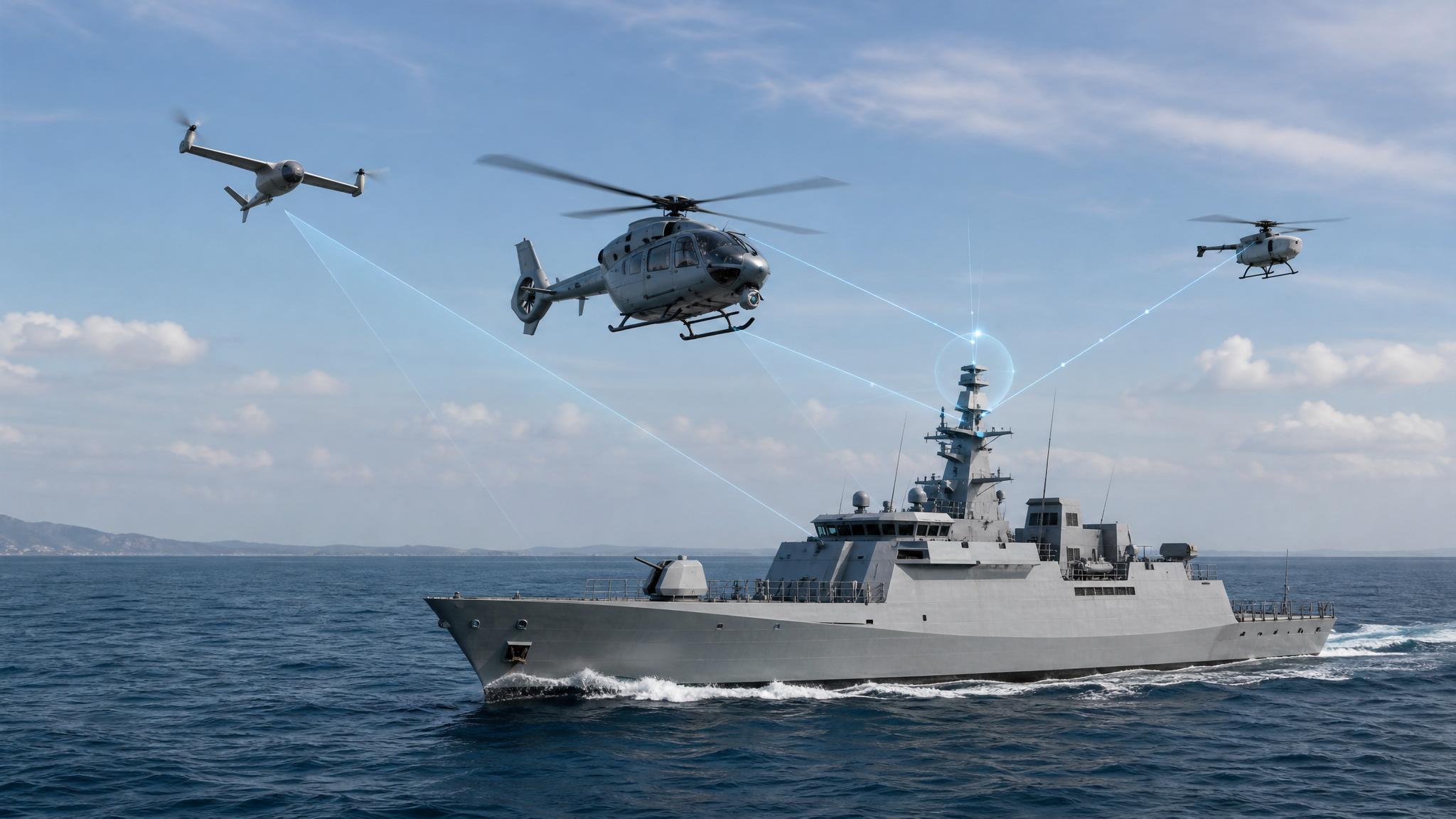
Concept image: maritime networking between helicopter, UAVs, and ship combat system.
It is precisely the modest size of the systems used that makes the test interesting. The Flexrotor is not a strategic large device, but a small tactical VTOL-UAS with a maximum takeoff weight of around 55 pounds, an average mission duration of about 12 to 14 hours, and a takeoff and landing space requirement of approximately 12 by 12 feet (Airbus U.S. Space & Defense). The A900 also does not fall into the category of expensive high-performance drones, but rather into that practical zone where European navies could actually generate mass: reconnaissance, target tracking, coastal surveillance, port protection, control of suspicious fast boats.
The operational sense is clear. A patrol vessel can only see as far as its own sensors allow, limited by radar horizon, mast position, and weather. A drone extends this horizon. A helicopter can serve as a manned control and decision platform without having to take on every risk itself. When data appears directly at the ship's Combat Station, it does not simply create an additional video image, but a different decision rhythm. The commander does not have to wait for an aircraft to report back; he can feed situational images into his own fire control and operational logic.
Rota Does Not Solve a European Standardization Problem
But this is precisely where the political analysis begins. The Spanish demonstration proves that Airbus, Navantia, Alpha Unmanned Systems, and the Spanish Navy can build a national integration chain. It does not prove that a Dutch frigate, an Italian helicopter, a French drone, and a German mission system could share the same situational picture tomorrow without special adaptations. Europe often confuses successful demonstrators with capabilities. This is not a small semantic error in defense planning, but a budget trap.
NATO now explicitly describes the maritime domain as a continuum of surface, underwater, air, space, and cyber. Since Russia's war against Ukraine, it has emphasized the protection of sea routes, reinforcement lines, hybrid threats, and critical underwater infrastructure. Since 2025, Baltic Sentry even includes a small fleet of maritime drones for monitoring critical infrastructure. This is the right framework. However, the framework does not replace common interfaces, certified data architecture, and robust operational rules.
The problem is reminiscent of Europe's air refueling, missile defense, and munitions production: one member state procures, a second demonstrates, a third develops software, and in the end, a collection of nationally useful partial solutions emerges. For maritime drones, this path is particularly dangerous because the actual military effect does not lie in the aircraft. It lies in the ability to keep sensors, identification, data link, electronic countermeasures, and command chain together under combat stress.
Maritime Drones Need Doctrine, Not Just Tablets
HTeaming is therefore important, but it is not a substitute for doctrine. Who is allowed to control a drone in a multinational formation? Who prioritizes the video data when multiple ships are tracking the same contact? When does a suspicious fast boat become a target? How are electromagnetic signatures protected when each additional radio connection is also a reconnaissance hint for the opponent? These questions sound bureaucratic. In combat, they determine whether a networked system acts faster or just produces more data.
Spain has an advantage here that larger European programs often lose: the test chain was manageable. One Spanish ship, one Spanish naval helicopter, one Spanish command system, one Spanish UAV manufacturer, and Airbus as a European integrator. This reduces friction. It also explains why the attempt worked. However, European defense integration only begins where friction can no longer be filtered out nationally.
For the European industry, Rota is still a useful signal. Airbus can offer HTeaming as a modular building block. Navantia can position NAIAD and SCOMBA as a maritime autonomy and combat system bridge. Alpha Unmanned Systems gets a realistic naval application case. However, it is crucial whether these building blocks are treated as open, certifiable architecture in NATO and EU procurements or as national industrial packages. In the first case, scaling occurs. In the second case, more islands are created.
The Strategic Value Lies in the Mediterranean and the Baltic Sea
The operational areas are obvious. In the Mediterranean, it is about maritime security, protection of infrastructure, illegal transfers, sabotage prevention, and situational awareness for Operation Sea Guardian. In the Baltic Sea, it is about underwater infrastructure, narrow sea routes, and rapid attribution since Nord Stream, cable damage, and Baltic Sentry. Small UAVs from ships are not spectacular for this, but that is exactly why they are useful. They are cheaper, more available, and politically less cumbersome than large maritime reconnaissance aircraft.
But is that enough? Not if Europe is again just collecting national pilot projects. The Rota test shows a realistic direction: manned platforms as tactical control nodes, small drones as persistent sensors, combat systems as the place of decision. It also shows the weakness of the European model: integration succeeds where few actors work within a national framework. However, Europe's security situation demands capabilities that function beyond this framework.
The paradox is typical for European defense in 2026. The technology is becoming more agile, but the institutions remain slow. An H135 can today lead two drones over a Spanish ship. Whether Europe turns this into a maritime capability depends less on the next tablet than on standards, procurement policy, and the willingness to truly open national combat systems. Without this decision, Rota remains a good attempt. With it, it could be the beginning of a European maritime drone architecture.
Spain demonstrated maritime crewed-uncrewed teaming with an H135 helicopter and two unmanned systems from an offshore patrol vessel in Rota on May 20, 2026. The demonstration showcased the integration of drone data into the ship's combat system during a simulated ISTAR operation. This event highlighted the potential for enhanced maritime capabilities in Europe, although challenges in multinational integration remain.
- Spain demonstrated maritime crewed-uncrewed teaming with H135 helicopter and unmanned systems.
- The demonstration took place on May 20, 2026, in Rota.
- Both unmanned platforms launched and landed from a moving ship.
- The scenario involved a simulated pursuit of a fast boat during a maritime ISTAR operation.
- The integration of data from drones to the ship's combat system was highlighted.